
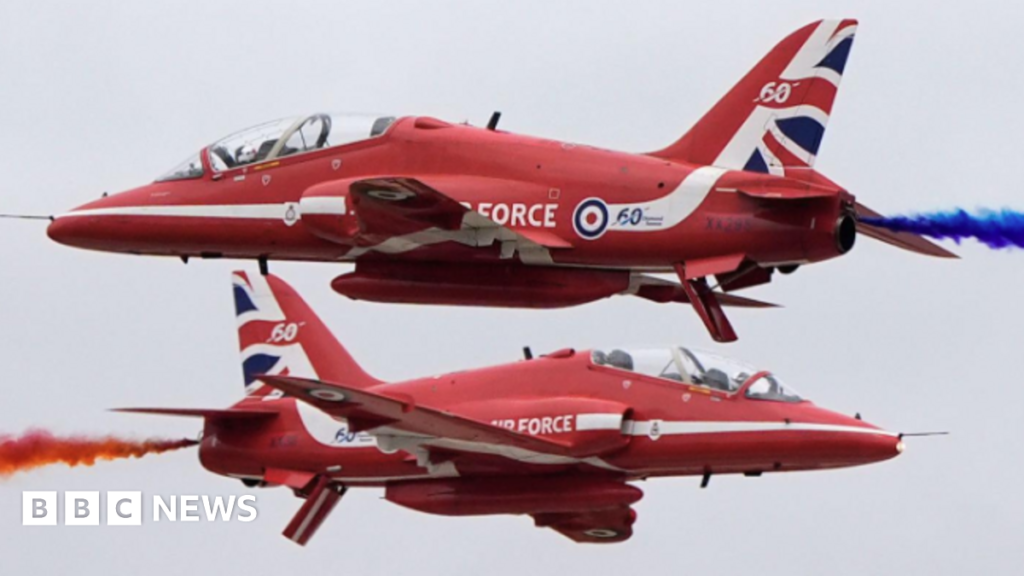
Last year, the UK government’s Strategic Defence Review recommended the Hawks should be replaced by a “cost-effective, advanced trainer jet”.
The review suggests that MoD procurement should prioritise British businesses to benefit the UK economy.
The MoD is considering options to replace the Hawk jets.
Aircraft offered by BAE Systems, Leonardo and several other companies are also considered to be contenders to replace the Hawk but no decisions have been made.
The long-awaited investment plan to deliver the review’s recommendations has been delayed significantly and Prime Minister Sir Keir Starmer is facing growing pressure to publish it.
This week, Sir Keir told MPs the defence investment plan was being “finalised” as he outlined his government’s legislative programme in the King’s Speech.
Last month Lord Robertson, the former Labour defence secretary who wrote the Strategic Defence Review, accused Sir Keir’s government of showing “corrosive complacency” on defence.
Southwell said Aeralis had been talking to the French government about the possibility of building its jet in the country.
But Aeralis’s preference was to design and manufacture parts of its advanced trainer jet at the company’s sites across the UK, before assembling the aircraft at Prestwick International Airport in Ayrshire, Scotland.
The company estimates that its programme could have created 4,000 new jobs in the UK and generate £600m in annual exports.
But the aircraft has only been designed digitally at this stage, with the company saying it needed government backing to start production.
Justin Bronk, a senior research fellow at the RUSI think tank, said the Aeralis option was “purely theoretical, and its only attraction is the promise of UK jobs at some point”.
“Its downsides include high programme and development risks, and long realistic timeframes until any serviceable aircraft might be delivered, compared to alternatives that already exist,” Bronk said.
He added: “A strong fast jet training pipeline is fundamental to all other UK combat air capabilities, so risk should not be taken with ensuring it is modernised rapidly and with high levels of assurance.”
Bronk said jet trainers developed by Leonardo, or Boeing/Saab in partnership with BAE Systems, were “low-risk, high-quality” options that “could be delivered from the late 2020s”.
BAE Systems is working with US manufacturer Boeing and Sweden’s Saab to develop the T-7 jet into a replacement for the Hawk, and has committed to assembling the aircraft in the UK.
“Our joint approach brings together three leading global defence primes at the heart of UK combat air capability, offering the UK a next-generation, cost‑effective, capable and reliable solution,” a BAE Systems spokesperson said.
Leonardo, an Italian company with operations in the UK, told the BBC its M-346 jet was “being assessed as an option for a number of emerging requirements”.
“We will work with UK industrial partners to provide a compelling, UK low risk solution to the RAF advanced jet training requirement based on our proven and highly successful International Flying Training System,” a Leonardo spokesperson said.