

Individuals earning the average wage can no longer afford to buy a typical house anywhere in Sydney, modelling shows, while options for dual-income households centre mostly on the west and Central Coast.
After the latest interest-rate rise, the purchasing power of an individual borrower on the average annual wage of $106,950, with modest living expenses and a 20 per cent deposit at their disposal, is $653,625, on Canstar modelling.
That’s almost $140,000 less than the median house price – $795,000 – in Greater Sydney’s cheapest suburb, Halekulani on the Central Coast. The Australian Bureau of Statistics considers the Central Coast to be part of Greater Sydney.
A couple jointly making 1.5 times the average wage, or $160,425, could spend $881,000, assuming a 20 per cent deposit. That could buy them a median-priced house in just 18 suburbs, 16 of which are on the Central Coast.
The same couple with two children would have $729,250 to spend, modelling shows, less than the cost of a median-priced house anywhere in the city.
Households collectively earning twice the average annual wage, or $213,900, would have more options, with $1,307,250 at their disposal, or $1,155,500 with two children, assuming a 20 per cent deposit.
But even those dollar amounts are insufficient to buy a median-priced house in most Sydney suburbs, including traditionally affordable areas such as Parramatta, Marrickville and Caringbah.
Suburbs that would be within reach include Fairfield, with a median house price of $1.3 million, and Merrylands West at $5000 more. Box Hill, Silverdale, Seven Hills and Guildford West are just shy of $1.3 million.
This week’s federal budget curbed property investor tax breaks and included new supply measures in a bid to increase home ownership. Some experts offered cautious optimism that the moves could help first home buyers compete, but also warned that housing is likely to remain expensive. The federal government also has two low-deposit schemes.
Sally Tindall, Canstar director of data insights, said strong house-price growth in Sydney’s outer suburbs – such as Gorokan on the Central Coast, where prices are up 14.7 per cent in 12 months, and Werrington in Penrith, which recorded a 12.2 per cent rise – showed more buyers had been priced out of suburbs closer in.
“For some, the time has come to activate their Plan B, which could mean moving further out just to get a foot on the property ladder.”
Tindall said three rate rises in quick succession had cancelled any benefit home-buying hopefuls might have gained from the softening of Sydney’s property market this year.
“Some people might be encouraged by reports that prices are starting to slide, but I’d say check with your bank before you pop the champagne, because you might find that your borrowing capacity has dropped so much that you can’t even afford those new prices.”
For a single average wage earner looking to buy a unit on a $653,625 budget, suburbs within reach include Parramatta, North Parramatta, Northmead, Westmead, Bankstown, Penrith, Roselands, Rosehill, Blacktown and Fairfield.
Buyers’ agent Michelle May said house-hunters had been compromising on location “for quite a while now” to secure a property.
“For example, we’ve seen many people who wanted to be in the inner west shifting their focus to places like the St George area.”
May said that many of her clients were feeling a sense of urgency to buy soon, regardless of speculation that Sydney property prices might keep falling this year, given the imbalance between supply and demand.
Those who can lean on parents or other family members for assistance are doing so, May said.
“I would say 80 per cent, if not more, of the first home buyers that we work with are getting assistance from family, whether that’s guarantorship or an actual cash donation.”
Second-home buyers are tapping into the bank of mum and dad too, she said.
“Maybe a couple is having their first child and they need a bit more space. They’ll often say: ‘Mum and Dad are chucking in 50 grand’, or whatever the case may be.”
Others are exploring multi-generational living options.
Doug Driscoll is chief executive of Starr Partners, which specialises in the western Sydney property market. He said he noticed an uptick in out-of-area buyers this year.
The redevelopment of downtrodden suburbs such as Airds, where the median house price has risen 20.6 per cent in the past 12 months to $903,250, was shifting perceptions of the west, he said.
Infrastructure spending and a burgeoning dining scene in Parramatta and beyond were taking inner-city escapees by surprise too.
“People who haven’t been west of Parramatta for years will say to me: ‘Wow, it’s actually nice here’. It’s a discovery for them,” Driscoll said.
Despite cheaper house prices, deciding where in the west to live remained a “tricky calculation” for many prospective buyers whose jobs and personal lives were closer to the city, he said.
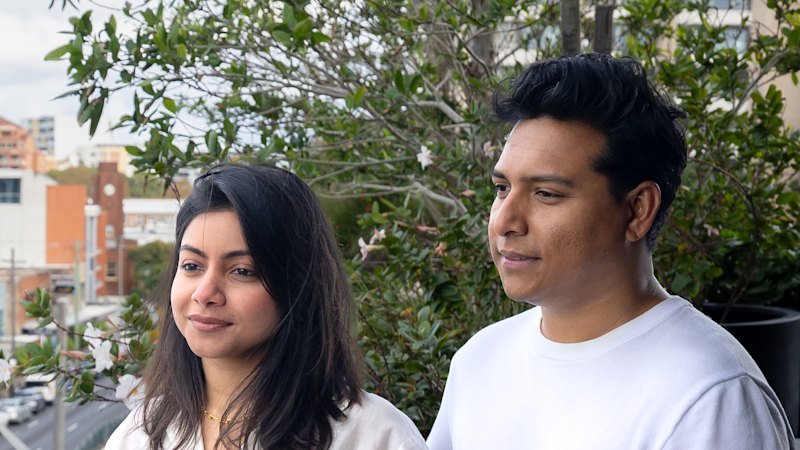
Jaky Junidul and his wife, Trina Lutfa, rent in Rockdale and looked at buying a home in the area, near their work in the logistics industry in Matraville.
“When we looked at the property market, we realised if we really want a house there’s nothing within our budget, within our affordability, in this area,” said Junidul, 34.
They considered apartments, but were deterred by the strata fees.
They bought a house-and-land package in Stockland’s Figtree Hill master-planned community near Campbelltown. Their home is being built and is due to be ready early next year.
“Even though we have to wait for a bit longer to get the house ready, this would be a new master-planned community and this would be a new house, which is a tick, and also the house-and-land package price is going to be fixed.”
Driscoll expected the number of Sydneysiders moving west for affordability to “increase exponentially” as the housing-market downturn ran its course.
“It doesn’t matter what gets thrown at this market, it seems to remain resilient,” he said. “There could be a nuclear disaster and Sydney property prices would still hold their own.”
With Elizabeth Redman
 Dan F Stapleton writes on First Nations issues, visual art, property and more. His writing has appeared in The New York Times, the Financial Times and others. He is based in Sydney.