
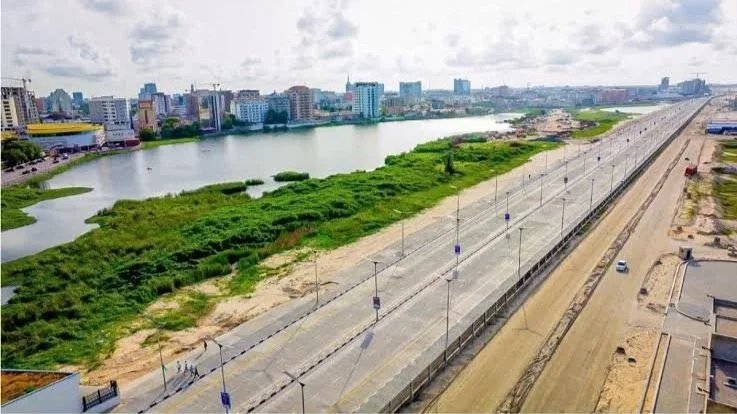
The appeal comes amid ongoing debate over the impact of the landmark infrastructure project on surrounding communities following severe flooding recorded in several parts of Lagos in recent weeks.
Stakeholders call for independent technical assessment
Speaking during a television programme over the weekend, the Chief Executive Officer of Winhomes Limited, Stella Okengwu, and the Chairman of Gtext Holdings, Stephen Akintayo, said an independent engineering and environmental review should examine whether alterations to the highway’s original 2006 gazetted alignment or aspects of its drainage design affected floodwater movement in adjoining communities.
Okengwu acknowledged the Lagos State Government’s efforts to address flooding but argued that the current situation requires an evidence-based assessment rather than political debate.
She said concerns over the project should be evaluated by engineering and environmental experts to determine whether any design changes influenced the extent of flooding experienced this year.
Investors seek compensation
Okengwu also renewed calls for compensation for investors whose properties were demolished during the execution of the project.
According to her, affected developments had attracted significant local and diaspora investment, and uncertainty surrounding compensation has raised concerns about property rights and investor confidence.
She argued that large-scale infrastructure projects should be implemented alongside due process, environmental compliance and fair treatment of legitimately approved developments.
Concerns over planning and drainage
Akintayo attributed the recent flooding to several factors, including blocked drainage channels, urban planning challenges and the elevation of sections of the coastal highway.
He argued that while the highway itself remains an important national infrastructure project, questions surrounding changes to the original alignment deserve independent technical scrutiny.
He also proposed the establishment of a compensation fund involving the Federal Government, Lagos State Government and industry stakeholders to support property owners affected by the project.
Federal Government rejects flooding claims
The Federal Government has previously rejected claims that the Lagos-Calabar Coastal Highway caused flooding in surrounding communities.
Minister of Works David Umahi said the highway was designed to improve drainage and facilitate floodwater evacuation rather than obstruct it. According to the ministry, flooding in parts of the corridor is linked to blocked drainage systems, illegal reclamation of waterways, poor urban planning and indiscriminate waste disposal.
The ministry has also announced stakeholder engagements and additional flood mitigation measures, including improved drainage infrastructure, while indicating that compensation would be paid to eligible property owners affected by the project in line with applicable government procedures.
Broader implications for the property market
The debate highlights the challenges of balancing major infrastructure delivery with environmental sustainability, land-use planning and investor protection.
For Nigeria’s real estate sector, issues surrounding project alignment, compensation frameworks and regulatory certainty remain important considerations for developers, institutional investors and property owners. Industry stakeholders say transparent planning processes and effective stakeholder engagement will be critical to maintaining confidence in future infrastructure-led urban development initiatives.
Conclusion
The call for an independent investigation adds another dimension to the ongoing discussions surrounding the Lagos-Calabar Coastal Highway. While stakeholders are seeking a technical review of the project’s alignment and renewed compensation for affected investors, the Federal Government maintains that the highway was engineered to improve flood management and that broader environmental and planning issues are responsible for recent flooding. As stakeholder engagements continue, the outcome of these discussions could influence future approaches to infrastructure development, environmental planning and property rights in Nigeria.