
Date: 22 April 2026
Campaigns: Trade
THE UK has been ranked as worst in Europe for propping up a “secretive” international corporate court regime, in new research published by a coalition of seven European organisations including Global Justice Now, PowerShift and CAN Europe. The findings come ahead of the First Conference on Transitioning Away from Fossil Fuels, taking place 24 – 29 April in Colombia, at which the system of Investor-State Dispute Settlement, or ISDS, is up for discussion as a key barrier to phasing out fossil fuels.
ISDS are provisions written into many trade and investment deals. They give companies the power to sue governments in private tribunals outside of national legal systems, over policies such as environmental protection or health regulation that they allege harm their profits – with payouts often reaching the billions.
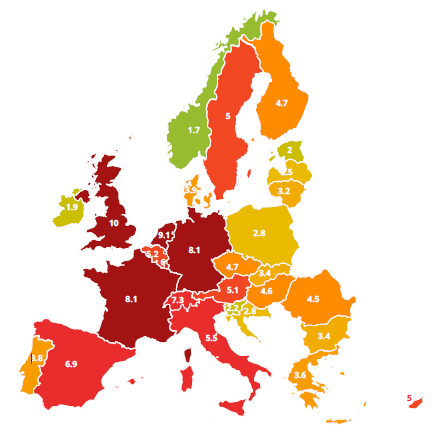
The newly released report, ‘European ISDS Scorecard: a ranking of the harmful effects of 30 countries’ investment treaties’, is published today with an accompanying interactive ‘scorecard’. It assesses 30 European countries to capture the scale of their investment treaty networks, their real-world use and the impacts of investors weaponising ISDS across ten indicators, including number of ISDS deals signed and its use across sensitive sectors such as fossil fuels or the scale of pay-outs. The scorecard reveals:
- The UK ranks worst overall in perpetuating the harm of ISDS, with UK investors particularly litigious in the mining and fossil fuel sector.
- The Netherlands comes close behind and Dutch investors (in many cases utilising ‘shell’ companies without actual business activity) have initiated more corporate court cases than those of any other European country.
- Ireland alone has no bilateral investment treaties with other countries (though this could soon change if European Union trade agreements with ISDS start coming into force), and Norway has already cancelled half of its relatively few treaties, showing that it is possible for European countries to choose alternative paths.
The report’s authors state that the scorecard demonstrates the outsized role Europe plays in the global ISDS architecture, revealing a highly concentrated system with a small group of countries – the UK, the Netherlands, Germany, France and Switzerland – accounting for a disproportionate share of the treaties, cases and climate risk generated by this “shadowy” system.
The report recommends that European governments, including the UK, stop signing new agreements that include ISDS provisions, and begin systematically cancelling existing treaties. Where those treaties have “sunset clauses” that allow treaties’ powers to continue after cancellation for a set period, often 10 – 20 years, countries should pursue mutual agreements to neutralise them. The report also urges governments to engage collectively with other countries, including outside of Europe, to support further potential for stepping away from ISDS.The treaty networks are described as “rooted in post-colonial economic relationships”, with the consequences felt particularly acutely by Global South countries that are subject to the majority of ISDS claims. The UK has been the home state of the investors suing in 124 cases, for example, British firm Biwater demanded a £10 million pay-out from Tanzania after the country ended a botched water privatisation contract.
However, European countries have been increasingly hit with cases themselves, especially over their climate policies. Recently, the UK was sued by investors in the Cumbria coal mine, after it was quashed by the high court over its climate impacts. The UK is also facing a second case brought by Russian billionaire oligarch Mikhail Maratovich Fridman, who was sanctioned in 2022 over his ties to the Russian regime. This is one among a large spike in cases across Europe directly challenging sanctions imposed following the Russian invasion of Ukraine.
Colombia, co-host of the First Conference on Transitioning Away from Fossil Fuels, has just announced its intention to withdraw from ISDS. With the topic of ISDS a central item on the conference agenda, campaigners across Europe are calling on their governments to “seize the opportunity” to plan a coordinated exit from the ISDS regime with other countries in attendance.
ENDS
Cleodie Rickard, trade campaign manager at Global Justice Now said:
“This report reveals a huge black mark on the UK’s claims to climate leadership. Our terrible ranking should be a wake-up call for the UK government to reverse its inconsistent and outdated approach to ISDS: while it agreed to exit the controversial Energy Charter Treaty, it is continuing to push for ISDS in new deals being negotiated. This hands foreign investors a loaded gun to hold us to ransom over our democratic decisions, and also means we’re harbouring pirates pillaging the coffers of other countries around the world. But there is a clear way out: the UK must seize the huge opportunity at the upcoming Colombia conference to join a collective exit from corporate courts.”
Tom Wills, Director of the Trade Justice Movement, said:
“The UK topping this ranking is not just embarrassing, it shows how deeply the UK is implicated in sustaining a secretive system that lets corporations challenge decisions taken in the public interest. This scorecard makes clear that a small group of European countries, with the UK at the forefront, are driving a disproportionate share of the harm caused by ISDS. This is not an economic necessity, it is a political choice. If the government is serious about climate action and democratic accountability, it should stop expanding this failed system and start working to dismantle it.”
Notes to editor
- Global Justice Now is a UK-based campaigning organisation part of a global movement to challenge the powerful and create a more just and equal world. We mobilise people in the UK for change, and act in solidarity with those fighting injustice, particularly in the global south.
- The report is jointly published by PowerShift in Germany, Global Justice Now and the Trade Justice Movement in the UK, CAN Europe, the European Trade Justice Coalition, the Veblen Institute in France and Alliance Sud in Switzerland.
- The report can be read in full at: https://www.globaljustice.org.uk/resource/european-isds-scorecard/
- The interactive scorecard web app can be found at: https://isds-scorecard-2026.netlify.app/index.html
- The Scorecard ranks 30 European countries – the 27 EU member states plus Norway, Switzerland, and the United Kingdom – by their structural involvement in the ISDS system. It adopts the home state perspective by examining which countries’ treaty networks and corporate actors are driving the system as sources of ISDS claims. Ten indicators capture different dimensions of this involvement, from the size of a country’s active ISDS treaty network to the number and financial scale of cases its investors have brought, and the fossil fuel investments those treaties cover. The raw values were normalised, weighted to a composite score, and transformed to a 0-10 scale, where higher scores indicate greater involvement in the ISDS system. Full methodology can be found in the annexes to the report.