
It was to be the biggest undertaking in Britain for OpenAI, the company behind ChatGPT. Stargate UK – a multibillion-pound UK datacentre project – would represent “a major step forward in the US-UK technology partnership”.
But the plans were paused in April, with an OpenAI spokesperson citing concerns over regulation and high energy costs.
Now the Guardian can reveal that OpenAI does not appear to have visited one of Stargate UK’s key sites – and that £20bn of the “potential” £30bn in investment touted by the UK government appears to have been totally hypothetical.
The findings raise questions about one of the most-hyped UK AI developments, and suggest a centrepiece of US-UK AI cooperation was in fact little more than a press release.
It follows a Guardian investigation in March, which revealed many of the deals to “mainline AI into the veins” of the British economy were “phantom investments”.
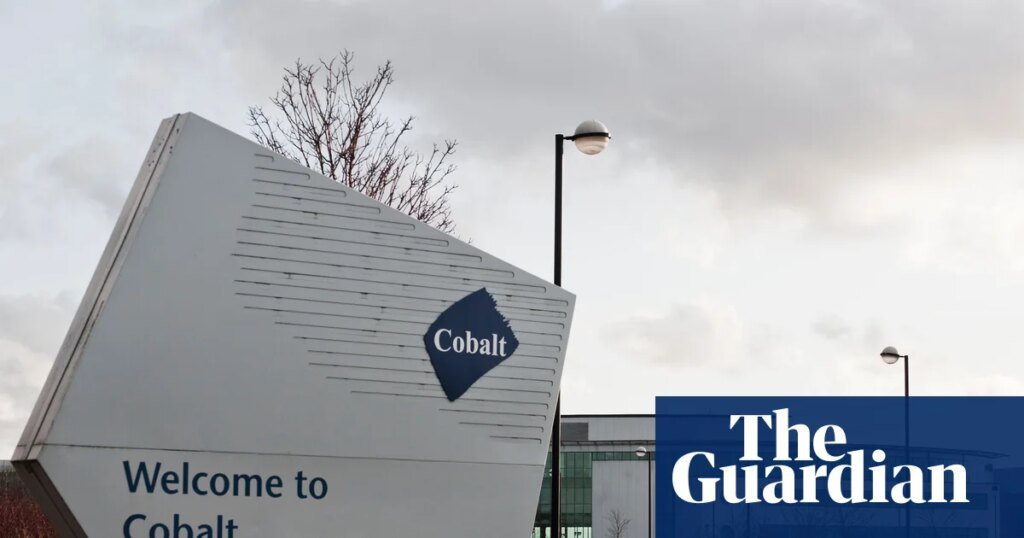
Sources with knowledge of the process to set up Stargate UK suggested the government had approached the UK firm Nscale and OpenAI shortly before Donald Trump’s visit to the UK last year, asking them to agree to develop the Stargate UK site in Cobalt Park, a business park in North Tyneside.
“They needed a big announcement,” said one.
Stargate UK was announced last year amid a flurry of high-gloss US-UK tech deals that accompanied Trump’s September visit to London. It echoed the Stargate AI project in the US, in which OpenAI promised to invest $500bn to “secure American leadership in AI”.
In comparison, Stargate UK’s ambitions were modest. OpenAI was to work with Nscale, which is building a supercomputer in Essex, and Nvidia, a maker of AI chips, to develop infrastructure at sites across Britain.
The most prominent of these sites was the planned datacentre at Cobalt Park, which the government designated as an “AI growth zone” during the US president’s visit.
A freedom of information (FoI) request returned to the Guardian shows that neither OpenAI nor Nscale ever met with the local authorities at the site in North Tyneside. Only Nvidia appears to have visited the North East combined authority, which oversaw the Stargate UK site. It did this in February 2026, five months after Trump’s visit to the UK.
“Nscale were pretty much told to back the Stargate project, and it caught them completely unaware,” said a source. “It was never really a thing. It was effectively just a government PR stunt, and [the OpenAI chief executive] Sam Altman took the hit when the plug got pulled.”
Asked if OpenAI ever visited the site, an OpenAI spokesperson referred the Guardian to a previous statement the company made when it pulled out of Stargate UK. “We see huge potential for the UK’s AI future … We continue to explore Stargate UK and will move forward when the right conditions such as regulation and the cost of energy enable long-term infrastructure investment,” it said.
An Nscale spokesperson said its chief commercial officer had gone to North Tyneside, but did not clarify if they had met anyone there – and there is no record of them doing so.
In its press release, the government said the AI growth zone that would house Stargate UK was “set to” bring in £30bn in investment. Of this, £10bn was “committed” by Blackstone, which is developing another datacentre in the area. (That datacentre, which is separate to OpenAI’s project, appears to still be going ahead.) After that, there was “potential for an additional £20bn in investment from future partners”.
In response to a Guardian query asking how the figure of £20bn was calculated – and who these future partners could be – the government declined to give further detail, saying only that the number represented the totality of potential investment the site could attract.
In response to the organisation Spotlight on Corruption, which asked the same question and shared the answer with the Guardian, the government said the figure of £20bn was given because that was the amount of money the site would need in order to build a datacentre and obtain the computing power necessary to utilise its electricity supply, which it said was 1.1GW.
In other words, the government suggested the site would attract £20bn because it needed £20bn.
“It is disingenuous for the government to imply that the £20bn for the AI growth zone will be forthcoming, when it reflects the amount needed,” said Kamila Kingstone, a senior campaigner at Spotlight on Corruption. “It will give false hope to communities that eye-watering amounts of money are on the way to boost the local economy when the reality might be very different.”
John Johnsson, the leader of the Conservatives in North Tyneside, said Stargate UK came as a surprise to local authorities. “When it was announced, we were really, really taken aback. We were surprised because we weren’t made aware of any of these discussions. All of a sudden, there’s all of this pizazz and these great big things announced,” he said.
The lack of meetings – or prior coordination – is unusual for a project that Altman described as reflecting OpenAI’s “shared vision” for the UK’s investment in AI infrastructure, and the Nvidia chief executive, Jensen Huang, said was “a historic chapter in US-United Kingdom technology collaboration”.
Other doubts hang over Stargate UK. An FoI request returned to the Guardian from the UK’s National Energy System Operator suggests the site did not have a grid connection. Instead, it submitted an alternative solution to power itself, which was redacted in the application returned to the Guardian.
“There’s just not the infrastructure there to be able to actually support it,” said Johnsson. “It’s now looking highly unlikely whether the project is going to come to North Tyneside.”
He added: “The fundamentals, energy costs, grid capacity and infrastructure do not appear to have been in place to support a project of this scale.
“It’s really disappointing. It did have a feeling of: this is too good to be true and then we started to sense quite quickly that perhaps things weren’t as further down the line as anticipated.”
A spokesperson for the government said: “The government is determined to create the right conditions for investment in the UK’s AI and datacentre infrastructure, and on the delivery of our AI growth zones, with work now well under way in the north-east.
“A dedicated taskforce co-chaired by the technology secretary and [the North East mayor] Kim McGuinness is driving forward planning, investment and skills for the region. The North East AI growth zone will increase its energy capacity to 1.1GW once fully operational, with over 400MW of this capacity to come online in 2028.”