
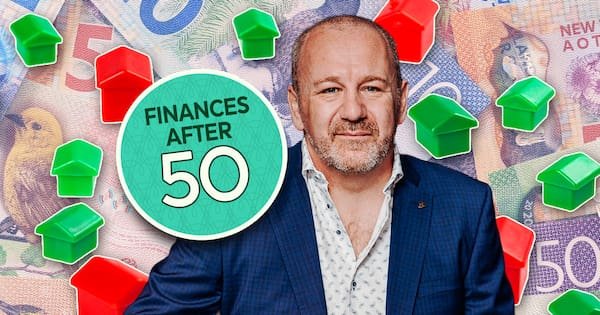
In the latest in our ‘Finances after 50’ series, we talk to investor, property coach and author Steve Goodey about riding the ups and downs of the property market.
Growing up, my dad was always the salaried employee and my mother was the entrepreneurial one, and she sort of nudged them into starting a tax consulting business. Mum always had a side hustle, and I think that developed my impression that your everyday job/ income/salary is just seed capital. And the real the real wealth comes from investing.
As a kid I was mowing lawns up and down the street. I did milk runs. I did newspaper runs. I co-purchased a house at 17 years old with my parents. It was in Makarini St, Paraparaumu, a classic Kiwi Beazley box. We bought it for about 80k; my parents put in 70k, and I put in 10k. We put second-hand carpet down; we bodged the shit out of that project. Put tenants into it for a few years, and then I decided I was going to take off over to Europe, and my parents paid me out.
I had a really interesting cousin, Mike. And Mike was very much into property and business and money, he was always going to set the world on fire. I went and had a chat to him at his wedding, and said, ‘Look, you know, how did you get involved in it?’ And he handed me a copy of Rich Dad, Poor Dad. I read the book cover-to-cover.

What I learned was the difference between an appreciating asset (a house) and a depreciating one (cars) and I learned that property and finance can actually be very exciting. But that book was not a how-to book. So when I first started writing my book, I wanted it to be more of a Kiwi how-to manual. I wanted it to be the book that I would have preferred Mike to have handed me.
I made my first million by the time I was 32. And then I had kids and houses and things, and I had a few slow years there. There’s a life cycle to most property investors and I think that it mirrors the personal life cycle. My best year was probably 2019 2020, when everything was going bonkers.

Millennials who can’t buy houses? Look, I’m 53 and I’ve got quite a lot of houses, and I won’t die with all of these houses, I will exit them at some point. This was how I bought most of my properties, when I was 20 and 30 years old. I was buying them off people retiring. I used to jokingly refer to them as Beryl houses. A lady’s lived in this property for the last 60 years, she’s going to a retirement home, she’s selling it, I’m buying it. And I think Millennials have got to realise that they’re not going to buy their first home and have it be the same as the house their parents are living in. Property is a ladder and there’s a bottom rung.
The first house that I bought to live in myself was actually the fourth house that I owned. It was a two-bedroom flat on the bottom of a larger house. We literally had to put the washing in the shower to hide it from visitors, because there was just nowhere else to put it. You’d stretch an elbow out and break a window, and we just faced the fact that we weren’t going to live in our dream house for the first property. We had our first newborn there. That was 24 years ago.
I wrote an acknowledgement to my ex wife in the forward to my book, because she did support my dreams and aspirations for decades. And I think it’s very, very important, if you’ve got lofty aspirations and dreams, to have a partner who’s on board with exactly what you are trying to achieve.
I go along to a lot of auctions, you look around the room and you go, who’s the really dangerous person here? Who do I have to compete with to buy this house? Five or 10 years ago, it was some guy in a Bunnings singlet with concrete on his work boots, and he’s got his cellphone and his business partner is literally on the line. Now, it’s a young couple with a pram. It’s very, very different.
The property market is a cycle. The problem with the cycle is that you don’t know what speed you’re going around in. We were in a serious boom before Covid. Covid came along, and Labour just chucked money at everything. Fine, I get that. There’s no rule book there, but they created a double boom, and that created a double bust. And so instead of being a 700- or 800-day recessionary period, the recovery took closer to 1500 days. Then we had the green grassy shoots of some sort of recovery, but then I feel like the economy realised how much Covid actually cost us, and we just went flat again, pretty hard. I mean, we’ve had a National government that doesn’t really want to spend any money in Wellington. Cool. I get that. So where is the money? Well most of the money in this country is in Auckland. Most of the cash flow in this country is in Christchurch, the only brand new city we’ve got. So it’s a kind of a two-speed economy at the moment and it’s not going to recover this year, in my opinion.
I love to travel. I like concerts and music, and I like really, really unaffordable vehicles. Last week I was inMelbourne at the Formula One with my oldest son. Last year he and I went and did a whole pile of concerts in the UK and Europe: Metallica, the Eagles, the Montreux Jazz Festival, Smashing Pumpkins. I really like food, I go to a lot of Michelin Star restaurants when I’m overseas. But I’m just some Kiwi bloke who got good at one particular thing. I’ve got a really diverse set of mates, some of them have got a few bucks, most of them are totally average New Zealand dudes. It’s nice to have freedom. To go, I got nothing on next week, I could just go to another country. But I certainly couldn’t go and buy a yacht.
Obviously there’s been a downturn in the property market the last few years, so I can’t spend money the way that I used to. Rents in Wellington have dropped. Values in Wellington have dropped. My portfolio is mostly in Wellington. But there’s a difference between equity and cash flow. So if I’ve got a property that’s worth a million dollars and it goes down to being worth $800K, do I care, as long as the rent keeps coming in? Well no, not really, because I’m a long-term investor and we’ll go back up again one day.
I’ve never actually publicly said how many properties I own. I just kind of don’t think it really makes a lot of difference, the number. I’ve been a professional property investor for nearly 30 years: trading, renovating, flipping properties. But I’ve also lived a good life, I’ve brought up three kids and done lots of trips and travels, so my core asset value has taken a hit. I’m not on the rich list, but I’m better off and well sorted than most people who just relied on KiwiSaver.
Roadmap to Property Success, by Steve Goodey (HarperCollins New Zealand) is out now.
This interview has been edited for clarity and concision.