
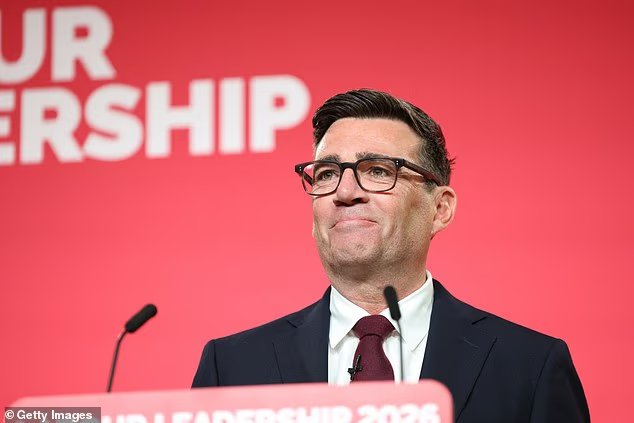
Mortgage rates have seen a weekly rise for the first time since Easter, dealing a blow to Andy Burnham as he prepares to enter Downing Street.
Analysis from financial comparison site Moneyfacts showed 13 major lenders have put up borrowing costs as renewed fighting in the Middle East stokes inflation fears.
Growing evidence suggests households are struggling to make ends meet, with official figures yesterday showing that 11,871 individuals entered insolvency in England and Wales in June – up 16 per cent from the same month last year.
Rising borrowing costs, together with increasing energy bills, will do little to help.
Moneyfacts said the average new mortgage rate rose from 5.42 per cent to 5.46 per cent over the course of the week, the first such increase since early April.

Rising rates: Mortgage rates have seen a weekly rise for the first time since Easter, dealing a blow to Andy Burnham as he prepares to enter Downing Street
For two-year fixed deals, rates went up on average from 5.46 per cent to 5.5 per cent and for five-year offers from 5.48 per cent to 5.52 per cent.
Adam French, head of consumer finance at Moneyfacts, said: ‘The latest disruption to shipping in the Strait of Hormuz has driven up investor expectations that inflation and interest rates will remain higher for longer, pushing up funding costs.
‘This leaves lenders with little choice but to reprice products, even if the Bank of England hasn’t changed the Base Rate. A more volatile world is a more expensive world, and recent months and years are clear evidence that borrowers cannot simply assume mortgage rates will continue moving in one direction.’
Conflict in the Middle East has already had a major impact on Britain’s mortgage market. Before the conflict started at the end of February, the Bank of England had been preparing to cut interest rates as inflation eased.
But the war disrupted oil and gas supplies via the Strait of Hormuz, resulting in higher fuel and energy prices and faster inflation.
That scotched hopes of rate cuts and left traders pencilling in as many as four Bank of England hikes this year.
The change in rate expectations forced lenders to react and withdraw their best deals.
A ceasefire and a subsequent deal between the US and Iran saw oil prices ease, cooling fears of inflation and rate hikes.
But the fighting has resumed in recent days, prompting those fears to return, with markets increasing the perceived likelihood of two rate hikes this year. NatWest, Barclays and Nationwide are among the lenders to have revealed recent rate hikes.
The troubling trend comes at a time when the economy is already suffering from sluggish growth and fears of stagflation – the toxic combination of stagnant GDP and rising inflation.
Figures this week showed Britain eked out growth of just 0.1 per cent in May.
Sonia Jordan, president of insolvency specialists R3, said the rise in personal insolvencies ‘demonstrates the acute pressures on household finances’, adding that the rise in the energy price cap from this month ‘will add further pressure to already stretched budgets’.
DIY INVESTING PLATFORMS
AJ Bell
AJ Bell
Easy investing and ready-made portfolios

Hargreaves Lansdown
Hargreaves Lansdown
Free fund dealing and investment ideas

interactive investor
interactive investor
Flat-fee investing from £4.99 per month

Freetrade
Freetrade
Investing Isa now free on basic plan

Trading 212
Trading 212
Free share dealing and no account fee
Affiliate links: If you take out a product This is Money may earn a commission. These deals are chosen by our editorial team, as we think they are worth highlighting. This does not affect our editorial independence.