

More than five million Britons will see their mortgage repayments increase as a result of changes to interest rates, the Bank of England has warned.
The central bank’s latest Financial Stability Report has revealed that millions of homeowners on fixed-rate deals will see their mortgage costs rise upon renewal.
Analysts from the Bank have cited the pressures stemming from the Iran conflict as a key factor in projections of higher interest rates down the line.
This figure represents a significant jump from the central bank’s December forecast, which estimated that 3.9 million mortgage holders, would experience payment increases at their next renewal.

The Bank of England is sounding the alarm over rising mortgage repayments
|
GETTY
If this forecast comes to fruition, this would see roughly 43 per cent of those with home loans impacted by changes to the base rate from the Bank.
As it stands, the central bank has held the cost of borrowing at 4.25 per cent after hiking interest rates to as high as 5.25 per cent in an effort to bring down inflation.
Tuesday’s report indicates that approximately one million additional households now face higher bills compared to earlier projections, with increases expected to materialise by the close of 2028.
For homeowners whose fixed-rate deals expire within the next two years, the Bank of England projects an average monthly payment rise of £45.
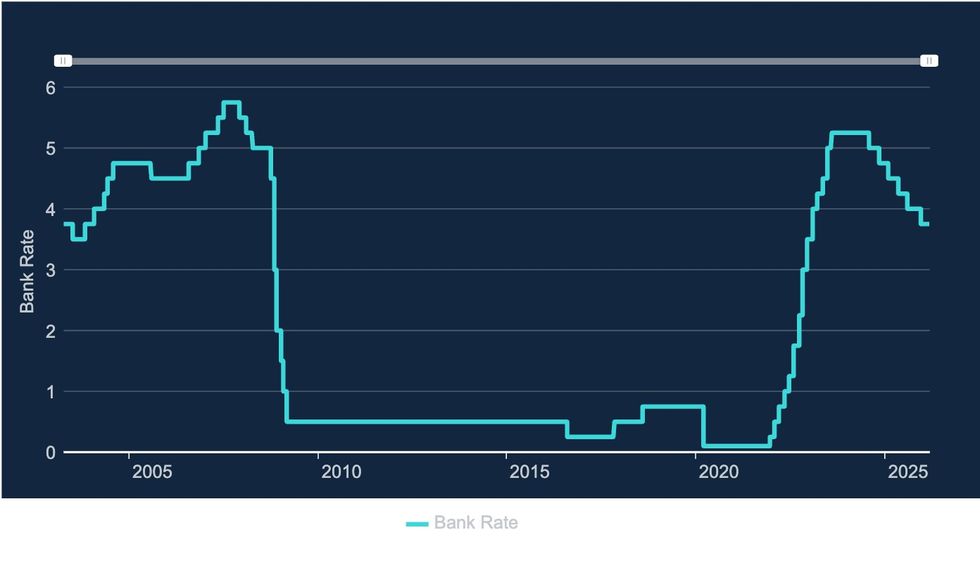 Bank of England interest rates over time | Bank of England
  Britons are being saddled with extra mortgage costs | GETTY
 Nearly 750,000 households paying interest rates below 3 per cent are set to see their fixed-rate mortgages end during 2026, resulting in typical monthly repayments climbing by £170.
The central bank cautioned that elevated borrowing costs combined with rising energy prices “could place additional pressure on household finances”.
However, it emphasised that even with these challenges, overall household debt would remain beneath previous peak levels.
Current market data shows that two-year fixed mortgages with 75 per cent loan-to-value ratios now carry an average interest rate of 4.92 per cent.
 Mortgage rates are likely to rise an expert warns | GETTY
 This marks a rise of 0.72 percentage points since the Bank published its previous stability assessment in December.
It noted that debt levels among both UK households and businesses remain low when measured against historical averages, leaving them well-positioned to withstand potential economic shocks.
Dr Charles Nimoh, a macroeconomist at the University of Salford, added: “For households, the decision [to hold the base rate] brings short-term stability but little immediate relief.
“Borrowing costs remain elevated compared with pre-inflation shock levels and the average two-year fixed mortgage rate has risen from around 4.8 per cent to the mid-to-high five per cent range in recent months.”