
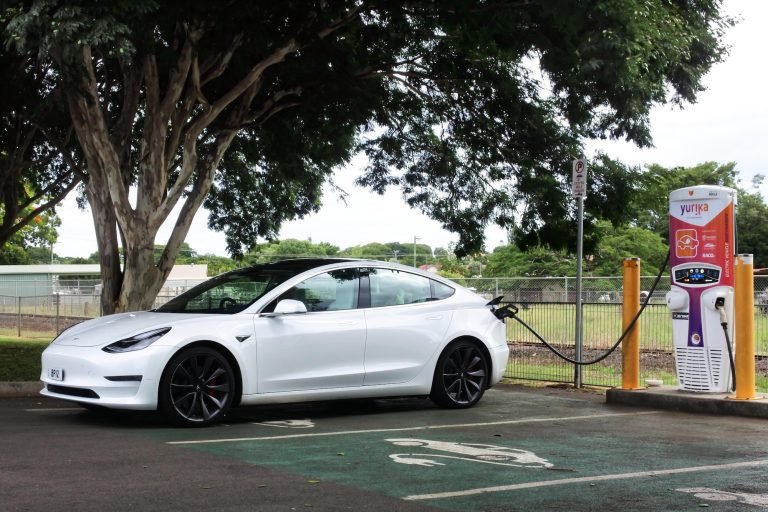
Sales of electric vehicles recorded a healthy spike as the 2026 financial year drew to a close, and experts are saying that charging infrastructure is growing to become a critical feature in commercial property investment.
June 2026 was a record month for overall vehicle sales, at 140,058 according to the Federal Chamber of Automotive Industries (FCAI), and battery electric vehicles made up 23.3% of that figure.
This is a significant jump from June 2025, where EVs made up just 7.6% of the total.

EVs are making up a larger proportion of new car sales, aided by cheap Chinese brands such as BYD. Picture: Getty
FCAI chief executive Tony Weber attributed the spike partly to oil price shocks and global uncertainties.
“Global uncertainty, including conflict in the Middle East and volatility in petrol prices, appears to have sharpened consumer interest in vehicles that reduce exposure to fuel prices,” he said.
Mr Weber also said the bump in sales is emerging as a permanent fixture.
The most recent, albeit short-lived, spike in oil prices has changed households’ mindsets around reliance on fossil fuels – which opens the door up for better EV infrastructure investment, according to various industry experts.
“The task now is to sustain this momentum. That means maintaining strong policy support through the electric car (novated leasing) discount and accelerating investment in public, workplace and home charging infrastructure,” said Rohan Martin, chief executive of the National Automotive Leasing and Salary Packaging Association (NALSPA).
The latest commercial property news
Get the latest news and insights straight to you.
Ray White head of research Vanessa Rader said retail sites having better charging infrastructure can also boost dwell time.
“A driver arriving for a 30-to-40-minute top-up does not sit in their car. They walk the centre, buy a coffee, collect a click-and-collect order, pick up groceries,” Ms Rader said. “The charge becomes the reason for an otherwise unplanned visit, and the longer the charging session, the deeper into the centre that visit tends to go.”
Ms Rader said infrastructure still has a way to go, however.
“The fleet is changing faster than the infrastructure supporting it, and that gap represents a direct opportunity for retail property,” she said. “Approximately 30% of Australians live in apartments or properties without dedicated parking, and the practical and regulatory complexity of retrofitting strata buildings with charging capability means that public charging networks will remain essential for years.”
A renewed push to ease minimum parking rules to aid in housing affordability also feeds into the viability of retail and public-use charging infrastructure, where motorists cannot easily charge at home.
“More sophisticated operators are treating charging bays as they would any high-footfall amenity: investing properly, in the right location, with canopy cover, clear signage, and app-integrated payment as baseline expectations rather than premium additions,” Ms Rader said.
Ms Rader said shopping centres with solar panels have the potential to turn sun into a money spinner via battery storage, and selling that to EV owners needing a charge.

A large portion of the population live in apartments without parking or EV charging, opening up commercial viability of third-space chargers. Picture: Getty
Automotive retail steers into bullish run
Australia’s record run of vehicle sales to end the 2026 financial year has also shone a light on the investment potential of automotive retail sites.
CBRE found investors are piling into tyre retailers, service centres, and auto parts shops with defensive credentials – long leases, steady yields with baked-in rent increases, and big brand tenants.
Think Repco, Supercheap Auto and Autobarn on the retail side, and Bridgestone, Goodyear and Jax on the servicing side.

Automotive retail and servicing sites are providing solid investment credentials. Picture: CBRE
The broker’s automotive report found yields have remained stable despite elevated interest rates, with metropolitan assets pricing between 4.14% and 5.82%. Regional markets generally provided 120 basis points (1.20%) of additional return.
Sales volume is projected to reach nearly $100 million in 2026, eclipsing 2024 and 2025’s total volumes.
Despite the volume and market volatility, yields have remained steady.

Investors are seeing the defensive strengths of some automotive retail assets. Picture: CBRE
Jesse Lapham, head of private wealth research at CBRE, said rather than look at EVs has a headwind, they should be seen as an opportunity.
“EVs still require regular servicing across tyres, brakes, suspension and air conditioning, and tend to wear tyres more quickly,” he said. “Fleet size matters more than drivetrain mix, and that fleet continues to grow.”