
Finance guru Alan Kohler has declared property a “bad investment” for Australians in the wake of the federal government’s major tax reforms.
The veteran finance journalist made the call as he predicted house prices to “stay where they are for a long time”, ending years of Australia’s seemingly endless growth.
Speaking on the Equity Mates podcast this week, Kohler backed the Albanese government’s decisions to scrap negative gearing and change capital gains tax concessions for existing properties.

The ABC expert has long advocated for those measures as part of the solution to address house prices outstripping wage rises over the past two decades.
“I do think that property is a bad investment now,” he said.
“And this is really what we’re talking about when we talk about, ‘We need to have housing become more affordable’. We’re talking about it becoming a bad investment.
“It has to … housing has to stop being the way to the people build wealth, and (be) just a place to live.
“That’s kind of what needs to happen and I think now for the first time that’s probably going to happen.”
Federal Housing Minister Clare O’Neil acknowledged last week that the national property market was experiencing a “correction” but the government has been keen not to take credit for this trend.
“The housing market’s cyclical in Australia, a very uncontroversial comment,” she told the ABC.
“We see periods of very significant house price growth and then we see the market make a correction, and that’s what we’re seeing at the moment.”
Albo spruiks ‘fairer system’
Both Prime Minister Anthony Albanese and Treasurer Jim Chalmers have said the tweaks to investment property taxes would level the playing field for first-home buyers and owner occupiers.
Mr Albanese told 7.30 on Monday night the reforms would make “the system fairer” but that properties would still gain value even if it was “by a lesser amount than they would have otherwise”.
“Everyone has acknowledged during this debate that the housing system is broken,” he said.
“Therefore we had to do something about it.”
New builds have been carved out of the tax reforms, meaning Australians could negatively gear fresh homes, and the settings have also been grandfathered for existing investors.
Kohler agreed that the reforms were not the biggest driver of house price falls, saying they were “good symbolic changes”, and that boosting supply was critical to long-term affordability.
“I’m now optimistic that housing affordability will improve in Australia,” he said.
“And I think, really kind of for the first time, I’ve got to the point of view that we’re probably going to see house prices stay where they are for a long time now for a number of reasons.
“One is that … housing construction is rising for the first time. Not as much as it needs to, but I think that the signs are good.
“I think that the CGT change and the negative gearing change will have an impact. I think that the days of super low interest rates … are over.
“And secondly immigration is declining, not as much as it needs to but it is coming down.”
‘Something much bigger’ unfolding
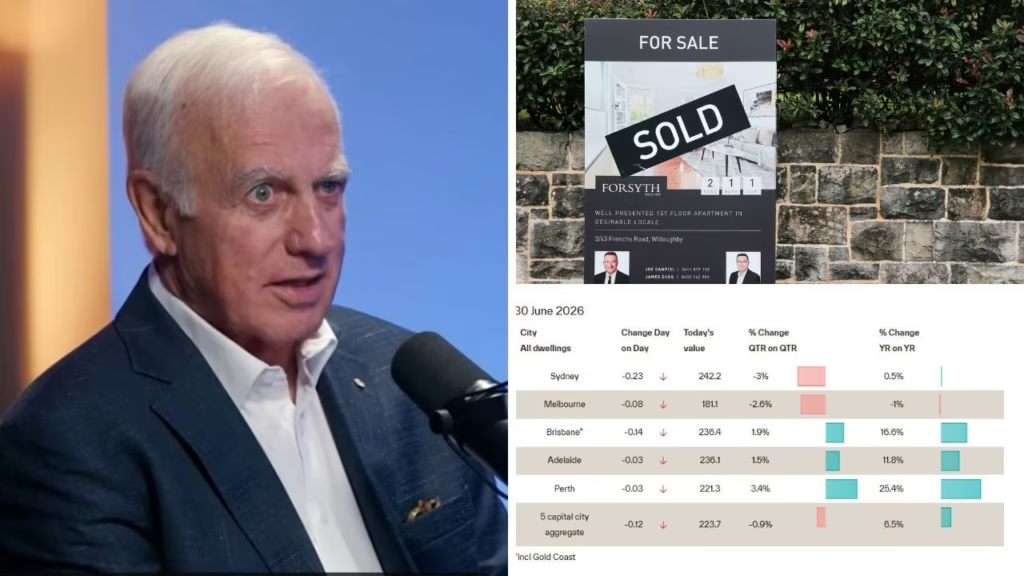
Data from all major property market trackers has shown prices in Sydney and Melbourne have begun falling throughout 2026 – first sparked by interest rate increases.
Cotality reported Sydney has dropped 3 per cent and Melbourne 3.6 per cent this calendar year, and the so-called price correction was hitting other capital cities.
Weekly data for the seven days to June 29 showed a 0.1 per cent drop in Brisbane and a 0.2 per cent fall in Adelaide.
Data from SQM Research also shows asking prices in Brisbane for the quarter were down 3.8 per cent and 1.3 per cent in Perth. Nationally, asking prices fell 1.3 per cent.
Senior property analyst Michael Matusik has argued a long list of factors were combining to push values down, writing there was “something much bigger” occurring than the impact of negative gearing and CGT changes.
“The reality is that housing markets are facing a growing list of headwinds,” he wrote in a blog post last week.
“Affordability is stretched. Interest rates remain restrictive. Household budgets are under pressure. Population growth is easing.
“Investor borrowing costs remain elevated. And confidence, which has been carrying the market for several years, is starting to wobble.”
Mr Matusik said he had been predicting a reckoning in Australia’s housing market and it “appears that reckoning has now begun”.
But he was “getting a little tired” of hearing the federal budget was the reason the market had slowed, something that was already happening before May.
He said auction clearance rates, which have fallen to Covid-19 lockdown levels, were instructive of wider economic pressures converging to hit housing.
“For years I have been told that housing demand is so overwhelming that dwelling values can only move in one direction,” he said.
“Yet genuine housing need and speculative housing demand are not the same thing.
“A large share of recent demand appears to have been driven by expectations of future capital growth rather than immediate shelter requirements.
“Once those expectations weaken, demand can evaporate surprisingly quickly.”