
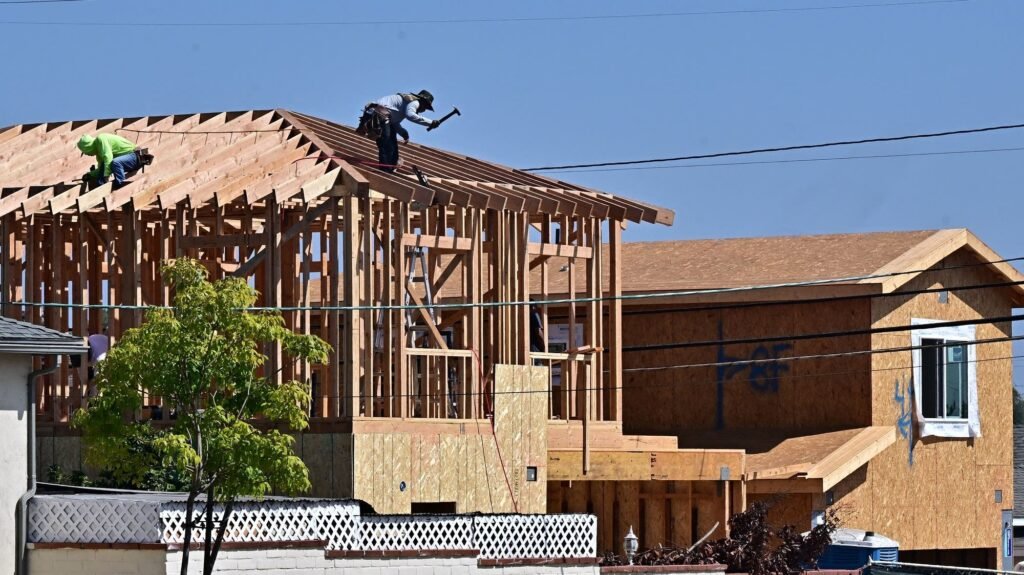
Construction spending is down year-over-year according to new U.S. Census Bureau data for May that was published Wednesday morning. Drilling down into the numbers, spending on single-family home construction — adjusted seasonally — is down 4% from last May.
After months of war-driven economic uncertainty and mortgage rates around 6%, homebuilders are struggling with affordability this summer. Robert Dietz, senior vice president and chief economist at the National Association of Home Builders, said that’s a result of some major headwinds:
“Ongoing elevated mortgage interest rates and elevated price-to-income ratio,” Dietz said.
But there are bright spots — like Midwestern markets.
“Homebuilding permits are up in Kansas City year-over-year,” said Will Ruder, executive vice president of the Home Builders Association of Greater Kansas City. “Anything under $500,000 in the Kansas City market is still moving with a relatively quick pace.”
He said there’s a lot of demand in the area. And available land.
“On both the greenfield, new development side, as well as the redevelopment side,” Ruder said.
Meanwhile, in Richmond, Virginia, people are moving to the area, but new home sales are lackluster, according to Danna Markland, CEO of the Home Building Association of Richmond.
“It’s a result of an affordability ceiling we’ve hit,” Markland said. “We have a scarcity of land that we haven’t seen in decades.”
Rebecca Remick, owner of City Homes in Minnesota, said things are picking up for builders in the Twin Cities.
“But we definitely had a slow spring,” she said.
Remick said land and construction costs are high. Zoning is an issue. Add in economic uncertainty, and its “like the trifecta of keeping people from moving forward,” she said.
In Northwest Arkansas, EJ Johnson is the president of the Lance Johnson Building Company. He said back in the beginning of the year, he was looking at a nice selling season.
“Then we decided to go to war,” Johnson said. “We’re still moving houses, but we’re not moving them at the rate that we should be today.”
Johnson said after the war started, mortgage rates jumped, as did the cost of transporting building materials like lumber.