

Expectations are rising for a recovery in stagnant regional construction and property markets as the “Three Mega Projects for Korea’s Great Leap Forward,” in which the government and major conglomerates jointly pursue large-scale investments in non-capital regions such as the Honam and Yeongnam areas, get into full swing. Amid observations that the 2,000 trillion won investment will serve as a relief pitcher to revive non-capital regions that had been losing vitality, property investment inquiries are already pouring into areas slated to benefit.
According to the regional property industry on Sunday, inquiries related to investment have flooded in from landowners and apartment owners in the Gwangju and South Jeolla regions. The Gwangju and South Jeolla regions have seen expectations for asset value appreciation surge after it became known that Samsung Electronics and SK hynix would build large-scale semiconductor clusters including front-end process fabs.
The head of brokerage A near Gwangju’s Cheomdan district, mentioned as one of the areas attracting semiconductor investment, said, “Since news of the semiconductor plant being attracted was reported, more than 30 inquiry calls pour in a single day.” He added, “In the Cheomdan district, supply was abundant, so ‘mapi’ (minus premium) transactions, in which presale rights traded at prices lower than the presale price, were rampant, but recently the negative premiums of major complexes in District 3 have quickly disappeared.” The head of nearby brokerage B also explained, “Even though unsold units have piled up across all of Gwangju, the mood has changed so much that ‘Hoban Summit,’ recently presold in Cheomdan District 3, showed a subscription competition rate of up to 7.7 to 1.” He added, “At the military airport site, also mentioned as one of the leading candidate locations for the semiconductor cluster, inquiries from landowners have increased and listings have disappeared.”
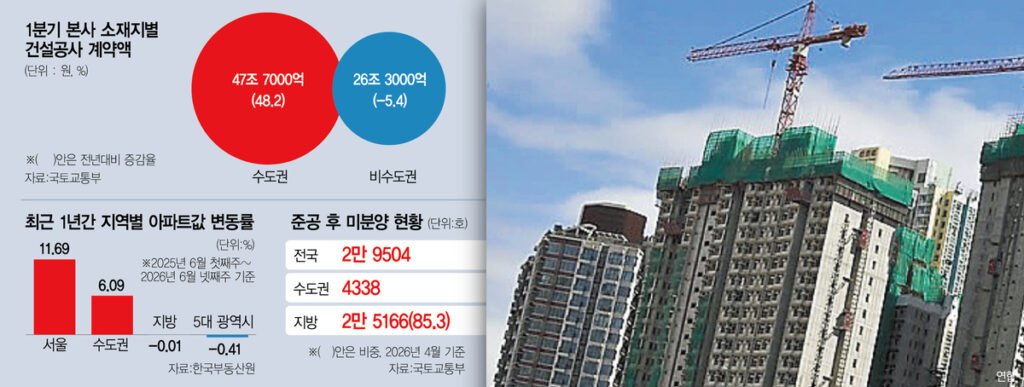
As regional property markets show vitality for the first time in a while, voices in the construction industry and the market predict a recovery in regional property markets that had been sidelined under the dominance of the capital region. There are deep concerns that the domestic housing and construction market is becoming entrenched in a K-shaped polarization structure of “capital region recovery, regional stagnation.” According to the Korea Real Estate Board, during the year since the Lee Jae-myung administration took office, Seoul apartment sale prices surged 11.69% while the five major metropolitan cities in the provinces fell 0.41%, widening the asset gap between regions. The risk of unsold units was also concentrated in the provinces. According to the Ministry of Land, Infrastructure and Transport (MOLIT), as of April, 73% of the nation’s unsold inventory had accumulated in non-capital regions, while of post-completion unsold units classified as “malignant,” 25,166 units, or 85.3% of the nation’s 29,504 units, were concentrated in the provinces.
With the cash flow of province-based construction firms blocked, regional gaps also widened in the value of construction contracts in the first quarter. Construction firms headquartered in the capital region recorded 47.7 trillion won, a 48.2% surge from a year earlier, while non-capital regions came in at 26.3 trillion won, a 5.4% contraction. The Construction Business Survey Index (CBSI; below 100 indicates negative sentiment), which shows construction firms’ perceived business conditions, hovered in the 80s to 90s in Seoul for the year since last June, while the provinces, except on one occasion, remained around the 50s to 60s.
Against this backdrop, the announced large-scale investment is analyzed as a lifeline that will rescue the provincial construction industry from a survival crisis, caught in a “triple whammy” of funding depletion from unsold units and a project financing (PF) crunch, soaring construction costs, and an order drought. If mandatory participation by regional construction firms and subcontracting volumes are guaranteed in the process of building advanced industrial complexes and corporate-led advanced cities, regional construction firms can not only win more orders but also secure local jobs. Park Se-ra, a researcher at Shinyoung Securities, forecast, “Large-scale construction orders accompany the process of pursuing major industrial policies,” adding, “A recovery in orders across the construction industry as a whole is expected, not only for large companies but also for mid-sized and small companies.” Some also observe that provincial mid-sized and small construction firms, which had relied solely on simple housing construction, could improve their structure by accumulating experience in advanced, high-value-added construction such as semiconductor fabs and artificial intelligence (AI) data centers.
However, some urge caution, noting that since this announcement includes mid- to long-term projects spanning 10 years, time will be needed before provincial unsold units or K-shaped polarization are resolved. Lee Eun-hyung, a research fellow at the Construction & Economy Research Institute of Korea, said, “Specific details about where and how much development will take place in provincial areas such as the southwestern region have not yet been disclosed.” He added, “The regions mentioned in this announcement may see asking prices and other figures fluctuate by partially reflecting future value in advance, but it will take time before actual housing demand increases and unsold units are significantly resolved.”