(Bloomberg) — At the height of the US bond-market selloff last month, Vishal Khanduja detected something unusual.
Most Read from Bloomberg
As yields on the longest-dated Treasuries surged toward a 19-year high, large waves of futures sales hit the market right when mortgage-backed securities were being pummeled particularly hard.
To Khanduja, a portfolio manager at Morgan Stanley Investment Management who has been on Wall Street for the past two decades, it was a clear sign that others, like him, were racing to protect against the risk of a deeper drop in their housing bonds by entering trades that would pay off if Treasuries slumped further — a strategy known as convexity hedging.
“It’s a big deal,” he said. “We didn’t talk about it for a long period of time.”
The nascent revival of the tactic is threatening to inject another source of volatility into the $31 trillion Treasury market, which is already being buffeted by turmoil in the Middle East, new Federal Reserve leadership, a steep rise in the national debt and an artificial-intelligence investment boom that’s being financed by a flood of new debt sales.
Mortgage-hedging activity largely disappeared as a force in the Treasury market after the Fed’s aggressive interest-rate hikes in 2022 sent bonds into a tailspin. Securities stuffed with low-rate mortgages tumbled so deeply that, once the dust settled, there was no need to safeguard against further declines. Nor was there much chance that homeowners would refinance and repay the loans early, which can alter the risk profile of the securities.
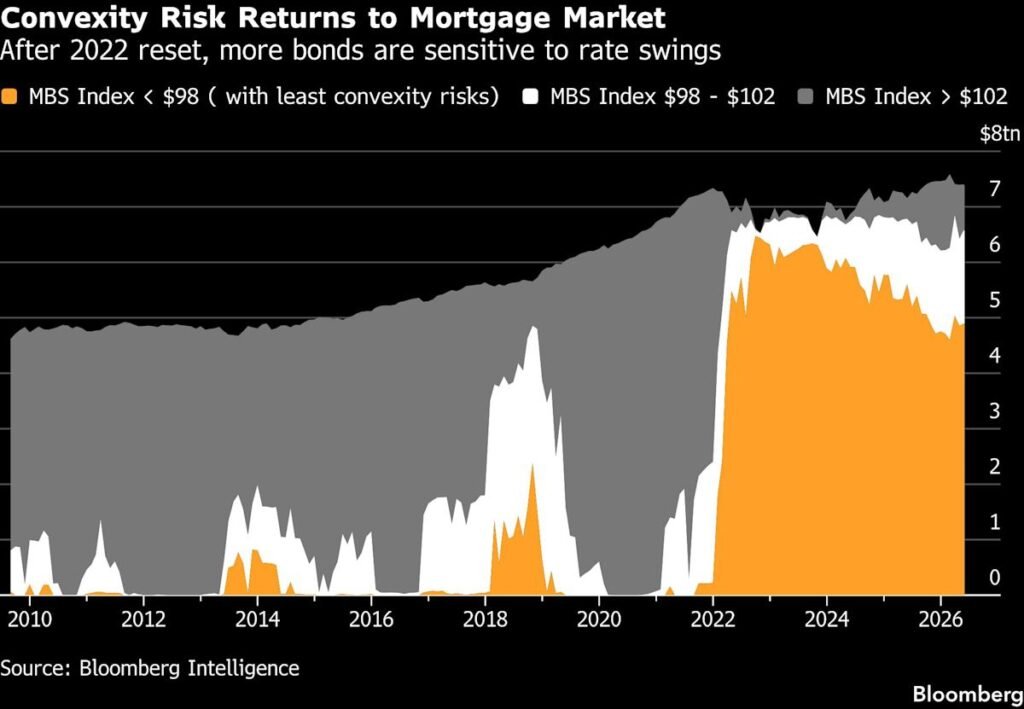
But since then, hundreds of billions of dollars of higher-rate mortgages have been packaged into new securities that are more exposed to convexity, which is a measure of how quickly prices change when yields move. With resurgent inflation again upending the outlook, there are signs that investors are being forced to hedge that risk in a way that causes them to buy when Treasuries are rallying or sell in lockstep when they slide, amplifying the market’s moves. Some called it the “Beast.”
“If it makes a selloff in yields worse, then it has broader significance,” said Amrut Nashikkar, a strategist at Barclays. “Higher yields create a lot of negative feedback dynamics. They raise the cost of funding for the Treasury and worsen an already concerning fiscal outlook.”
The strategy remains less prominent than it once was, and it was far from the dominant driver of the recent downturn. That was the oil-price shock, which has rekindled inflation and stoked speculation that the Fed will need to start raising rates again as soon as late this year.
Yet the hedging activity was seen as adding fuel to the selloff after Treasury yields broke out of their long-held trading range. When that happened, strategists and investors say, many who amassed sizable positions in newer mortgage securities started hedging the risk of deeper price declines.
Some of that risk stems from the fact that when borrowing costs rise fewer homeowners refinance their loans. That effectively extends the maturity of the securities, which in turn means the prices will decline more when rates increase.
To offset that, investors enter into Treasury trades — often through derivatives — that will pay off if bond prices fall. When rates are declining, making refinancings more likely, the same strategy is deployed in reverse, which means it can amplify rallies, too.
It is difficult to determine exactly how large those flows have been or how much they contributed to last month’s rout. But analysts at Goldman Sachs Group Inc. estimate that selloff increased the interest-rate exposure of active mortgage-bond hedgers significantly — roughly akin to what would be taken on by buying $40 billion of 10-year Treasuries.
Investors and strategists say it’s clear the Treasuries are becoming more vulnerable to the hedging flows as the mortgage-bond market emerges from the long shadow of the pandemic.
Barclays estimates that more than $2 trillion of the securities now carry coupons of 5% or higher, roughly four times the level of three years ago, and bondholders need to hedge some of that interest-rate risk.
Barclays’s Nashikkar said the potential for that to add to Treasury volatility has drawn little notice. “Today’s MBS universe looks very different from what it did in 2023,” he said. “The extent to which it can destabilize rates now, I think, has been under-appreciated.”
What Bloomberg Strategists say…
“The benchmark 10-year Treasury bond is testing a pivotal level that, if decisively breached, could unleash convexity hedging flows, fueling a fresh bout of volatility and upward pressure on yields.”
—Alyce Andres, Macro Strategist, Markets Live
For the full analysis, click here.
Harley Bassman, the creator of the widely followed bond-market volatility index, sees a similar shift underway. In a recent note titled “Awakening the MBS Convexity Beast,” he argued that the average price of mortgage-securities has moved much closer to levels where the pricing dynamics are heavily affected by changing expectations about the pace of refinancings.
About a third of outstanding mortgage securities are now trading near par value, where sensitivity to yield changes — or convexity — is greatest. As a result, investors may need to rebalance their hedges more frequently, a process that tends to amplify volatility, according to Bassman.
“This is becoming big enough” to impact the market, he said.
Another factor is the Fed’s diminishing role. The central accumulated more than $2.7 trillion of mortgage securities while it was injecting cash into the financial system during the pandemic. But after inflation surged, it has stopped buying, cutting its holdings sharply.
Hedge funds and other private investors have filled the breach. And unlike the central bank, they frequently hedge their exposure.
“You will see more volatility,” said Bassman. “The last 10, 15 years, it has not been that important because the mortgage market has been basically like the Treasury market. Now, it’s coming back into being important again.”
–With assistance from Scott Carpenter and Dan Wilchins.
Most Read from Bloomberg Businessweek
©2026 Bloomberg L.P.