
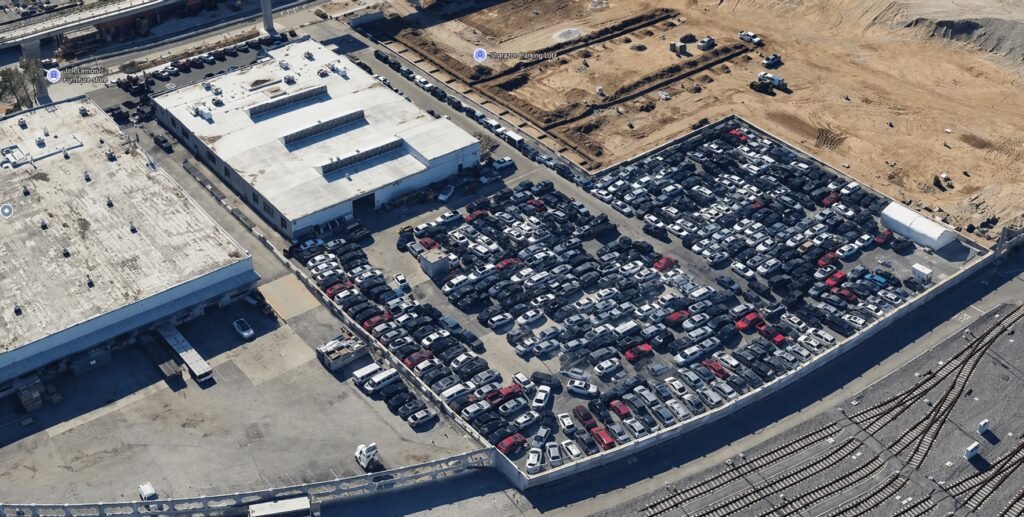
Benji Miller has specialized in warehouses throughout his 15-year career in real estate. In that time, he says he’s found that the most in-demand type of industrial real estate in Southern California isn’t a building — it’s the yard around it.
Industrial outdoor storage, a once-obscure property type, has been gaining mainstream attention in recent years as a niche yet profitable sector for investors.
These sites were previously just considered truck yards and have been long overlooked. Now they’re one of the most competitive parts of the industrial market.
Benji Miller, Founder, Negresco Property Group
As he’s seen firsthand, returns on these properties have more than doubled in the past five years and are outpacing the broader industrial sector by roughly 1.3 percentage points annually, according to the National Council of Real Estate Investment Fiduciaries’ Expanded Index.
“These sites were previously just considered truck yards, and have been long overlooked,” Miller told CoStar News. “Now they’re one of the most competitive parts of the industrial market.”
His firm is among several national businesses forming ventures targeting the segment. His new company, named Negresco Property Group in an homage to an inspirational family member, is working with Bethesda, Maryland-based industrial outdoor storage landlord Open Industrial. They are spending about $150 million on sites that are mostly open-air yards across Southern California in the next two years.
Miller acknowledges he is entering a competitive market where supply is rising in some areas and zoning complexities can quickly derail deals. He’s learned that those challenges can require a hyper-local understanding of what uses are truly permitted.

But the highly fragmented ownership and barriers to entry in the industrial outdoor storage sector have kept supply and vacancy rates low and prices high in certain pockets, he said.
“This acquisition is the first of many,” Miller said.
Interest in industrial outdoor storage is heating up from Los Angeles County to the Inland Empire and beyond, anchored by the nation’s busiest ports and a logistics network that continues to evolve with electrification and shifting tenant needs, Miller said.
He adds that such properties typically include a large lot and a small building, with outdoor space used to store items such as construction materials, heavy machinery and vehicles.
Bethesda, Maryland-based Open Industrial is one of the country’s biggest investors in industrial outdoor storage assets, with 97 properties totaling 1.3 million square feet. Alterra, Manulife Investment Management, Foundry Commercial, TPG Angelo Gordon and Fortress Investment Group are among the other investors targeting the segment in recent years, according to CoStar.
The first deal in the partnership between Miller’s Negresco and Open Industrial is a $20 million acquisition of a 3.15-acre site near Los Angeles International Airport that’s 100% occupied by car rental giant Avis. Located at 5721 West 96th, the property includes a 32,500-square-foot building and 100,000 square feet of outdoor storage space. Miller sourced the off-market deal with the help of real estate services firm JLL.
Miller grew up in Southern California, attended the University of Southern California then launched his real estate career working for Michael Hackman. He spent more than seven years at Hackman Capital Partners focused on acquiring and repositioning industrial properties tied to corporate liquidations and factory shutdowns, where he gained an early education in the nuances of industrial real estate.
He later returned to the firm after business school and began zeroing in on infill industrial assets, including a low-coverage site that would shape his thinking about outdoor storage.
At the time — the early 2010s — such properties were largely owned by mom‑and‑pop operators or users and were mostly ignored by institutional investors and lenders.
“What was interesting was there was really no debt for these assets at that point,” Miller said. “While mission critical to tenants, the capital markets were still finding their way.”
As Hackman Capital Partners pivoted toward studio investments, Miller moved to First Industrial Realty Trust, where he covered markets from Los Angeles to the Inland Empire and watched the industrial outdoor storage sector begin to take shape.
“I had seen a fair amount of opportunities that I wanted to acquire and kind of formulated a business plan in my mind about how I could institutionalize some of these smaller yards,” Miller said.
Miller’s first venture was 5‑Ronin, an industrial outdoor storage investment firm he founded where he assembled a $100 million portfolio.
Now, with Negresco, Miller is reloading another portfolio with a new partner seeking exposure to West Coast industrial outdoor storage properties.
Miller is targeting properties that are at least 70% outdoor, focusing on functionality, zoning and layout to accommodate a wide range of industrial users. That includes equipment rental firms, trucking companies and businesses tied to charging infrastructure and electrification.
“Power is becoming extremely important to tenants,” he said.
Short-term demand drivers are also emerging, from rebuilding efforts after wildfires to infrastructure tied to global events like the Olympics, even if some of that demand is temporary, he said.
The name behind Miller’s new venture reflects something more personal than a typical real estate brand.
It traces back to his grandfather, a World War II veteran who visited the landmark Hotel Negresco in southern France in 1945 after the war ended — an experience that would later inspire the company’s name.
Miller’s family cherishes a photograph of his grandfather taken in front of the hotel.
“He looks just like me in the picture,” Miller said. “In my family, the hotel represents kind of new beginnings, hope, positivity.”
Miller said he wanted the firm’s name to reflect that sense of renewal rather than something generic tied to geography or branding conventions.
That narrative now underpins the launch of Negresco as it looks to build scale in a sector that is itself being redefined.