
British politicians have cast doubt on their country’s ability to develop and deliver nuclear submarines promised as part of the AUKUS defence pact.
The House of Commons Defence Committee on Tuesday released the findings of its year-long review into the trilateral partnership.
While the report was broadly supportive of AUKUS, it also “laid bare the scale of the endeavour that will be required to deliver it”.
As part of the deal, the United Kingdom and Australia are working together to design and build a new class of nuclear-powered attack submarine, known as SSN-AUKUS, scheduled to enter service in the late 2030s and the early 2040s.
“For the UK, delivering SSN-AUKUS will be a lengthy and complex undertaking requiring a sustained financial commitment from government across several electoral cycles,” the report noted.
“It is deeply concerning that there are signs that the investment pipeline that underpins that commitment has already faltered.”
The report urged the UK government to devote more money to the partnership.
“Shortfalls or delays in funding risk a failure to deliver SSN-AUKUS on time, with potentially severe consequences for UK and wider Euro-Atlantic security, and our standing with our trilateral partners,” it read.
The ability of the United States and Australia to make good on their AUKUS commitments was also under the inquiry’s microscope.
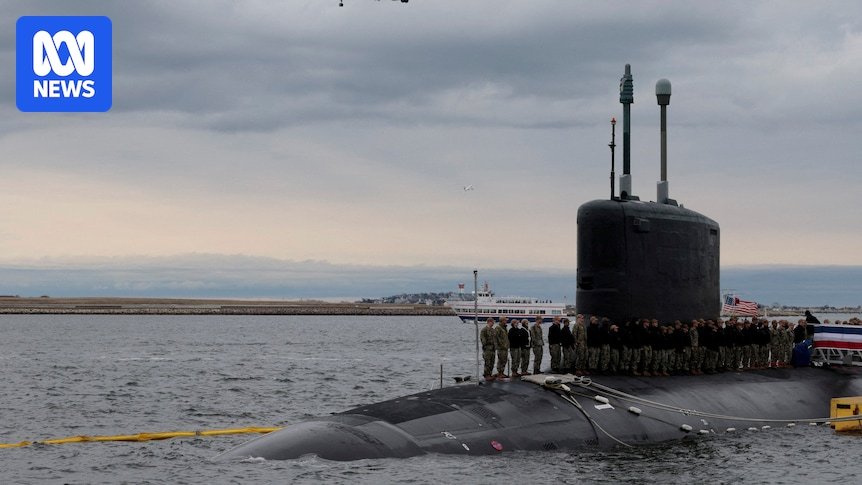
As part of the pact, the US is supposed to sell Australia several of its Virginia-class nuclear submarines, the first two of which are due to be delivered in the early 2030s.
The House of Commons report described low production rates in the US as “a matter of concern” and “a potential risk” to the deal.
While the White House has reiterated its commitment to the partnership, and Australia has already given the US $US500 million ($798 million) to try to reinvigorate the country’s shipbuilding industry, critics contend the AUKUS deal’s fine print means nothing is guaranteed.
Australia is expected to invest a total of $US3 billion in US submarine manufacturing capabilities as part of the deal.
It has been estimated AUKUS could cost Australia around $368 billion by the mid-2050s.
“For Australia, AUKUS is an unprecedented undertaking to be delivered to ambitious timescales,” the House of Commons report noted.
“The UK will need to work closely with Australia at both industry and government level to share expertise and support Australia in meeting its own milestones.”
Trump ‘an unreliable ally’, submission claims
US President Donald Trump has expressed his support for the trilateral pact, but the House of Commons inquiry received submissions claiming the president’s “America First” approach to foreign policy, Russia’s full-scale invasion of Ukraine, and other geopolitical factors “had undermined the case for AUKUS and its chances of successful delivery”.
The Australian Peace and Security Forum — a not-for-profit that has been calling for a public inquiry into AUKUS to be held in Australia — gave a written submission to the inquiry in which it contended the US under Mr Trump was “an unreliable ally”.
The group also claimed that “geopolitical circumstances have changed for both the UK and Australia since AUKUS was conceived in 2021”.
“Strategic priorities for both countries do not align,” the submission read, adding “the UK should not proceed with AUKUS if it cannot guarantee delivery of its commitments on time and on budget”.
But the inquiry also heard from the UK’s Minister for Defence Readiness Luke Pollard, who said the changing geopolitical context and increasing threats meant “the importance of making sure that AUKUS delivers is even more prominent than it was when the original initiative was launched all those years ago”.
The House of Commons report highlighted difficulties in staff movement between the AUKUS partner countries, due to the security clearances required to work in the defence sector.
A consultancy company involved in AUKUS told the inquiry that moving employees between its UK and Australian businesses was a “time-consuming and administratively burdensome” process.
While AUKUS enjoys significant support from both major political parties in Australia, the deal has also attracted criticism, notably from former prime ministers Malcolm Turnbull and Paul Keating.
Tan Dhesi led the probe into AUKUS. (ABC News: Alex Parsons)
Tan Dhesi, the Labour MP for Slough and chair of the House of Commons Defence Committee, told the ABC the inquiry was designed to review the UK government’s progress with regard to AUKUS.
“Many of us had concerns that things were perhaps not progressing at the pace they should be, but we wanted to gain expert advice as well as evidence,” he said.
Mr Dhesi said as part of the inquiry, representatives of the defence committee visited locations in the UK, US and Australia.
“Our key recommendation is that the UK government needs to do much more and it needs to do it faster in order to reap the full benefits of this once-in-a-generation, long-term strategic partnership with Australia and the US,” he said.