
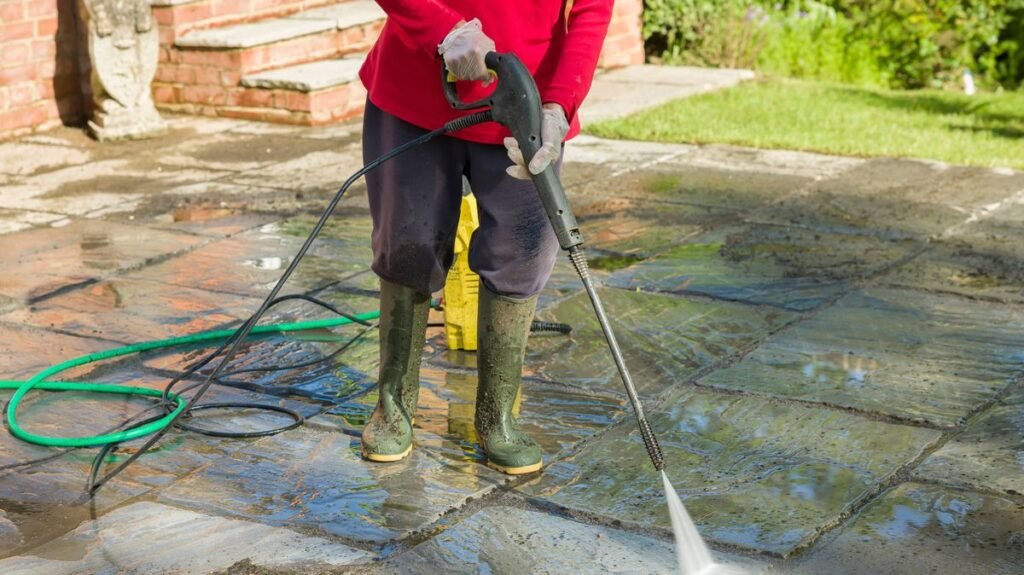
A landscaping specialist is urging homeowners to be aware of the risks before cleaning their patio this summer

Many believe jet washing a garden is a quick and sufficient way to clean the garden(Image: PaulMaguire via Getty Images)
We’ve all been scrolling online and stumbled across a gardening TikTok trend that we’ve been tempted to give a go. But some of these trends could actually be causing more harm than good to our homes.
Homeowners, in particular, are keen to discover the latest cleaning hacks to get their gardens looking pristine once more. However, exposing your garden to an array of unusual chemicals and unique cleaning methods can come at a cost.
Andy Mclaughlin, a landscaping specialist at RF Paving, has shared his insights on the dangers of cleaning hacks, alongside his top tips on how to safely clean your patio and paving this summer.
Here’s what you need to know, reports the Express.
What chemicals should you avoid when cleaning your paving?
“There are products and chemicals that should be avoided completely when cleaning paving”, Mclaughlin said.
“It is just knowing which substance can be used on which paving, along with knowing what type of marks need to be cleaned off the surface. Whilst most domestic products will be fine when cleaning any paving, if a stronger more industrial substance is used, then knowing what type of paving you have is key.
“The pH of the cleaning substance may not be conducive to the type of paving being cleaned and may cause a chemical reaction and could leave marks on the surface of the paving, which can be irreversible, such as if brick acid was used on limestones.”
What are the risks of using indoor cleaners on your paving?
TikTok users have been sharing their distinctive paving cleaning techniques to tackle grime using products such as the Pink Stuff Cream Cleaner.
However, before reaching for your go-to surface cleaner, it’s crucial to understand what type of paving you’re dealing with, and what substance needs removing from the surface.
He said: “Whilst most cleaners will work to a certain extent and may not harm the paving itself, consideration should be given to the surrounding areas; like lawns or planted borders, wood, planters, or patio furniture.
“The cleaning substances may cause harm in their ‘neat’ form, but dowsing with water will dilute the substance if contamination occurs. As always, if using any type of chemicals, they should be used with caution and the manufacturer’s instructions must be followed.”
What are the safest ways to effectively clean your paving?
Pressure washing can prove an ideal approach for stubborn areas, but it’s essential to exercise caution when cleaning particular materials.
The expert advises clearing all furniture from the space and sweeping away any loose debris beforehand, to prevent any damage or additional cleanup.
He suggested: “To clean block paving or a patio, we would recommend: a sturdy sweeping brush, a leaf blower for loose material, a shovel for any built-up dirt, a wheelbarrow, a pressure washer and fine sand for re-sanding any joints.
“Starting with a clear surface free of dirt and debris, remove any organic growth like moss or weeds. These can be removed using a pressure washer, and this will also remove any old sand in between the paving joints.
“If you don’t have a pressure washer, a block paving cleaner such as lithofin outdoor cleaner will help remove any organic growth that has accumulated.
“After cleaning, wait a day for the paving to dry, and make sure to pour new sand over the paving and gently sweep it into the joins, to make sure they are evenly filled and stable.
“For your patio, apply undiluted using a garden sprayer, and let the product get to work for two to 10 hours. Once this time has passed, rinse with clear water and reapply if necessary.
“Alternatively, a simple mix of baking soda and water can effectively clean your patio and is a safe and eco-friendly option that’s gentle on paving material, and also affordable.”