
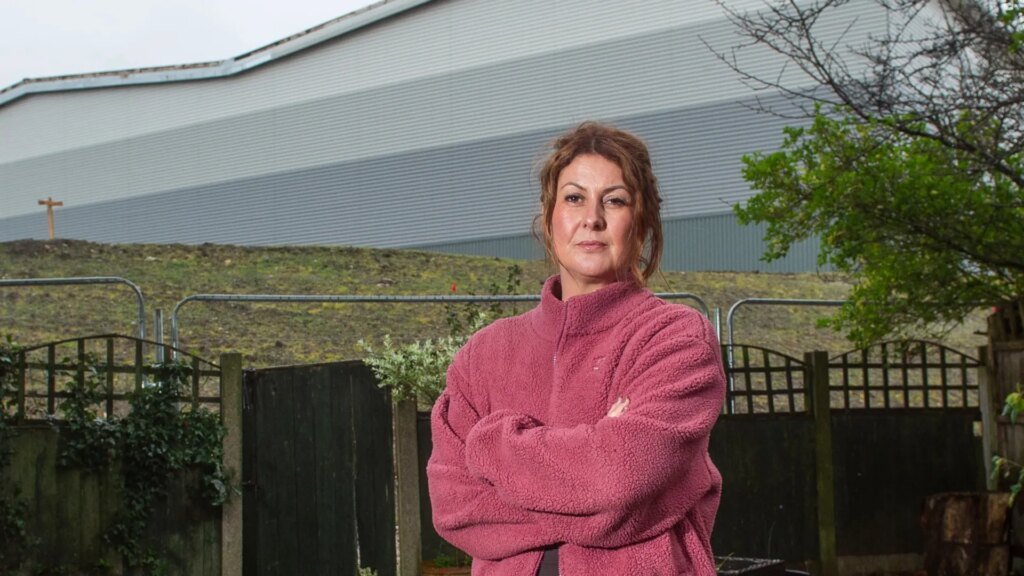
STARING out of her back kitchen window, mum-of-two Paula Boardman’s heart sinks.
Instead of the lush green fields that once lay beyond her garden fence, a grey 18m tall eyesore – the equivalent of seven storeys – looms menacingly over her peaceful cul-de-sac on the Henfold Estate in Tyldesley, Greater Manchester.
The warehouse is part of a hellish 32,500sqm hub – the size of four and a half full-size football pitches – comprising four ‘megasheds’. The development was given the OK by Wigan Council, despite its suburban setting.
“It has taken all the skyline out, along with the sunshine,” says Paula, 47, a customer service manager who has lived in her three-bedroom semi for 18 years with husband, Steven, 49, a site manager.
“Before, we had views of fields where people walked their dogs and kids played.”
In recent years, supersized industrial units have been increasingly springing up in residential areas across the UK.
In 2022, the Office for National Statistics reported that the number of business premises used for transport, logistics and warehousing had almost doubled in a decade, rising by 88 per cent between 2011 and 2021.
Paula suspected the area behind her home would eventually be used for building, but was stunned by the sheer scale.
“The problem is the extremity of what’s gone up,” she says. “It’s humongous, like a cruise ship.
“Work started in April and it got erected very quickly. Everyone was in shock as the only consultation we’d had was a notice on a lamppost.
“The neighbours have formed a steering group and we’re trying to challenge the council’s decision – we don’t think they considered the application properly.”
It’s not just the sight of the buildings that’s causing distress.
“The construction noise and dust have been horrendous,” says Paula, who is mum to Max, 18, and Annie, 13.
“I’ve also suffered damage such as noticeable cracks to my walls and internal floors since the piling [where deep foundations are bored into the ground] began.
“And when they start using it, there will be lights and noise from lorries potentially at all hours.
Worse still, Paula is now fearful her home will be unsellable, as prices on her street plummet.
‘Shattering peaceful lifestyle’
“An estate agent says this could have knocked at least £50k off the estimated £350,000 value,” she says. “One neighbour has been unable to sell her home, despite dropping the asking price from £425,000 to £330,000.
“The worry has been dreadful on top of the building work shattering our peaceful lifestyle.”
Allan Wilen of construction data firm Glenigan says new warehouses are also getting bigger, with an average size of 14,000m2 in 2025, compared to 7,000m2 in 2017.
“The big driver has been people shopping differently,” he explains.
“Companies need big regional distribution centres close to motorway junctions and smaller ones near urban areas for the ‘final mile’ delivery.”
Residents of Hooke Close in Corby, Northampton, were blindsided when an 18m metal frame appeared behind their homes in January 2024.
Permission had been granted on the site of a former Weetabix factory at the neighbouring Earlstree Industrial Estate in 2022.
North Northampton Council mistakenly consulted the wrong street, making the consent illegal.
But when locals applied for a judicial review to overturn the decision last November, the High Court was unable to grant one because the time limit of six weeks to challenge it had expired.
To add insult to injury, they were liable for the council’s £5,000 legal costs.
“I work in distribution and understand the need for warehouses, but this is vastly larger and we can see a green glow from all the lights at night,” says dad-of-three Jamie Hume, 39, who has lived in a three-bed townhouse on the street for eight years with wife Rachel, 35.
“We used to love sitting outside in the summer, but we’ve lost our sunset now.”
Despite being completed a year ago, the warehouse remains vacant, leaving residents in limbo.
It has taken all the skyline out, along with the sunshine. Before, we had views of fields where people walked their dogs and kids played
Paula Boardman
“I paid £225,000 for my house and have no idea how the price will be affected, as we don’t know how much traffic or noise there will be,” says Jamie.
“Prospective buyers won’t want to take the risk without the full facts.”
Mish Liyanage of Mistoria Estate Agents warns streets like this could see values plummet by 10-25 per cent – or £26,900 to £67,250, based on the average UK house price.
“In quiet suburban or rural settings, losses can reach ten to 30 per cent due to higher expectations of privacy and tranquillity,” he says.
Is YOUR area next? How to find out
Given the proliferation of megasheds, property lawyer Frank Smith, of Frank Smith & Co Solicitors, says buyers should request an additional planning search.
“Your solicitor can look at whether sites nearby have been designated for light or large industry, as well as housing, and the ten-year development plan for the area,” he explains.
For the 1,500 residents of Pilning, a village north of Bristol, there wasn’t even a consultation about a “stadium-sized” 20m tall warehouse which will span 46,500sqm when completed.
The developer used an historic planning consent from 1957 which meant South Gloucestershire Council had limited powers.
Devastated Anna Birnie, 47, had no idea about the planning permission when she and partner Mike Drewett, 54, a tower crane driver, bought their house two years ago.
“We put our life savings into this,” says the mum-of-one.
“It was to be our forever home and cost £545,000, with more than £15,000 in stamp duty.
“I can’t afford to move again, especially if the house is devalued.
“I work from home as a health and safety co-ordinator and this summer, there was banging all day long. We had to keep the windows shut in 30-degree weather.
“We had a public meeting with more than 150 people last month, but there’s a kind of ‘tough luck’ attitude, with the council saying it has no powers to listen to us.
“I feel so angry that developers have abused an outdated planning permission created at a time when no houses were here.
I feel so angry that developers have abused an outdated planning permission created at a time when no houses were here
Anna Birnie
“And now, I’ve got a monstrosity to look at instead of beautiful trees.
“It’s really unfair that we’re expected to fight against all of this. It’s like a small restaurant battling McDonalds.
“This is a worrying time for villages like ours – and your street could be next.”
A South Gloucestershire Council spokesperson says: “Much of the new development at Severnside is governed by a planning permission granted in 1957, pre-dating both South Gloucestershire Council and probably the arrival of many local residents in the area. This permission gives wide ranging powers for development with limited remaining control for the council to exercise.”
A North Northamptonshire Council spokesperson says: “We are aware that areas of the process were not followed in 2022 around the determination of an application for a commercial building on site in Corby and measures continue to be taken to strengthen processes regarding future planning applications.
“Residents can be assured that we are doing all we can to ensure a similar issue does not happen again by improving the current planning processes.”
A Wigan Council spokesperson said: “We are confident that the decision to grant planning permission aligns with national planning policy. Nonetheless we fully acknowledge the concerns being raised and we have committed to carrying out an independent audit of the planning process to ensure additional transparency.
“We will remain in dialogue with the group as that progresses.”
WAR ON WAREHOUSES: WHAT YOU CAN DO
SOLICITOR Frank Smith says:
“Unless plans for a new warehouse fall under permitted development, it is the norm for permission to be sought from the council for large developments like this.
The council must usually consult locals, for 21 days minimum. This typically involves a simple notice like a poster, often displayed near the site, directing the public to an online planning portal where they can view the application and submit comments or objections.
Only ‘material’ concerns, such as noise, loss of privacy, density of development, traffic and ecology, can be considered.
If you think planning has been granted without following due process, you can apply to the High Court for a judicial review. But this must be done within six weeks of the application being granted and can be costly.
In 2012, Halebank Parish Council had permission for a 111,000sqm Amazon warehouse quashed after arguing Halton Borough Council misinterpreted its own development plan for the area.
But the decision was controversial because 1,000 jobs had been promised at the logistics base.