
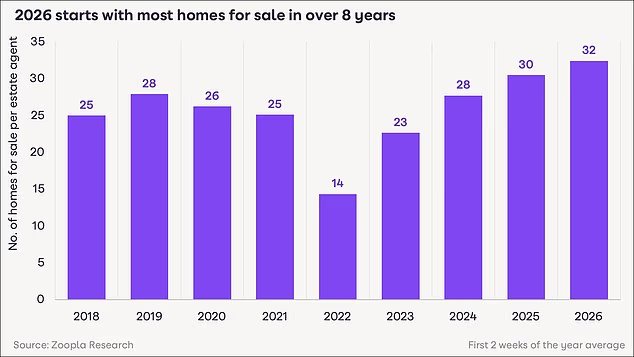
The number of homes for sale has reached an eight-year high, giving buyers a golden opportunity to knock down the price of properties.
The average estate agent has 32 homes for sale, according to the property website Zoopla, the highest level at this time of year since 2018.
The increase is being driven by an outsized increase in homes going up for sale in London, where the property market has struggled.
Zoopla said there is an increased appetite to move home, after the property market slowed down at the end of 2025 due to rumours of new property taxes in the Budget.
However, the increased number of homes on the market also suggests some sellers are struggling to shift their properties.
One third of homes currently for sale were previously listed in 2025, and have been brought back to market to try again.

Lots to sell: The average estate agent has begun 2026 with 32 homes for sale – the highest for eight years, says Zoopla
Where are there most homes for sale?
London saw by far the biggest increase in homes for sale, up 16 per cent on last year, according to Zoopla.
This was followed by the south east, where the number of homes was up 9 per cent.
Southern regions were most impacted by Budget uncertainty, according to Zoopla.
This included rumours such as stamp duty getting replaced by an annual levy and capital gains tax becoming payable on people’s main homes.
One rumour which was proved right was a mansion tax, which will be payable in the form of a council tax surcharge on £2million-plus homes.
The effect was to stall sales in the final months of 2025 meaning more homes carried over into 2026.
More supply is boosting choice for home buyers and keeping house prices in check across southern England where prices fell by up to 1 per cent in the last year, Zoopla said.
Across other regions of the UK, supply is broadly the same as last year, according to Zoopla.
What should sellers do?
With more homes on the market, sellers may be wondering what they can do to encourage buyers to make an offer on theirs.
Richard Donnell, executive director at Zoopla, says it is crucial not to price your home too optimistically.
‘Buyers are price-sensitive and have more choice, so achieving the best result depends on setting a competitive asking price and attracting early interest,’ Donnell says.
‘Homes priced too high often take longer to sell and at the risk of achieving a lower price. It is important that homeowners price carefully and seek the advice of agents to plan the right strategy for their home sale.’
‘Homes that are well-presented and realistically priced continue to sell, while those priced optimistically will take longer and may need price reductions to attract interest.’
Buyers are back house hunting
Last year house prices didn’t rise much because not only were there more homes for sale, but there were fewer buyers in the market.
At the start of this year, Zoopla says buyer enquiries have rebounded somewhat and are up 20 per cent compared to early 2023.
However, enquiries are still 10 per cent short of the strong start to 2025 when the ending of stamp duty reliefs and lower mortgage rates provided additional stimulus.
‘After a sluggish end to 2025 it is positive to see a strong rebound in buyer demand over the first weeks of the year across all parts of the country,’ said Donnell.
‘Growing numbers of homes for sale is evidence of a strong underlying appetite to move home for many households.’
Tom Bill, head of UK residential research at estate agent Knight Frank says he has also seen renewed interest from buyers and sellers, though he admitted that sentiment was fragile.
‘The combination of clarity around taxation and the prospect of further rate cuts means demand in the first weeks of January has been stronger than normal,’ said Bill.
‘That doesn’t mean the market is now on an upwards trajectory and domestic political risks could still undermine sentiment over the next six months.
‘For now, the absence of bad news means that some of the demand that became pent up last year is being released and we expect UK prices to grow by 3 per cent this year.’