
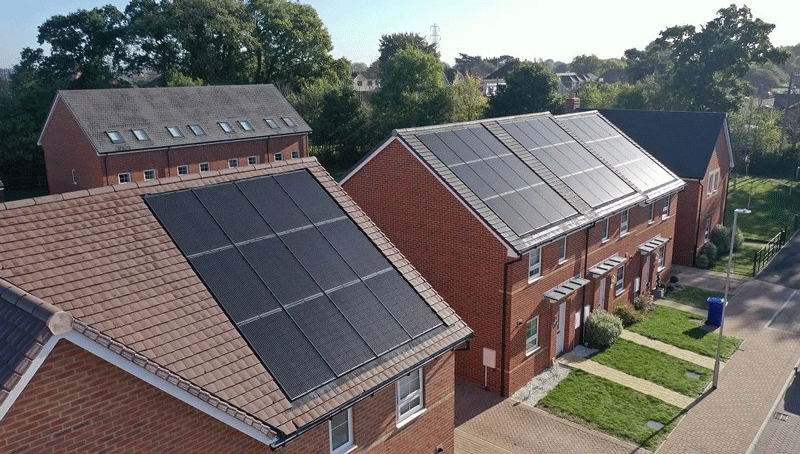

Image: UPOWA x Barratt Homes.
But a requirement for homes to be delivered in line with the Standard has been delayed by one year to 2028. Industry observers have attributed this to a combination of delays within Westminster and pressure from large housebuilders as the Government seeks to enable the delivery of 1.5 million new homes this Parliament.
The Future Homes Standard will require homes built from 2028 onwards to produce 75% less greenhouse gas emissions across their lifespan than those built in line with existing requirements, which have not been updated significantly since 2013.
Housebuilders will need to think more carefully about the embodied carbon of homes, altering materials and design and construction processes as needed. Additionally, they will need to enhance energy efficiency using a fabric-first approach.
The vast majority of developments will also need to be fitted with rooftop solar panels. Developers will need to install solar panels equivalent in size to at least 40% of the building’s floor area. Where this is not possible, they should still install a “reasonable” amount of solar. Flexibilities will be implemented for homes with lots of shade overhead, for example, from tree cover.
On heating, most new homes will be fitted with heat pumps or connected to a heat network.
However, it has been reported that the Standard will include a loophole to allow for wood-burning stoves in some properties.
The full Standard is expected to be unveiled later today (Tuesday 24 March). It has been in development for around a decade and was originally meant to be published under the previous Conservative-led Government.
It follows on from the Warm Homes Plan, which details £15bn of Government spending to retrofit existing homes.
Cost savings
“As we make the switch to clean, homegrown energy, today’s standard is what the future of housing can and should look like,” said Housing Secretary Steve Reed.
“Not only will these changes protect hardworking families from shocks abroad, but will also slash hundreds of pounds off their energy bills every year.”
The Government claims that a family living in a home built to the Standard will pay up to £830 less for their energy bills, compared to an existing home with an EPC rating of ‘C’.
The MCS Foundation, which certifies the installers of small renewable energy projects, has stated that savings of up to £1,000 are possible depending on property type and energy use patterns.
Join the conversation at the edie Green Buildings Forum & Workshops
Taking place during London Climate Action Week, edie’s Green Buildings Forum & Workshops is a new, dedicated event designed to help businesses tackle one of the most complex challenges on the net-zero journey: decarbonising building stock.
Join us at IET London: Savoy Place, on 23 June 2026, for a day of collaboration and inspiration. Our agenda includes keynote speeches, an industry expert panel, networking and hands-on workshopping.
The focus is firmly on real-world decision-making, balancing carbon reduction, cost, performance and organisational priorities.
Click here for more information.