
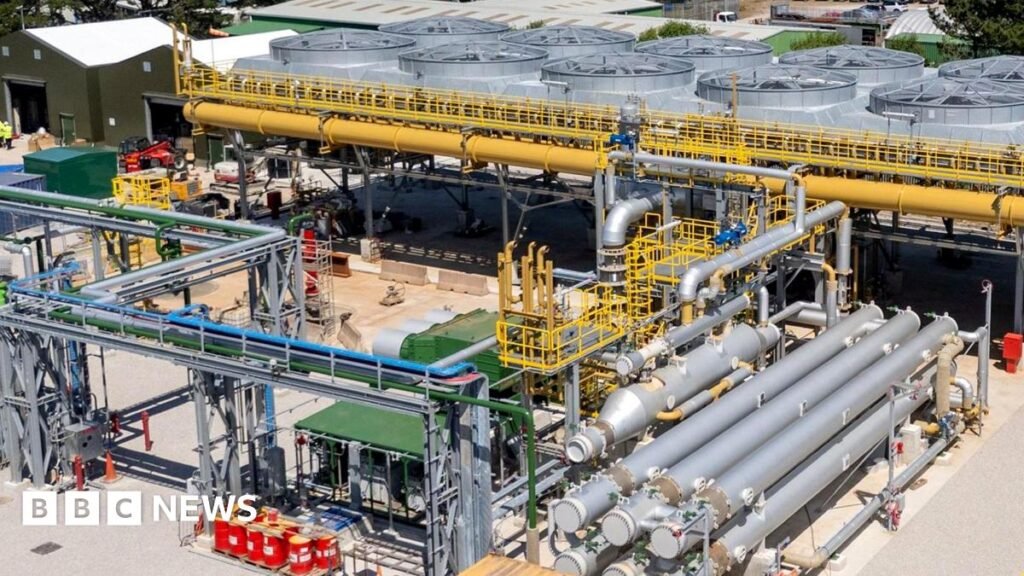
The Earth generates heat which can be harnessed by drilling down below the surface to provide a renewable, and continuous source of energy to heat and power our homes – known as geothermal energy.
The further down you go the hotter it gets. At shallow depths the heat is enough to warm our homes and businesses. This is already done in some parts of the UK – for example, ground source heat pumps are a form of geothermal technology, and in places like Southampton, heating is provided to hundreds of homes via a local network.
But this project has drilled to far greater depths – three miles below the surface – where temperatures climb to nearly 200C, and this is enough heat to generate electricity.
“You drill deep boreholes into the ground, and then fractures within the granite rock are used to circulate the water that pick up the heat [that is] used for electricity production,” explained Dr Monaghan, head of geothermal at the British Geological Survey (BGS).
Granite is particularly ideal for this technology as it is very effective at holding and conducting the Earth’s heat.
This is the first time the feat has been achieved in the UK because drilling this far down is a technically and financially costly endeavour. The project has cost £50m to date, funded through private investors and the EU.
Ryan Law, CEO of GEL, told the BBC: “[I’m] tremendously excited after 15 years of hard graft, difficulties, we’re finally there.”
He said geothermal power was “really important” for the UK because there are no price fluctuations like with gas.
“And unlike other renewable sources like wind and solar we are constantly on, 24/7 electricity,” he added.
The power generated at the United Downs site has been sold to Octopus Energy who will deliver it, via the national grid, to meet the electricity needs of up to 10,000 homes.
“This project is a genuine game-changer. For the first time, we’re tapping into “always-on” green power in the UK, providing a steady stream of clean, home-grown energy,” said an Octopus spokesperson.