
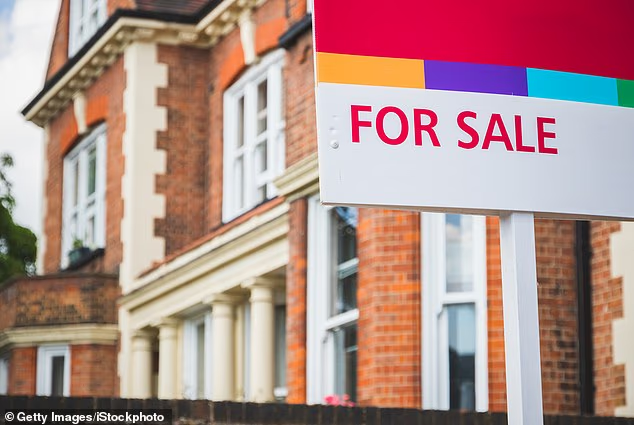
There’s a certain logic most people follow when renovating: yes it’s costly now, but in the long run you’ll make money as your house will be more attractive to buyers.
Except, surprisingly, it often doesn’t work out like that.
In fact, some of the most common upgrades homeowners make can actually devalue a property, either by knocking thousands off the asking price, or putting buyers off entirely.

Experts told us renovations can knock up to 10% off a home’s value
From losing bedrooms to ‘Instagrammable’ kitchens, we asked property investors, estate agents, interior designers, finance specialists and renovation experts what exactly turns a buyer off a house. Keep reading to find out – and, hopefully, save yourself a few thousand quid.
Turning a bedroom into a walk-in wardrobe or gym
That spare room turned dressing room might feel like a luxury – but it’s one of the quickest ways to drop your home into a lower price bracket.
Unless you’re selling a mansion with countless rooms, buyers overwhelmingly prioritise bedroom count, even if the room itself is small. While bespoke wardrobes or storage can cost between £7,000 to £11,000 they rarely add value in the same way an additional bedroom does – and can even cost hundreds to remove.
In practical terms, what feels like an upgrade to you often reads as a problem to fix for the next buyer. And it’s a decision you’ll regret as a seller, too: an extra bedroom can add up to 10% to a home’s value.
Matt Gerrish, Head of Investments at Sold.co.uk
Installing a bold kitchen
A bold kitchen might get likes online, but it can quietly shave thousands off your asking price.
I regularly see homeowners spend £10,000 to £25,000 on highly personalised kitchens influenced by social media trends. The worst offenders are bright coloured-cabinets, ultra-dark units, open shelving and oversized statement islands.

You might love your bold kitchen – but the next buyer (and bank balance) won’t
Yes, they look great online – but the first thing most buyers think about is the cost of ripping them out. Bright colours, unusual layouts or statement finishes can all limit appeal, particularly if they feel dated or overly specific.
As a result, buyers often reduce their offer by £5,000 to £15,000 for a kitchen redo – sometimes more.
Karl McArdle, Co-Founder at The Property Buying Company
Mismatched extensions
I see so many customers who have completed extensions on their older home, maybe a Victorian property, without fixing anything else. The extensions don’t work with the rest of the house and end up being too warm in the summer, whilst the rest of the home is draughty and freezing cold.
With the costs for planning applications, scaffolding, contractors, and materials, some homeowners are spending £2,000 per square foot for their extensions. And there’s no way they’re going to make a return, particularly if buyers can see the rest of the house still needs major work.
Becky Lane, Founder at Furbnow
Knocking through walls
Open-plan living is still popular – but there’s definitely such a thing as too open.
Removing too many walls, particularly if it eliminates a separate living room, can make a home feel less practical, especially for families who might want to eat, rest or play separately. While it might make a space look visually bigger, it often functions worse on a practical level.
In some cases, over-opened layouts can knock between £5,000 and £15,000 off a home’s perceived value, simply because buyers start thinking about reinstating walls and reworking the space.
Katie Cromwell, Founder at No.86 Estate Agency

Open-plan living isn’t always ideal for families
Removing ‘pokey’ storage space
Making a space look bigger doesn’t always make it better.
I’ve often seen people knocking through pantry or utility rooms to create a large, airy kitchen. Yes, it makes a space look, and feel, more spacious. But buyers quickly notice when there’s nowhere to store everyday essentials.
That loss of function – even in a small way – can impact value up to 5% percent, particularly in homes where storage is already limited. That’s because the buyer won’t be enjoying viewing your home – they’ll be thinking about where they can hide their mop and bucket if they move in!
Chris Murphy, Founder at Waterfront Homes
Converting a garage
Turning a garage into a home office or extra living space might seem like an easy upgrade – until buyers realise they’ve lost somewhere to park.
This is a common mistake, particularly in many areas of the UK where off-street parking is in high demand. Even a well-finished room won’t outweigh the inconvenience of losing parking, especially for families or commuters.

Removing a garage without off-street parking can be a costly mistake
However nice a conversion is, most people will choose practicality over aesthetic. In some cases, it can reduce a property’s value by up to 10%.
Abi Hookway, property investor and expert
Bad DIY
Bad DIY doesn’t just look messy – it makes buyers nervous.
Poorly finished bathrooms, uneven tiling or ‘creative’ electrics can immediately raise red flags about what’s going on behind the scenes. And once that doubt creeps in, buyers either walk away or start negotiating down.
Fixing those issues properly can cost thousands – which is exactly what buyers will factor into their offer.
Becky Lane, Founder at Furbnow
Creating a ‘shower’ room
Some changes make perfect sense for your lifestyle, but not for the next person who’ll live in your home.
Removing key features, such as a bath in a family home, can massively reduce a property’s desirability. Buyers tend to have certain non-negotiables, and when those are missing, it can directly impact what they’re willing to pay.
Just because it works for you doesn’t mean it works for the market.
Jamie Williams, Property Finance Specialist at Pure Property Finance
Removing original features

Original fireplaces and flooring are attractive to buyers
Stripping out period features might modernise a home, but it can also remove exactly what made it valuable to buyers in the first place.
Original elements like fireplaces, high ceilings or architectural details often drive appeal, particularly in older properties. Once they’re gone, they’re hard (and expensive) to reinstate, and there’s a certain subsection of buyers who really tend to notice.
Homes that retain their character are often more desirable because they feel more distinctive. If a buyer is doing dozens of viewing, they could well be the thing that makes your place memorable.
Grace Cooper, Interior Designer at Department, Campfield
Installing a heat pump without insulation
Adding a heat pump or solar panels sounds like a smart investment, but only if the rest of the house is up to standard.
Installing green tech without addressing insulation or ventilation first can actually put buyers off. If the home is still inefficient, the upgrade won’t deliver the expected savings and will just be seen by buyers as a noisy machine that warrants a discount.
In some cases, it becomes a costly addition that doesn’t meaningfully improve value.
Becky Lane, Founder at Furbnow