
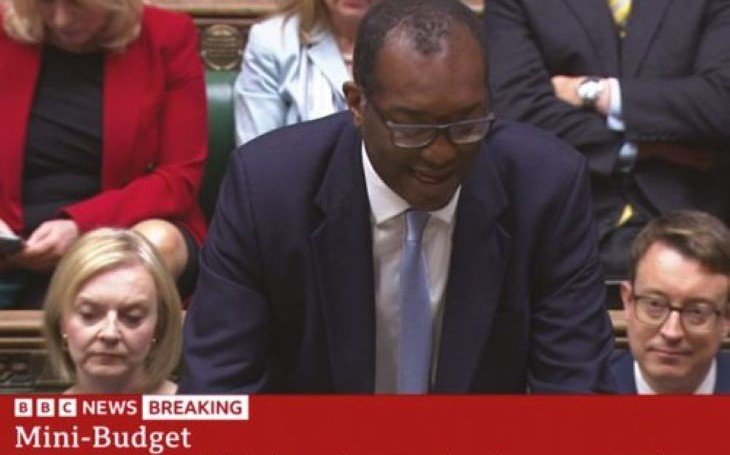

The mortgage market is now becoming as turbulent as it was following the Liz Truss mini-Budget, which saw loan rates jump dramatically, according to Moneyfacts.
The data comparison firm says there are worrying trends among mortgage offers that resemble the disastrous effects of the infamous mini-Budget in 2022 delivered by Chancellor Kwasi Kwarteng (main picture).
War in the Middle East is threatening to drive up inflation and put pressure on the Bank of England to raise interest rates when its decision-makers meets next week.
Recent days have been some of the most turbulent in the UK mortgage market since the aftermath of the September 2022 mini-Budget.”

Adam French, Head of Consumer Finance at Moneyfacts, told the BBC: “Recent days have been some of the most turbulent in the UK mortgage market since the aftermath of the September 2022 Mini-Budget.
“It’s unwelcome news for borrowers, as the prospect of falling mortgage rates has quickly given way to rate rises,” he says.
“How far they could go is now heavily dependent on how global markets and inflation expectations evolve as conflict in the Middle East unfolds.”
Collapse
Experts are also pointing to the collapse of the mortgage lending firm Mortgage Financial Solutions (MFS) last month as a factor adding to the uncertainty.
The average rate on two-year fixed mortgages has risen above 5% as lenders react to the economic jitters.
And there are reports that up to 500 mortgages have been withdrawn, which is the most since 2022.
Widespread confusion
Meanwhile, the HomeOwners Alliance is warning that millions of first-time buyers are being “held back by widespread confusion” about mortgages.
Misunderstandings about the criteria used to assess potential loans means many homebuyers are not applying for mortgages, the Alliance says.
Its research found that 65% believe having bad credit means you cannot get a mortgage, while 62% think you need at least a 10% deposit to buy a home.
At the same time, 49% believe the maximum they can borrow is limited to four to five times their income, 47% believe the lowest interest rate automatically means the cheapest mortgage overall, and 40% believe it is best to get a mortgage with their current bank.
In addition, 25% think you cannot explore mortgage options until you have found a property.

Paula Higgins, CEO at the HomeOwners Alliance, says: “Too many first time buyers are putting themselves out of the running before they have even had a proper conversation with mortgage experts about what might be possible.
“Misunderstandings about deposits, borrowing limits and how mortgages work are denting confidence at the very first hurdle.”