
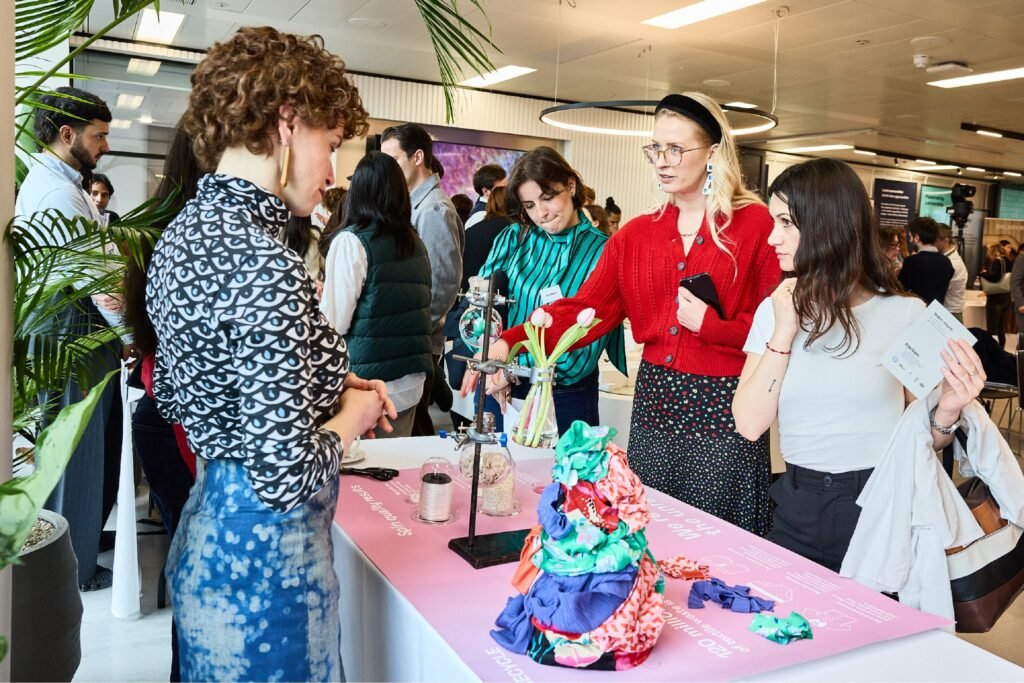
Fashion industry leaders, investors and founders joined eleven of the UK’s top innovators at Imperial to discuss what is needed to get the best fashion and textile innovations out of the lab and into wardrobes: long-term investment, and the support to stay, scale and manufacture in the UK.
With fluctuating oil prices making polyester production costly, climate change harming cotton production, and a raft of sustainability regulations coming into force, fashion industry leaders – including fashion designer and Vogue Business Young Creator Award Winner Genaro Rivas – predict science and technology will come to the rescue of the global fashion industry, with Britain poised to benefit.
From bio-sequins inspired by beetle wings, and 18 carat gold jewellery made from electronics, to vivid dyes made from algae – UK sustainable fashion technology has “never been more ready to drop in to supply chains, and be adopted by big brands”, according to fashion investor and CCO of Imperial spin-out DyeRecycle Irene Maffini.

The panel of experts, which included fashion designer Genaro Rivas, fashion investor Irene Maffini, Julian Ellis-Brown, CEO of Ponda and James McDonald, CEO of Solena Materials, were speaking at a sustainable fashion showcase held at Imperial’s White City campus.
“We can reclaim Britain’s proud heritage in the textile industry by embracing frontier technologies that are both disruptive and sustainable.” Professor Mary Ryan Vice-Provost (Research and Enterprise) at Imperial
The campus is rapidly becoming a hub for sustainable fashion innovation and is at the heart of the White City Innovation District, a cluster of the WestTech London ecosystem.
Imperial staff and students have created 17 sustainable fashion startups and spinouts in the last five years – many supported by Undaunted – a hub for the UK’s climate innovation community.
Professor Mary Ryan, Professor of Materials Science and Vice Provost at Imperial College London, chaired the panel discussion and emphasised the need to stop the UK’s best innovators in this space going elsewhere to scale up.
She said: “We can reclaim Britain’s proud heritage in the textile industry by embracing frontier technologies that are both disruptive and sustainable. We’re entering an era where vats of bacteria can be designed to synthesise planet-friendly textiles, new chemical and biological tools are capable of breaking down existing fashion waste into the molecular building blocks for new materials, and CO2 is being removed from the atmosphere and turned back into valuable products. If we are smart about supporting the ecosystem all the way up the value chain then the UK economy can reap the benefits.”
To help keep startups staying and scaling in the UK, Imperial last month unveiled a first-of-its-kind facility for pilot and demonstration advanced manufacturing in West London.
Here, Imperial spin-out Solena Materials is developing novel materials using computational design. Solena Materials CEO and co-founder Dr James MacDonald said: “From the Stone Age to the Silicon Age, civilisation has always followed breakthroughs in the materials we can make. At Solena, we’re using AI to design entirely new textile fibres—materials that outperform existing options while being manufacturable from non-petroleum feedstocks. Solena exists to restart fibre innovation after decades of stagnation and to give the textile industry a material platform that can finally compete with incumbents on performance, scalability and impact.”

Part of the Imperial-led innovation ecosystem WestTech London, the new facility – Grapht Works – will also be home to Epoch Biodesign, a startup using breakthrough AI-engineered enzyme technology to recycle previously unrecyclable nylon textiles. Lululemon and Leitmotive (a Volkswagen-backed Venture Capital firm) were part of the company’s recent £9m investment round, and the company have just signed an MoU partnering with INVISTA, the world’s largest manufacturer of nylon.
Irene Maffini predicted a second wave of companies emerging from the UK, after what she described as the “hype and then heartbreak of US-based overvalued companies”. Maffini said: “Investors have had their fingers burnt. But British companies have watched and learnt – the alternative materials they’re developing are genuine replacements to climate-destroying products like leather, cotton, fur, and polluting dyes.“ With sustainability regulations coming into force across the EU and UK, and current geopolitical events making oil-derived textiles much less appealing, there are shrewd investments to be made in alternative next-generation materials.”
London-based Peruvian fashion designer and Visa x Vogue Business Young Creator Award Winner Genaro Rivas – who has used plant-based alternatives to leather and fur in his most recent London Fashion Week collection – said: “Innovation in fashion only matters if it reaches people. Designers play a key role in translating new materials into something desirable, accessible and culturally relevant. That’s how sustainability can truly scale.”

One example is Genaro Rivas’ recent collaboration with Imperial start-up Ponda, where they explored the use of BioPuff® – a plant-based alternative to traditional insulation materials, within a fashion context, bridging innovation with real-world application.
Forbes-30-under-30 entrepreneur Julian Ellis-Brown co-founded Ponda while studying at Imperial in 2020. Ponda is a biomaterials company transforming bullrushes grown on UK regenerated wetlands into new insulative materials for fashion. Ponda’s plant-based insulation BioPuff® has already been used in collaborations with brands Stella McCartney and Berghaus, and Ellis-Brown says could be a solution for the 280,000 hectares of peatlands the government plans to regenerate by 2050. He said: “UK farmers are often on the cutting edge of innovation – just two weeks ago we were seeding new wetlands in Cumbria using our drone-compatible pellets. “With more financial backing we could scale our wetland regeneration to other areas of the UK – returning crucial natural habitats for local wildlife, supporting the agricultural industry, and making fashion more sustainable.”
Ellis-Brown’s latest step moves beyond materials and into garments, with a Ponda x Imperial College London collaboration in development, hoping to launch later this year. The collaboration is part of the university’s Sustainable Imperial initiative aiming to lead in the global fight against climate change, biodiversity loss, and pollution – through research, education, operations, and community action.
Also on show at the Imperial event were products already commercially available – including Petit Pli’s children’s and maternity clothes, inspired by satellite folding, that grow with children and baby bumps, and Incador’s fine jewellery designed and crafted from discarded electronics:
Petit Pli garments are currently on sale at a pop-up shop in Harrods, and Incador have just expanded into bespoke engagement rings. Their designs have been worn by British celebrities including Sophie Habboo and Melissa Tattam.
Incador will be speaking at Arnold Schwarzenegger’s Austrian World Summit in June about the urgent issue of electronic waste and the untapped value sitting in discarded devices.
Other start-ups showcasing at the event included:
- Biodegradable sequin company Sequinova, who are commercialising with Stella McCartney for their Spring Summer 2027 collection, as well as other luxury brands, recently received a £500,000 Innovation UK grant for scaling bioengineered proteins and pigments in the UK. They will be exhibiting at Future Fabrics in Brussels on the 24-25th June.
- PulpaTronics which manufactures affordable and metal-free RFID tags for retail inventory tracking in Bermondsey, and has begun sampling its tags with global retailers. They are currently looking for brands to join their pilot program. They kicked off their £1.5m raise in March 2026 and already have £800k in soft commitments.
- Brilliant Dyes – a company making algae-based natural dyes – who have secured ~£500,000 through awards and grants, 5 LOIs from textile and fashion industry partners, and are progressing toward paid pilot trials to commercially validate their natural dyes and fixation technology with global sustainable fashion brands. They have developed a strong team and will soon open their pre-seed investment round.”
- Fibe – who make clothes from potato harvest waste – and have recently been awarded a £3M Green Future Fellowship Award from the Royal Academy of Engineering, which they are using to build a Pilot Production Facility in the UK to demonstrate their technology at industrial scale.
- Radiant Matter – a material innovation company, developing a new generation of sparkling colour and material solutions for the circular economy. They have previously collaborated with Stella McCartney.
- DyeRecycle – is testing and scaling its fibre decontamination technology in partnership with the UK’s first polyester recycling plant, Project Re:claim, a joint venture between Salvation Army Trading Company (SATCoL) and Plan B Recycling Technologies. The collaboration removes dyes and coatings from clothing to prevent them being disposed of, recycling into industry- grade materials ready to be remade into new garments.