
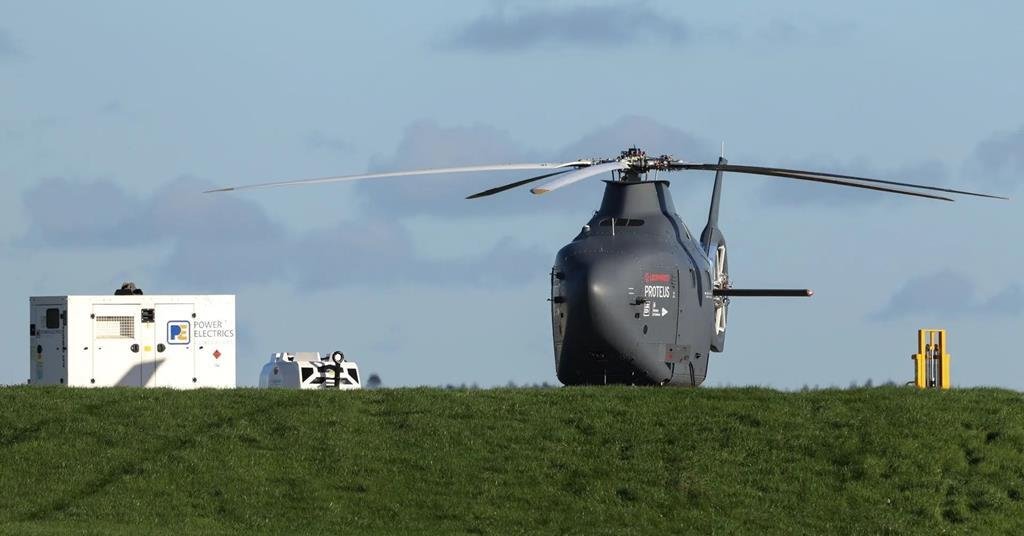
UK defence procurement officials are considering investing hundreds of millions of pounds to fund the development of two Proteus uncrewed concept demonstrators for the Royal Navy’s (RN’s) 700X Naval Air Squadron.
These would be similar to the current Proteus technology demonstrator prototype – due to fly in the coming weeks – which is based on the Leonardo Helicopters AW09 light-single, a 3t maximum take-off weight helicopter.
FlightGlobal understands funding for the two concept demonstrators, including support, is likely to be announced by the Ministry of Defence (MoD) as part of its imminent Defence Investment Plan (DIP), according to a source familiar with the matter.
Publication of the DIP is scheduled before year-end, following the UK government’s budget statement on 26 November.
If confirmed, the funding for further Proteus assets would mark a significant acceleration of the RN’s Maritime Aviation Transformation Strategy (MATx), which seeks a shift to unmanned platforms for most missions.
It would also show a marked increase in the financial commitment for such activities: development of the current Proteus technology demonstrator prototype is being performed under a four-year contract worth £60 million ($79 million).
While the Proteus demonstrator has yet to fly, consideration is already being given on how to transition technologies to a fieldable aircraft.
That platform will have to be considerably larger than the 3t Proteus – likely in the range of 5t or more – to accommodate higher power requirements, an anti-icing system, a defensive aids suite and, crucially for embarked operations, landing gear. The current prototype features only skid-gear.
It is unclear whether the manufacturer would pursue a clean-sheet design or instead use an existing helicopter in its range, like its 4.8t AW169 medium-twin, as the basis for an uncrewed asset.
Leonardo says the Proteus effort has already “generated considerable evidence” informing the UK government’s Strategic Defence Review, published in June, and the MATx strategy.
“Leonardo eagerly awaits the conclusion of the Defence Investment Plan to confirm the MoD’s priorities for future defence procurement,” it says.
Leonardo says that Proteus “was conceived to prove the viability of large autonomous VTOL [vertical take-off and landing] uncrewed systems through a low‑risk, cost‑effective 3t platform, with scalability built in from the start.”
Critical to achieving that goal is “Leonardo’s autonomous functionality” which is, it says, “transferable across both crewed and uncrewed platforms of varying weight classes”.
“Should the Royal Navy require a heavier Proteus‑derived system, Leonardo has the understanding, expertise and experience to deliver,” it adds.
The MoD did not respond to FlightGlobal’s request for comment on its plans, however.
The uncrewed asset would be designed to take over many of the tasks, including anti-surface and anti-submarine warfare, currently performed by the RN’s crewed helicopters like the Leonardo Helicopters Wildcat HMA2 and AW101 Merlin HM2.
Both types will soldier on until 2040, but the MoD and RN appear to be prioritising the development of autonomous uncrewed systems over work on future manned assets.
Meanwhile, both Leonardo and Lockheed Martin continue risk-reduction studies under contracts awarded in June to address obsolescence issues with the Merlin HM2 and HC4/4A fleets.
Development of solutions to address those issues will inform the final business case (FBC) needed to move to a design and manufacture contract.
Although the FBC is expected to be approved in 2027, its scope is so far uncertain, leading to speculation it may focus solely on avionics and system updates rather than more costly airframe issues.
Similarly, Leonardo says it “continues to discuss with the MoD” how the Wildcat “will continue to provide the Royal Navy with a versatile strike and reconnaissance capability from frigates and destroyers into the 2030s and 2040s.”
The MoD did not respond to questions on its long-term plans for the Merlin or Wildcat helicopters.
“Leonardo continues to work closely with the MoD assessing options for the continued sustainment and enhancement of its crewed aircraft fleets,” the company adds, highlighting the development of capabilities like autonomy and crewed-uncrewed teaming which “promise to enhance the effectiveness of crewed aviation for years to come”.