
Unlock the Editor’s Digest for free
Roula Khalaf, Editor of the FT, selects her favourite stories in this weekly newsletter.
Senior figures in the UK military have called on Sir Keir Starmer to solidify his ambitions to raise defence spending, amid concerns that his cash-strapped government is deferring tough choices on funding the armed forces.
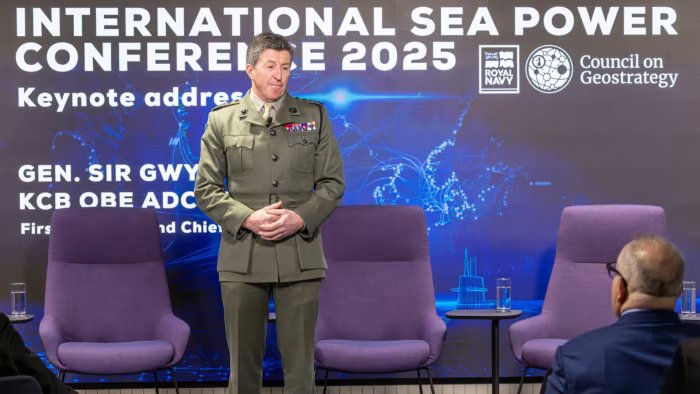
General Sir Gwyn Jenkins, the First Sea Lord and head of the Royal Navy, told a conference that the UK and Nato’s “opponents are investing billions” and warned that the western alliance’s dominance of the Atlantic was under threat from Russia and other rivals.
“The advantage that we have enjoyed in the Atlantic since the end of the second world war is at risk. We are holding on, but not by much. There is no room for complacency,” Jenkins told the International Sea Power Conference.
“Our would-be opponents are investing billions. We have to step up, or we will lose that advantage.”
Others, speaking under Chatham House rules during panel discussions at the event, were more pointed, saying that the UK government had to “bloody commit” to a Nato pledge to raise members’ defence spending to 3.5 per cent of GDP by 2035.
“When I hear senior political leaders, heads of state and government, commit to spend 3.5 per cent of GDP by 2035, I want to see it programmed,” said one senior military commander. “If we do commit, let’s bloody commit.”
Relations between the armed forces and government have been strained in recent weeks as the Ministry of Defence attempts to deliver its Defence Investment Plan ahead of Christmas, which will map out long-term investments in equipment to modernise the military.
The DIP is designed to flesh out the UK’s Strategic Defence Review, which was announced this summer and predicated on defence spending rising to at least 3 per cent of GDP.

Starmer has repeatedly said that defence and security is the government’s first priority. The prime minister slashed the UK’s overseas aid budget to boost defence spending to 2.5 per cent by 2027 from about 2.3 per cent in 2024.
Chancellor Rachel Reeves’ Budget last month mapped out government spending plans to 2030-31, but there was no reference to how defence spending might increase after hitting 2.5 per cent in 2027.
The Office for Budget Responsibility said that increasing defence spending to 3.5 per cent of GDP by 2035 would cost an additional £32bn a year, well above the extra taxes Reeves already raised in her Budget.
“It was disappointing not to see anything at all in the recent Budget,” one senior military commander told the Financial Times on Monday.
The FT reported last month that the heads of the armed forces were at loggerheads over how defence spending should be divvied up under the DIP, with the Royal Navy and Royal Air Force favouring plans prioritising homeland defence and countering Russia in the north Atlantic over boosting the army.

The MoD launched its Atlantic Bastion plan on Monday to counter Russian submarine activity in the region.
People familiar with the discussions say the services are now attempting to present a more united front and are working on strategies to secure greater funding from the Treasury.
One senior commander told a panel that he wanted to see the 3.5 per cent commitment cemented into the DIP as well as the government’s defence industrial strategy.
“If I don’t see it in any of those documents, if it’s just a thing, then I’m afraid it’s not nearly strong enough to give our military leaders back here in the UK the confidence that they can work with industry,” the senior commander said.
James Murray, chief secretary to the Treasury, spoke at the conference on Monday and said the department “stands ready to support the First Sea Lord and the defence secretary” in their plans to modernise the armed forces.
He referred to the “government’s ambition” to hit 3 per cent of defence spending in the next parliament, not the 3.5 per cent in core defence spending pledged to Nato by 2035 to help address criticism from US President Donald Trump.
Shortly after Murray’s speech he left the conference hall with Jenkins for a private meeting.