
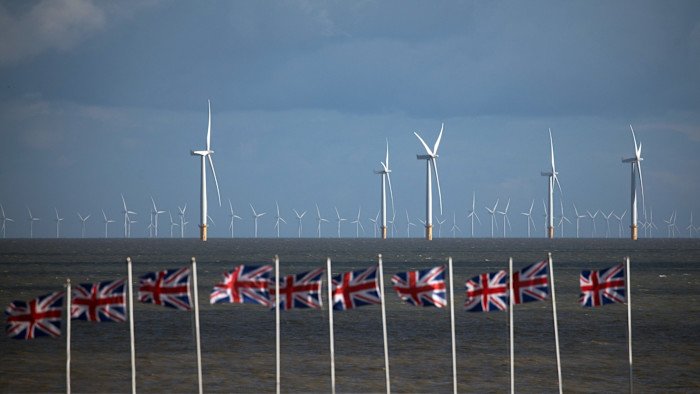
The UK has handed out record subsidy contracts for offshore wind projects as the government increased the price it was willing to guarantee developers as part of its drive to decarbonise the power system by 2030.
Officials said on Wednesday they had awarded “contracts-for-difference” to 8.2 gigawatts of fixed-bottom offshore wind projects and 192MW for newer floating offshore wind, in what they called Europe’s “biggest ever” offshore wind auction.
One gigawatt of offshore wind in Britain can typically supply enough electricity for the equivalent of 1mn homes. The result is a boost for the sector despite cost and supply chain challenges in recent years.
The prices guaranteed to developers in this auction round range from £89-£91 per megawatt hour for fixed-bottom offshore wind to £216 per MWh for floating offshore wind. The current wholesale price is between £80 and £90 per MWh.
The prices for fixed-bottom offshore wind are about 11 per cent higher than last year, and roughly 75 per cent above prices awarded in 2022. Some of the 2022 contracts resulted in developers pulling out or rebidding for more money.
Under the contracts, electricity users pay wind farm owners the difference between the guaranteed price and the prevailing wholesale price. If the wholesale price is higher than the guaranteed price, developers have to pay back the difference.
The government was able to increase both the prices guaranteed to developers and the number of wind farms awarded contracts after it raised the annual budget in this auction for fixed-bottom offshore wind projects to £1.8bn a year, up from £900mn when it first announced the auction terms in October.
The budget reflects official estimates of the levies that could be added to energy bills, although the actual costs will depend on future wholesale prices.
Chris Stark, the civil servant who leads the government’s efforts to decarbonise the power system by 2030, said the results meant the UK should have roughly 36GW of offshore wind operating in the next four years, putting it on track to meet the 2030 goal.
“There’s been a lot of scepticism about the goals that we set, but I’m very pleased that we stuck to our guns,” he told reporters.
It follows a failed auction in 2023 when no offshore wind developers made bids for contracts, saying the level of financial support on offer from the government was not enough to mitigate rising supply-chain costs.
Ben Backwell, chief executive of the Global Wind Energy Council, a trade group, said the industry was “back with a bang” and that the projects would bring “billions of pounds of investment to the UK”.
However, critics are likely to question the cost of the technology in this year’s round. As well as the prices being higher than last year’s round, the length of the contracts, which are inflation-linked, has been extended from 15 to 20 years.
Claire Coutinho, Conservative shadow energy secretary, said the auction would lead to “the highest offshore wind price in a decade. Ed [Miliband] will try to spin that this is cheap. It is not”.
She added that the energy secretary was “cementing our uncompetitive electricity prices for even longer at a time when the world is becoming more unstable and we need cheap, reliable energy to compete”.
Labour pledged during the 2024 general election campaign to bring down household energy bills if it won power. The government on Wednesday said the new wind farms would be cheaper than new gas-fired power plants.
Richard Tice, deputy leader of Reform UK, which is leading in national opinion polls, signalled that the populist party was prepared to cancel the contracts if it won the next election.
“Reform UK is again warning developers, investors and lenders that any new renewables projects from hereon will not be recognised as valid,” he said on X.
Stark, from the UK government, said he was “pretty confident” the auction round would “bring bills down overall . . . the crucial point is we are displacing expensive gas”.
Ahead of the auction, energy consultancy Aurora said in a report that contracts could be awarded at a guaranteed price of up to £94 per MWh without pushing up bills, since the new wind farms would push down wholesale prices.
The analysis, commissioned by German energy company RWE, assumed a fall in gas prices between 2026 and 2028, before a sharp increase between 2029 and 2035.
RWE dominated the auction, winning contracts for its Dogger Bank South and Norfolk Vanguard projects. The group said it would sell a 50 per cent stake in its Norfolk Vanguard project to KKR and jointly develop the wind farms.
One 1.4GW phase of UK energy company SSE’s mammoth 4.1GW Berwick Bank project off the Scottish coast also succeeded in the auction.
Martin Pibworth, SSE chief executive, said the contract “enables us to advance the project towards a final investment decision”.
Gillian Martin, Scotland’s energy secretary, welcomed awards to two Scottish projects but said it was “a missed opportunity” to secure more projects north of the border.
She said higher transmission costs for Scottish projects had left them at a competitive disadvantage and called on the UK government to reform the system ahead of the next auction, due to take place later this year.
This story has been amended to clarify prices for fixed-bottom offshore wind relative to 2022
Climate Capital

Where climate change meets business, markets and politics. Explore the FT’s coverage here.
Are you curious about the FT’s environmental sustainability commitments? Find out more about our science-based targets here