
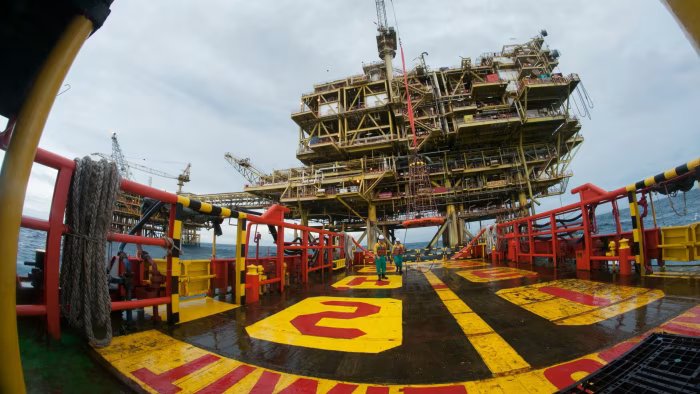
About £15bn of potential investment in North Sea oil and gas production is at “very high risk” of being cancelled after the UK government decided to retain windfall taxes in the sector, analysts have warned.
Chancellor Rachel Reeves disappointed executives by keeping the 78 per cent headline tax rate until 2030, leaving many considering whether to focus on opportunities elsewhere.
“The Budget has provided certainty — companies now have a decision to make,” said Gail Anderson, research director at Wood Mackenzie, which estimated the figure in a report last week. Wood Mackenzie said that along with “falling prices and increasing global competition for upstream investment”, retaining the energy profits levy could wipe out non-essential UK investment.
Harbour Energy, the UK’s largest producer in the North Sea, on Monday said it would cut 100 of its roughly 700 offshore workforce. This brings the overall number of job losses at Harbour to 700 since 2023.
Scott Barr, managing director of Harbour’s UK business, said keeping the profits levy meant the company would “struggle to compete for capital within our global portfolio”.
As well as its decision to retain the headline 78 per cent tax rate in place until 2030 at the latest, the government said it would push ahead with its plan to ban new oil and gas exploration licences.
It added that new drilling in fields connected to existing pipes and rigs would be allowed, prompting a slight increase in 2029 production estimates from the North Sea Transition Authority, the industry regulator.
However, several executives argued that taxes still needed to be lowered.
“This is like saying, you can buy this house, but the interest rate will be 30 per cent,” said one Aberdeen-based executive. “None of this matters if investors’ confidence is shot.”
David Whitehouse, chief executive of Offshore Energies UK, the trade group, added: “The fundamental issue is that the UK continental shelf is not attracting investment — and the fundamental issue is the windfall tax.”

Not all companies greeted the Budget with such gloom: Serica Energy, one of the North Sea’s largest gas producers, said while it was a “missed opportunity” to unleash investment, it had delivered “greater clarity” and the company had “multiple, and material, organic growth options”.
However, executives in Aberdeen said the Budget contributed to growing doubts about the economic viability of the North Sea under the UK government’s regulatory and fiscal regimes.
The North Sea has helped fuel Britain for decades and filled the government’s coffers with tax receipts, but is well past its heyday.
Production of oil and gas is at its lowest levels since the 1970s, while direct jobs have fallen by about a third over the past decade.
NSTA estimates production will fall about 54 per cent between 2021 and 2030, to 33.42mn tonnes of oil equivalent. The UK’s National Energy System Operator warned last week about the prospect of gas shortages in the 2030s.
The government, which says the basin is in “natural decline”, wants to shift rapidly towards lower-carbon energy, which it argues is more secure as it is less exposed to international markets.
But many in industry argue the North Sea’s decline is being accelerated by government policy and that the UK should not be strangling its own production.
Oil and gas still supply about 75 per cent of Britain’s total energy, despite government efforts to develop more wind farms and push people towards electric cars and heat pumps.

John Swinney, Scotland’s first minister, warned of the “deeply damaging” prospects for employment and sought to blame the leader of Scottish Labour, Anas Sarwar, for the decisions made in the Budget.
“There are going to be job losses in north-east Scotland that Anas Sarwar is going to be responsible for,” he said, speaking at first minister’s questions last week.
Reeves and her team considered bringing forward the end of the levy by one year but sought assurances from the industry that the move would unlock extra investment.
However, in the end the chancellor concluded the move would not be a “net positive” for the exchequer. One person briefed on the discussions said: “They made the case but we ended up not doing it.”
Speaking after the Budget, Sarwar said he had argued for a balanced approach in the North Sea, but that Reeves had prioritised ending the two-child benefit cap, in the hope of lifting 450,000 children across the UK out of poverty.
“If others want to suggest that oil and gas giants should get a tax cut and not put money into reducing energy bills and child poverty — that’s a real hard argument to make,” he told reporters in Holyrood.
The UK government says it is committed to a “fair” transition, announcing plans last week for a “North Sea Jobs Service” to help workers find work.
The Office for Budget Responsibility expects to make £2.7bn from the North Sea tax receipts this year, 41.4 per cent less than in 2024-2025, due to lower oil and gas prices as well as producers merging to combine their tax losses.
In 2030-2031 when the windfall tax is due to end, it expects to raise only £300mn from the basin.
The windfall tax was put in place in 2022 by the Conservative government as oil and gas prices soared after Russia’s full-scale invasion of Ukraine, and was later increased and extended by Labour.
It will fall away automatically before 2030 if oil and gas prices drop below a certain threshold.
Ryan Crighton, policy director at Aberdeen & Grampian Chamber of Commerce, said it was a “national scandal” that the levy was still in place even though prices had eased.
“People need to wake up to the huge ramifications this will have for our energy security,” he added.
Additional reporting by George Parker
This article has been updated to clarify that the windfall tax will be in place until 2030 at the latest