
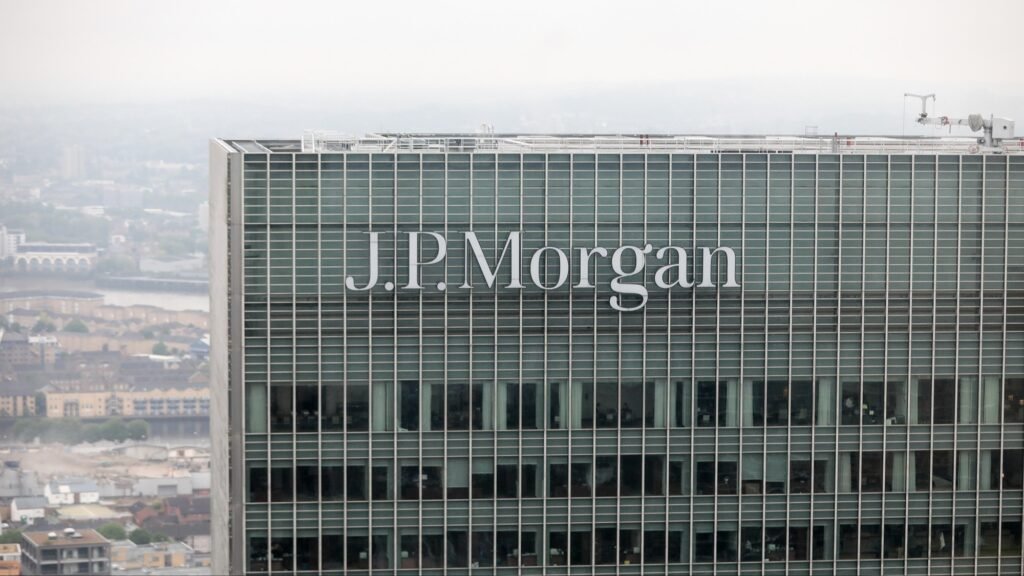
Banks and analysts have welcomed JPMorgan’s announcement that it is bringing its $1.5tn security and resilience investment initiative to the UK, with Italian lender UniCredit saying it would support similar initiatives in Europe. Banks say it could “embolden” rivals to follow suit and speak more openly about financing the defence sector.
Last week, the US investment bank announced that its 10-year plan to facilitate finance and investment in strategic areas such as defence and aerospace, energy independence and supply chains for critical minerals and advanced manufacturing, would also be rolled out in the UK.
The initiative, which was first launched in the US in October, will see JPMorgan make direct equity and venture capital investments, with further details to be announced soon.
Some expressed concern at the “outsized influence” such an initiative could give the Wall Street lender in matters related to national security interests. However, banks are largely supportive of the JPMorgan resilience and security initiative, with Italian lender UniCredit saying it would support similar plans in Europe.
“Broadly speaking, initiatives like this are a welcome development, bringing more focus to the private-equity/pre-IPO phase of financing,” said Ronan McCullough, head of equity syndicate at UniCredit, adding that it is “actively engaged” in connecting early-stage and late-stage private investors with companies in the aerospace and defence sector.
According to McCullough, private capital investors are looking closely at the defence and defence-tech sectors as there is a clear need to foster and support new companies and technologies.
Nick Leitch, managing partner at UK boutique investment bank Heligan, said the move by JPMorgan will inevitably “encourage and embolden other institutions to follow in a similar manner”.
Other major Wall street lenders, like Citigroup and Goldman Sachs, as well as leading European players like UBS and BNP Paribas, could potentially follow JPMorgan’s move, he said. “All of these [organisations] have investment exposures in public markets, so moving to an approach akin to JPMorgan’s would not be radical,” said Leitch.
His comments were echoed by Arnaud Journois, senior vice-president for European financial institution ratings at Morningstar DBRS, who said JPMorgan’s security and resilience initiative could encourage European banks to provide more equity, rather than debt financing, for European defence companies.
According to Dealogic, since 2022, corporate bonds have far outstripped equity and capital market transactions for European defence firms, based on deal value. However, ECM deals have gained ground since 2023, with US banks making up just over 30 per cent of these transactions.
Leitch distinguishes between large international investment banks like JPMorgan, and more local UK and European lenders, which he says typically provide debt facilities rather than making or undertaking equity investment strategies.
He said UK banks had long supported defence sector businesses with debt facilities but had done so on a “discreet basis”, mainly due to reputational risk and concerns relating to ESG strategies which have gained more prominence in board and shareholder agendas and influenced credit and lending policies.
Since Russia’s full-scale invasion of Ukraine in 2022, European lenders have also come under pressure to amend their lending and exclusion policies as part of a broader EU drive to re-arm Europe.
According to Journois, a number of large European banks are scaling up their defence teams to support governments’ investment strategies for the sector. However, he said few firms are willing to talk about this openly. “JPMorgan’s announcement could not only trigger more investment, but also encourage European banks to be less discreet about their activities in the defence sector,” he said.
While other institutions might follow JPMorgan’s lead, Frédéric Ducoulombier, who heads climate regulation and policies at the EDHEC Climate Institute, warned about the risks of lenders gaining “outsized influence” in strategic resilience investment, particularly at a time when governments are “fiscally constrained”.
“As we enter a decade defined by massive resilience and climate transition needs, the question is not only whether private capital will step in, but also on what terms and with what safeguards,” he posted on LinkedIn.
To restore fiscal and budgetary space to protect governments when negotiating with financial institutions over the public investments that must remain on their own account, Ducoulombier said states must ensure that regulation and procurement encourages firms to strengthen their own resilience.
This article has been updated since publication to include comments from UniCredit