
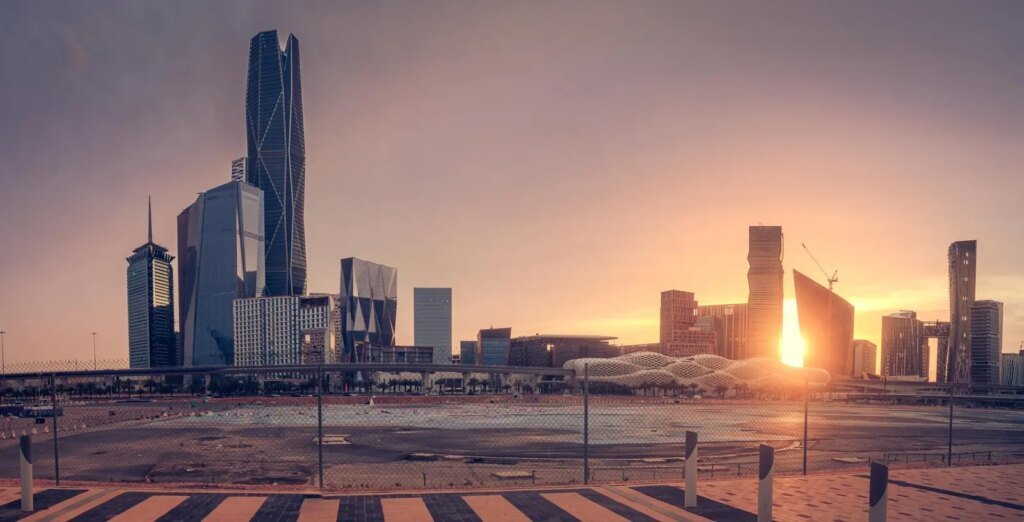

Professionals in Riyadh’s King Abdullah Financial District gain new options under Saudi Arabia’s 2026 property reforms.
getty
Saudi Arabia’s Royal Decree M/14, effective January 21, 2026, permits foreign ownership in zones yet to be specified—a reform that arrives as Dubai’s property market navigates its first significant supply adjustment in a decade. The timing reflects deliberate positioning. The framework indicates Saudi Arabia is pursuing a distinct investor demographic rather than replicating Dubai’s model.
The decree replaces the 2000 framework, allowing non-Saudi individuals, companies, and funds to acquire ownership, usufruct, or easement rights in areas designated by the Real Estate General Authority. A SAR 30 million ($8 million) minimum investment applies for certain activities, with notarization barred for non-compliant transactions. This matters because Dubai’s residential prices—having climbed 60 per cent from 2022 to early 2025—now face what Fitch forecasts as a double-digit correction, potentially 15 per cent, driven by 210,000 units entering the market in 2025-2026.
The strategic question is not whether Saudi Arabia can attract property investment, but which investor segments its framework serves. The decree’s structure—higher investment thresholds, designated zones, cultural alignment—targets Muslim families, GCC nationals, and investors prioritizing religious proximity alongside returns, rather than the globally mobile cosmopolitan capital that drove Dubai’s four-decade expansion.
Two Markets, Two Strategies
The reform exploits Dubai’s cyclical pressures. Dubai’s average prices reached AED 1,683 per square foot in October 2025, doubling over five years, with prime Palm Jumeirah villas exceeding SAR 73 million. First-half 2025 transactions hit 125,538—strong volumes that now face supply rebalancing. Riyadh’s central properties at $2,664 per square meter offer a nominal 65 per cent discount to Dubai’s $7,602, though direct comparisons require adjusting for market maturity, infrastructure depth, and target demographics.
Saudi real estate supported first-quarter 2025 FDI inflows of SAR 22.2 billion ($5.9 billion, up 44 per cent year-on-year), contributing 5-6 per cent to non-oil GDP, with transactions reaching $29 billion according to CBRE. These figures demonstrate Vision 2030’s progress in diversifying economic foundations beyond hydrocarbon revenues—a structural transformation that property market development supports.
The premium residency program requires SAR 4 million property investment—double the UAE’s AED 2 million Golden Visa. This pricing reflects Saudi Arabia’s positioning toward higher-net-worth individuals who value cultural familiarity and religious significance. Knight Frank’s 2025 survey documents 82 per cent interest among global Muslim high-net-worth individuals with $4.7 million average budgets—Makkah commanding 30 per cent, Riyadh 25 per cent, Madinah 19 per cent. The $2 billion potential from this cohort represents a defined market segment rather than competition for Dubai’s broader international flows.
Henley’s migration projections estimate 9,800 millionaires relocating to the UAE in 2025. Saudi Arabia’s opportunity lies in Muslim-majority source markets—India’s projected 3,500 high-net-worth individuals controlling $26 billion—who seek cultural alignment alongside investment returns. Both Gulf markets can expand simultaneously by serving complementary demographics.
Geopolitical Context Supporting Regional Investment
The post-2023 Iran-Saudi normalization, facilitated by Chinese mediation, has contributed to regional stability improvements. Houthi maritime attacks declined from 150 in 2024 to seven in 2025 following September’s Gaza ceasefire. While Red Sea traffic patterns shifted—share declining from 12 per cent to 9 per cent—Egypt’s Suez revenues showed resilience with 14 per cent July-October 2025 growth, indicating adaptation rather than permanent diversion.
Regional connectivity investments—Saudi Arabia’s Landbridge rail project, UAE’s expanded port capacity—support both markets’ long-term growth regardless of temporary volatility. The UAE’s 2025 Year of Community and 2026 Year of Family initiatives emphasize cultural values alongside economic openness, demonstrating that Gulf markets can maintain distinct identities while competing for capital.
Implementation Timeline and Regulatory Clarity
Saudi Arabia’s mega-projects—NEOM’s sustainable city vision, Qiddiya’s entertainment sector development, Red Sea tourism zones—represent ambitious timelines compressing decades of infrastructure development into accelerated schedules. These projects target 2030-2035 completion horizons, creating medium-term rather than immediate property investment opportunities as infrastructure and amenities develop.
Transparency reforms include SAR 10 million fines for registry violations and auction remedies for non-compliance, strengthening enforcement mechanisms. Dubai’s four-decade head start in developing property market infrastructure—transparent registry systems, established mortgage markets, mature legal frameworks—provides operational advantages that Saudi Arabia’s systems are building. Both approaches serve investor preferences: Dubai optimized for transaction speed and international standardization; Saudi Arabia targeting investors who value sovereign oversight and cultural alignment.
Zone designations and approval processes await implementation regulations expected in early 2026, which will clarify geographic scope and sectoral focus. This regulatory development period is standard when reforming established frameworks—the Real Estate General Authority’s capacity will be demonstrated through execution rather than announcement.
The Kingdom’s reforms—cinema licenses, entertainment districts, mixed-gender professional environments—advance Vision 2030’s objectives while maintaining cultural distinctiveness. Saudi Arabia’s property market explicitly prioritizes family-oriented, culturally rooted development over purely cosmopolitan positioning. These represent different strategies rather than incomplete execution: investors should assess which demographic their capital serves.
What the Investment Data Indicates
Property markets reflect governance approaches and target demographics. Dubai’s supply correction, while creating near-term price pressure, occurs within a framework refined over four decades—investors understand transaction processes, rely on established legal precedents, and access deep mortgage markets. Saudi Arabia’s reform operates within a newer institutional architecture where regulatory clarity will emerge through implementation practice.
The realistic scenario involves market segmentation: GCC nationals and regional investors allocating across both markets for diversification; Muslim-majority international investors prioritizing Saudi Arabia for religious-tourism exposure; globally mobile institutional capital maintaining Dubai positions while monitoring Saudi execution. Track CBRE’s quarterly assessments, zone designation announcements, and Iran-Saudi diplomatic stability for investment timing signals.
Developers targeting King Abdullah Financial District or Riyadh’s diplomatic quarter benefit from clearer regulatory precedents than early-stage mega-projects. Investment phasing should match infrastructure completion timelines—NEOM and Qiddiya will deliver returns over 2030-2035 horizons as amenities and connectivity mature.
The Strategic Framework
Royal Decree M/14 represents Saudi Arabia’s deliberate positioning toward investor segments valuing religious proximity, cultural familiarity, and GCC regional exposure. This complements rather than directly competes with Dubai’s cosmopolitan market—both can expand by serving distinct demographics. The reform will capture its defined segments: religious-tourism property, GCC national diversification, Muslim family-oriented developments, and patient capital accepting longer implementation timelines for participation in Vision 2030’s infrastructure buildout.
Investment success requires matching capital timeframes to project execution phases. Near-term opportunities exist in established Riyadh districts with clear zoning; medium-term positions suit mega-project participation as infrastructure develops; long-term allocations align with Saudi Arabia’s 2030-2035 economic diversification trajectory. Both Gulf markets offer distinct risk-return profiles serving different investor priorities—the question is not which market succeeds, but which market serves your capital’s objectives.
Dubai provides liquidity, transaction speed, and four decades of operational precedent. Saudi Arabia offers religious significance, cultural alignment, and early-stage participation in a multi-decade infrastructure transformation. Sophisticated portfolios can allocate to both, recognizing that Gulf property markets are expanding the investable universe rather than competing for fixed capital.