
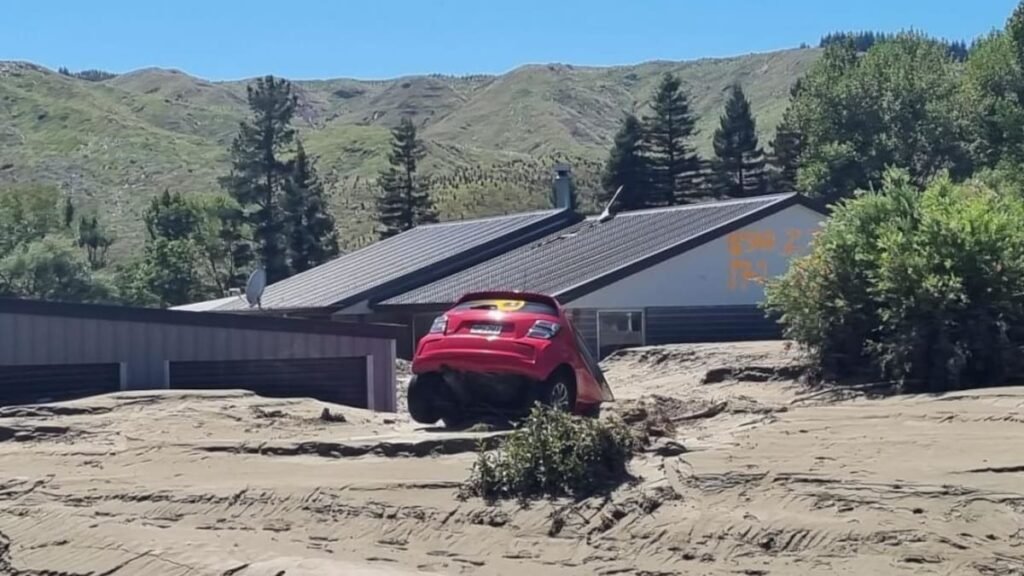
So if I were buying my house again today, what should I be finding out?
What’s happened there before?
The Natural Hazards Commission’s Natural Hazard’s portal was just updated this month. It shows settled natural hazard claims, for example, those through EQC. My address doesn’t show anything – phew. But that doesn’t necessarily mean the property has never experienced a natural hazard event – it might simply mean there was no settled natural hazard claim, the event occurred before 1997, or the damage was covered solely by private insurance.
It’s also piloting natural hazard maps where you can overlay things like faultlines, quakes and liquefaction – but that’s only currently available for the Bay of Plenty.
Ask awkward questions
If vendors have disclosed a defect to their real estate agent, they’re expected to disclose it to you. Auckland-based licensed conveyancer Alex Sintes from Quinn Law says buyers should ask vendors (or their agent) directly whether the property has experienced flooding, land subsidence or other natural hazard events during their ownership – and get the answer in writing.
When you get your building report, the inspector should also be on the lookout for tell-tale signs of water damage – not just from a leaky building, but previous flooding.
Know your flood risk
Of course, just because something hasn’t happened to a property before, doesn’t mean there isn’t a risk it will.
Some councils have specific flood data tools available online – although when I check Auckland’s, to plug in my address, the word ‘TEST’ written in red at the top doesn’t fill me with confidence.
But I searched my address and checked whether it lies in floodplains, flood-prone areas, overland flow paths or is susceptible to coastal inundation.
It’s useful – but the accessibility of similar information varies significantly around the country.
Cotality’s head of data and analytics, Craig Dargusch, says in the main centres the data is great, but “Outside of the major areas, it takes a fair bit of work from the consumer to go and do that. If you’re not a cartographer or a geospatial expert or a data scientist, how much do you trust your work?”
Given I can barely tell north from south, my answer is: not much. The challenge isn’t a lack of information – it’s knowing where to find it and how to interpret it.
The Ministry for the Environment has a New Zealand flood map under development that could help provide more national consistency – but it’s not expected to be ready until May 2027.
Property records
The LIM has always been on the list of ‘must dos’ before buying a property because it contains information the council holds about the property. Conveyancer Alex Sintes says it now contains much more comprehensive information about natural hazards like flood zones. She says if the LIM or the property file shows any land subsidence or soil stability issues “some clients are starting to engage engineers to obtain Geotech reports if the property is identified as possibly being at risk of shallow or large-scale landslides”.
Can you insure it, and borrow against it?
What used to be mostly a tick-box exercise at the end of the house-buying process now needs to be moved much closer to the top of your priority list.
Squirrel mortgage adviser Adam Clark told me there’s been a big change. “I used to be super relaxed about insurance, but now I insist all borrowers have confirmation of coverage before going unconditional or going to an auction”.
Difficulty obtaining insurance can affect both financing and future resale. Without insurance, most banks won’t lend – the property is the security for the loan, after all. If a bank won’t lend, or an insurer won’t insure – you’d also have a tough time selling it.
What do they know that you don’t?
Banks and insurers increasingly use specialist hazard risk modelling and analysis to assess properties.
The insurance council told me insurers use “their own modelling and claims data, alongside publicly available information” while Westpac says it is “investing in our natural hazard modelling risk data, based on a range of public and private sources”.
Cotality, for example, has specialist teams analysing data and building tools for clients, creating what Dargusch says is “an uneven playing field for consumers versus professionals”.
While you might not have access to the same level of data, their approach offers a clue. Sky-high premiums, or a reluctance to insure or lend on a property are major red flags.
It’s always been advisable to do your research when buying a property – but the list of what’s required, and what’s possible, has grown longer.
The ground has shifted under property buyers’ feet – doing your homework properly is your best chance to ensure it doesn’t shift under your house.
Catch up on the debates that dominated the week by signing up to our Opinion newsletter – a weekly round-up of our best commentary.
Catch up on the debates that dominated the week by signing up to our Opinion newsletter – a weekly round-up of our best commentary.