
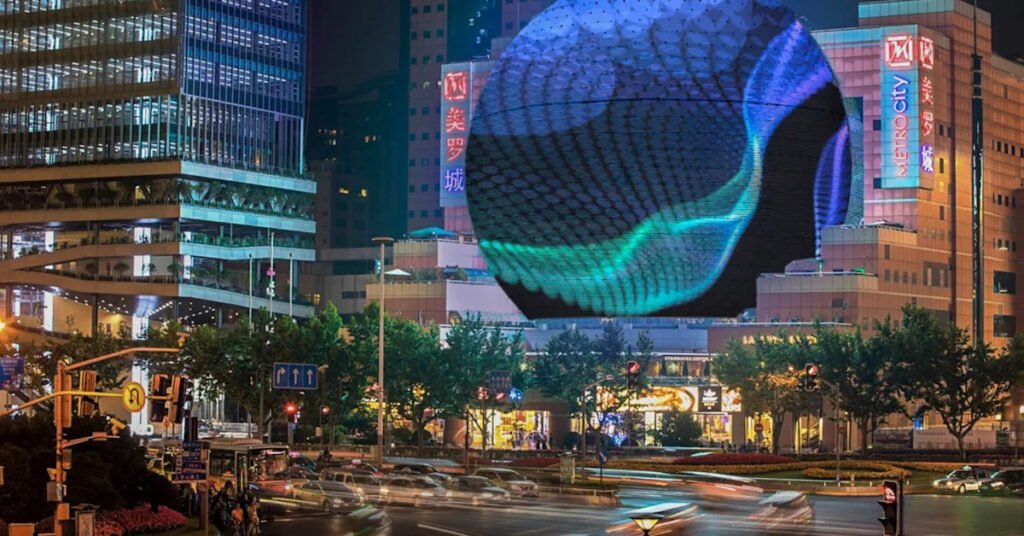
Metro City (pictured) and Metro Tower in Shanghai and GIE Tower in Guangzhou reported average occupancy of 70.5%, down from 74.3% a year earlier (Photo: Metro Holdings)
Singapore-listed property investment and development group Metro Holdings Limited narrowed its net loss for FY2026 ended March 31 to $203.1 million, from $224.8 million a year earlier. Lower fair value and impairment losses from its China property exposure helped moderate the decline.
Revenue fell 6.5% y-o-y to $97.7 million, mainly due to lower residential property sales in Jakarta and weaker retail sales at Metro’s department stores in Singapore.
The bulk of the losses remained tied to China’s prolonged property downturn, which continued to weigh on valuations, leasing demand and the performance of Metro’s associates and joint ventures.
Read also: Metro sells 26% stake in Boustead Industrial Fund ahead of proposed UI Boustead REIT listing
Metro recorded $88.2 million in fair value losses, mainly linked to properties in China held by associates and joint ventures. It also recognised a $65 million share of losses from its 20.5%-owned associate, Top Spring International Holdings, amid fair value declines, impairment losses and weaker operating performance.
Weakness in China’s property sector
In addition, Metro booked impairment losses of $30.2 million on amounts due from associates, mainly related to its co-investments with real estate investment manager Bentall Green Oak China Real Estate Fund, as weakness in China’s property sector persisted.
Still, the scale of losses moderated compared with FY2025, helped by lower fair value declines at several China assets and resilient contributions from properties outside China.
Contributions from Singapore, the UK and Australia properties held under associates and joint ventures totalled $16.2 million during the year.
Metro chairman Tan Soo Khoon said the group continues to operate in a challenging environment shaped by geopolitical tensions, economic uncertainty and ongoing weakness in China’s property sector.
“We remain focused on strengthening our portfolio across geographies and asset classes, while maintaining a disciplined balance sheet to position the group to capture opportunities as they arise in the future,” he said.
Read also: Metro Holdings appoints Erwin Wuysang-Oei as CEO of Metro Limited to oversee retail division
Accelerating capital recycling
The company has increasingly shifted its focus towards proactive asset management and capital recycling as it repositions its portfolio beyond China.
In March, Metro divested its 26% stake in Boustead Industrial Fund — a Singapore industrial and logistics portfolio — to UI Boustead Reit for net sale proceeds of about $116 million.
Earlier, Metro and its joint venture partner Sim Lian Group sold Dalyellup Shopping Centre in Western Australia for A$35.8 million ($30.4 million).
The group also said about 93% of the strata area at VisionCrest Orchard — a freehold Grade A commercial property in Orchard Road in which Metro holds a 20% stake — has been sold.
Meanwhile, asset enhancement works at Metro’s 50%-owned freehold office property at 5 Chancery Lane in London remain on schedule for completion by end-2026. The redevelopment is expected to increase net lettable office space by about 25%, from 80,000 sq ft to 100,000 sq ft.
Investment properties outside China stay resilient
Metro said its investment properties outside China have remained relatively resilient despite broader macroeconomic volatility.
In Singapore, its premium Grade A office towers at Asia Green in Tampines Regional Centre maintained occupancy of 98.7% as at March 31, up from 90.7% a year earlier.
In Australia, Metro’s 30%-owned joint venture portfolio with Sim Lian — comprising 17 office and retail assets valued at about A$1.4 billion ($1.2 billion) — recorded occupancy of 93.9% and a weighted average lease expiry of 4.7 years.
Its UK purpose-built student accommodation portfolio under Paideia Capital UK Trust maintained occupancy of 97.8%, although valuations softened amid cautious capital market conditions.
However, China remains the group’s biggest challenge.
Metro said office leasing conditions in China remain difficult amid oversupply and slowing demand. Shanghai’s Grade A office vacancy rate stood at 23.6% at the end of 2025, with another 1.3 million sq m (about 14 million sq ft) of new office supply expected to enter the market in 2026.
Against this backdrop, Metro City and Metro Tower in Shanghai and GIE Tower in Guangzhou reported average occupancy of 70.5%, down from 74.3% a year earlier.
The group noted that some landlords in China have resorted to longer rent-free periods, rental cuts and subsidies to attract or retain tenants amid intensifying competition.
Retail division remains under pressure
Beyond China, Metro’s retail division in Singapore also remained under pressure from cautious consumer spending and intense competition.
The retail division posted a loss after tax of $11.4 million for FY2026, compared with a loss of $6.9 million a year earlier, as sales at Metro Paragon and Metro Causeway Point declined.
Metro said it will continue focusing on operational efficiencies, strategic partnerships and experiential retail formats to strengthen customer engagement.
Despite the losses, Metro maintained a relatively strong balance sheet, with net assets of $900 million and total assets of $1.8 billion as at March 31.
Net gearing stood at 0.16 times, while cash, cash equivalents and short-term investments totalled $435.9 million.
The board has proposed a final dividend of 2 cents per share.
Group CEO Yip Hoong Mun said Metro remains focused on preserving liquidity, optimising its portfolio and strengthening its asset base amid ongoing uncertainty.
“While ongoing geopolitical tensions, challenging macroeconomic environment, and prolonged headwinds in China’s property sector are expected to continue weighing on our near-term performance, we remain committed to navigating these challenges and positioning the group for sustainable long-term growth,” he said.
See Also: