
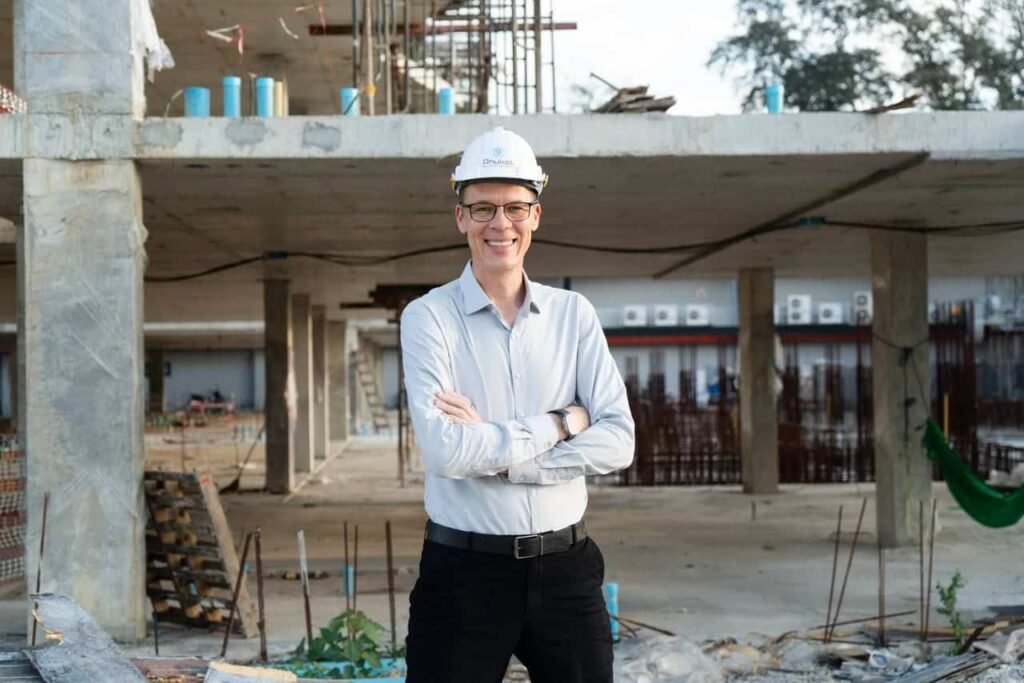
One of Phuket’s largest developers, CEO of Phuket9, on strategic growth in times of crisis, shifting investment cycles, and why control over the entire value chain has become the key competitive advantage.
In 2026, the Asia-Pacific region is once again in the spotlight of global capital. According to the latest CBRE Asia Pacific Investor Intentions Survey, investment intentions in real estate across APAC have reached their highest level in four years—despite ongoing geopolitical and economic turbulence. Investors are increasingly focusing on residential, office, and hospitality assets, while markets such as Tokyo and Singapore continue to attract international capital as “safe havens.” This is more than just another growth cycle—it signals that real estate in Asia is once again becoming a strategic tool for preserving and growing capital in uncertain times.
But behind the numbers are real management decisions—and it is those decisions that determine who can turn a global trend into a sustainable business. Kirill Vyalykh, CEO and Managing Partner of the developer Phuket9, led the company through the pandemic, preserved the team and assets, and then multiplied revenue, turning the business into a market leader in Phuket. Under his leadership, the company shifted to a full-cycle model—from design and construction to asset management through its own hotel group—built a team of more than 1,500 employees within the holding structure, and created one of the region’s largest resort projects, Rawayana Beachfront Village. In 2023–2024, Phuket9’s projects received a series of professional awards in Thailand, Asia, and Europe, confirming that this is not a local success story but a matter of systemic quality.
Kirill spoke with us about how to build strategic growth in times of crisis, why betting on in-house teams and moving away from outsourcing can become a competitive advantage, how to read global investment cycles and prepare a company for shifts between markets—from China and India to the Middle East and Europe—and what really stands behind the figure “sevenfold growth” in a development business dependent on tourism, capital, and investor trust.
“A full-cycle company that takes sole responsibility from entry to exit will always be more attractive to investors”
Kirill, over the past four years, the company under your leadership has grown roughly sevenfold—despite this period including the pandemic and a near-total shutdown of the tourism market. Which management decisions do you consider key to this leap, and what from this experience can be applied to other markets?
During the pandemic, having effectively lost income from property sales and with short-term rentals completely halted, we quickly developed a long-term rental program that allowed us to generate at least some revenue and cover operating expenses. We do not use bank financing for construction and fund projects solely through sales, so to stabilize the situation, I developed a remote transaction system where clients did not need to fly to Phuket: everything was handled remotely, and documents were sent via DHL and UPS. We carried out thorough legal preparation to ensure full compliance with local legislation. We were among the first in Phuket to do this, which allowed us to survive even in that critical situation. Later, remote sales became a feature that the entire market adopted.
In 2020, you took over the company at the moment of collapse. Why did you choose to preserve the team and assets rather than make radical cuts, and how did that decision affect subsequent growth?
For a developer working simultaneously on several projects and planning several more, it is far more advantageous to have its own team, from the chief engineer and architect to line workers on the construction site. This allows you to maintain a fixed cost structure, strictly follow budgets, ensure quality through full control of the technological process, make changes quickly, and avoid the risks and force majeure of subcontractors. The decision to keep the team allowed us to return to the market very quickly at full capacity, while many competitors had dissolved their offices during the pandemic and essentially had to rebuild their businesses from scratch.
Today, Phuket9 is running up to five projects simultaneously and manages the entire chain—from design and construction to operations through its own hotel group. Why did you deliberately abandon outsourcing and build a model with more than 1,500 employees within the holding?
The reason is to maintain full control on behalf of our investors. Any third party—whether a hotel chain or another management company—does not, in fact, bear real responsibility toward investors who entered at the construction stage. Such companies are focused on their own operations and are not always able to work effectively in local realities. Building our own hotel brand gave us a serious marketing advantage: a full-cycle company that takes responsibility from entry to exit will always be more attractive to investors, reducing their risks and giving them a clear roadmap.
“No one wants to buy property that won’t perform, generate returns, or appreciate in value”
You were one of the first in Phuket to offer investors a “turnkey” model with passive income and subsequent asset management. How did you arrive at this concept, and why do you think it became a new market standard?
The Southeast Asian market has never been particularly transparent. Due to the lack of real oversight and regulation, investors often fell into marketing traps, being sold inflated expectations that rarely materialized. We wanted to create a clear, measurable product with no fine print—and, most importantly, one that actually worked.
Many developers still sell “square meters,” while you focused on ecosystem projects in the “city within a city” format, such as Rawayana Beachfront Village. What has changed in investor and buyer behavior that made this model in demand?
Buyers’ demands for quality are constantly increasing. Previously, a beachfront bungalow for a million dollars was considered the best offer. Today, expectations are much higher. No one wants to buy a property that won’t perform, generate returns, or appreciate. The foundation of resort capitalization is competent management, marketing, technical maintenance, and, of course, infrastructure. We continuously implement and improve all of this.
If we look at Phuket9 as a business system, what is its main competitive advantage today: the product, the operating model, the market strategy, or the management team?
A combination of all these factors. At the core of our scaling and growth is a system of personal values—family, honesty, and responsibility. Perhaps we could grow faster, but we prefer to move carefully and deliberately, testing the ground many times before taking the next step.
“The investor has become significantly younger”
Over the years, you have consistently reoriented sales from one market to another—from Russia to China, then to India, the Middle East, and Europe. By which indicators do you determine which market will become the next growth driver?
Economics and geopolitics. These are the factors that allow you to anticipate and work with potential demand. It is already clear that India is becoming the “new China,” but before the pandemic, it was often viewed with prejudice. However, deep analysis showed that India’s growing economy would inevitably make a breakthrough, and we started preparing for that. Real estate in the tropics is not a basic necessity—you can sell it only to those who have already made several investments in their home country and are thinking about expanding their portfolio. Such demand forms either during rapid growth or on the eve of a downturn, when people are looking for ways to protect their capital.
In 2018, the company opened sales offices in Beijing and Chengdu, and today your client geography covers dozens of countries. What managerial and cultural challenges arise with such international diversification of demand?
One could write an entire dissertation on this topic. In general, professional investors are similar in all countries, but cultural codes require their own etiquette. In India, you must observe and respect ceremonies related, for example, to religion, while in China, negotiations often can only be conducted in person, for hours, and typically over a lunch that turns into dinner, followed by a bathhouse and karaoke.
You often speak at professional conferences—from London and Dubai to Shanghai and Miami—discussing investment, capital migration, and resort real estate. How has the global profile of investors in such projects changed in recent years?
First of all, the investor has become significantly younger. Rapid rises in IT and cryptocurrencies have created an entire class of new investors. Most of them, however, understand that diversifying funds earned in high-risk sectors requires allocating part of them into more conservative instruments. Overall, demand for real estate investment remains one of the strongest worldwide. Presentations in different countries help me present Thailand more deeply as a destination, because for many, it remains something exotic, unclear, and sometimes even perceived as risky.
“COVID taught us to value reserve funds, diversified income sources, and autonomy”
In 2023–2024, the company’s projects received a series of professional awards in Thailand and Asia, as well as international recognition from ESQR in Europe. How important are such evaluations to you—and what do they really say about business quality in your view?
I am always somewhat skeptical about awards, although I am, of course, pleased to receive them. For me, the main criteria remain the company’s financial performance, team stability, and continuous growth. But when professionals recognize your work, it serves as additional motivation—and, to be honest, I simply enjoy it. It is especially valuable to receive recognition from conservative countries with a long history and serious achievements.
Resort real estate is highly dependent on cycles—crises, as you say, repeat every 5–8 years. What principles of strategic planning do you apply so that the company not only survives such periods but also emerges stronger?
COVID taught us the importance of reserve funds, diversification of income sources, and autonomy. We still operate without borrowed funds so that in the next international collapse, we are not strangled by creditors.
You have already announced plans to enter the Bangkok market. What is more important for you at this next stage: scaling the current model or searching for fundamentally new development formats?
To enter the capital market, we will have to significantly upgrade our system and adapt it to a new level, with a possible shift toward residential real estate. At the moment, short-term rentals in Bangkok look even more attractive than in Phuket, but they are highly vulnerable to demand drops, cost fluctuations, and constantly changing rules of the game. Most likely, we will start with a pilot residential project and then see how the situation develops.
Have you read?
2026 GHPI Report: Mapping the New Leaders in Global Prosperity.
SWI Capital Lists on Euronext as SWI Group Goes Public.
Loving Your Work Might Be Your Biggest Advantage.
AI Is Killing “Pause to Improve”—CEOs Must Adapt.
Execution Beats Ideas: The Mindset That Drives Results.