
Stay informed with free updates
Simply sign up to the Chinese economy myFT Digest — delivered directly to your inbox.
Chinese investment declined further last month while retail sales weakened sharply, as President Xi Jinping launched an unusually blunt attack on “reckless” government spending that Beijing believes is constraining growth in the world’s second-biggest economy.
Fixed asset investment declined 2.6 per cent for the January-November period on a year earlier, the National Bureau of Statistics reported on Monday, a steeper fall than the 2.3 per cent decline forecast by a Bloomberg survey of analysts and the 1.7 per cent fall for the year to October.
The NBS also said retail sales, seen as an indicator of household demand, expanded 1.3 per cent last month on a year earlier, the slowest pace of growth since December 2022 and short of analyst forecasts of 2.9 per cent, which would have been in line with October’s figure.
The weaker economic data on Monday followed calls by China’s top leadership last week at the central economic work conference, the Communist party’s top meeting on the economy, to raise consumption and “stabilise” investment.
China’s economy for decades has relied heavily on state financing for growth, particularly in infrastructure and property as well as high-end manufacturing.
Xi hit out at wasteful investment at the economic work conference, criticising outsized development zones as well as “inflated figures” and “fake construction starts” that he said were being used to create a false impression of economic performance.
“Some places disregard reality and blindly chase trends,” Xi said In comments published on Sunday in the People’s Daily, the party’s official newspaper. He called on officials to pursue “genuine growth without exaggeration”, and highlighted superfluous investment by local governments in advanced technologies such as semiconductors.
“Those who are unrealistic, hasty, reckless and haphazard in their efforts will be held strictly accountable,” he said.

China’s trading partners have increasingly accused Beijing, which reported a record year-to-date trade surplus of more than $1tn in November, of not doing enough to stimulate its domestic consumption, and relying instead on exports of low-cost goods.
The IMF last week called on Beijing to take stronger measures to stimulate demand and reflate its economy, which has suffered persistent deflation amid a years-long property sector slowdown.
In the CCP’s magazine Qiushi on Monday, Xi stepped up his support for consumption, saying that “expanding domestic demand is related to both economic stability and economic security; it is not an expedient measure but a strategic move”.
But analysts have pointed out that the party’s next five-year plan, which will come into effect in March, continued to prioritise investment in high-tech production.
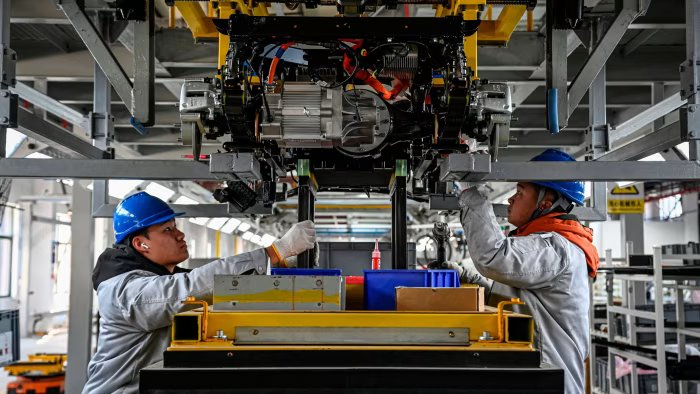
Xi’s tough stance on redundant investment — which authorities blame for excessive price competition and deflation that they refer to as “involution” — came as regulators threatened last week to crack down on unfair pricing in the auto industry.
China’s automotive sector has dramatically increased capacity in recent years, aided by local government subsidies and spending which has driven down prices and hit profits.
Other official data on Monday also showed that industrial production rose 4.8 per cent year on year, trailing analyst forecasts of 5 per cent growth and October’s rate of 4.9 per cent.
Analysts at Goldman Sachs wrote that “November activity data broadly missed market expectations, especially for retail sales”, and noted that fixed asset investment growth “remained depressed”, with a year-on-year decline of 10.7 per cent in November on a single-month basis, against 11.4 per cent in October.
But they cautioned against over-interpreting the slump, as a “recent study suggests that the NBS statistical correction of previously over-reported data has played at least as large a role as fundamental factors”.
Unlike other major economies, China does not publish full quarterly breakdowns of GDP under what is known as the expenditure approach, which include investment, consumption and net exports.
Instead, it publishes its own monthly data series, such as fixed asset investment and retail sales.
Since 2018, the statistics bureau has also stopped reporting sectoral breakdowns of fixed asset investment by value, leaving only growth rates across different sectors.
Chinese authorities have set a full-year growth target of about 5 per cent for 2025. In the third quarter, data showed the economy expanded 4.8 per cent, the slowest pace in a year. Economists expect China to hit the 5 per cent target this year.
Additional contributions from Cheng Leng in Beijing