
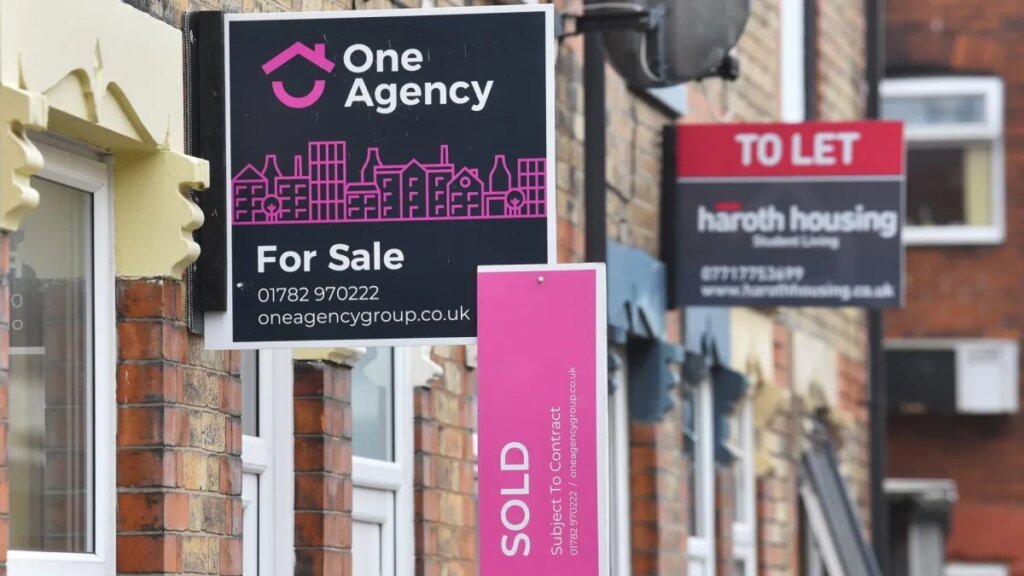
Major lenders have started to cut their mortgage rates this week after weeks of hikes, in a rare bit of good news for households.
Since the start of March, mortgage rates have shot up because of the conflict in the Middle East and its impact on oil prices.
High oil prices have put pressure on inflation, which rose in Wednesday’s reading to 3.3 per cent, and is expected to go up by more later this year.
This in turn has increased expectations that the Bank of England could raise interest rates later in 2026.
But in the past few days, some lenders have started to reduce rates a little bit – though these are still far higher than before the conflict began at the start of last month.
On Wednesday, Barclays cut rates on more than 20 products and by as much as 0.36 percentage points, while Santander is cutting rates on Friday by up to 0.25 percentage points.
The average rate on a two-year fixed deal was 4.83 per cent at the start of the conflict, but rose to a peak of 5.90 per cent in early April, according to Moneyfacts. It now stands at 5.82 per cent.
So, what could happen in the coming months, and what should you do if you have a mortgage locked in now but are wondering if you could improve it? The i Paper spoke to experts to find out.
What could happen to mortgage rates in the coming months?
Exactly what will happen to mortgage rates going forwards depends heavily on what happens to swap rates.
These swap rates represent the market’s forecast of future interest rates over a specific period, and are used by banks to set their fixed interest rates.
Over the last two weeks, these swap rates have broadly fallen, dropping particularly last weekend when it appeared that the Strait of Hormuz – a key shipping lane for oil that has been disrupted during the conflict – would reopen.
But these rates can fluctuate – swap rates have actually nudged upwards again in the past days- so there is no guarantee that there will be further falls.
Other factors also come into play, such as the margins banks and lenders need to make on their mortgages. In time of volatility, these margins can sometimes be higher to account for the higher risk of lending.
“Clearly the situation in the Middle East is changing all the time causing the money markets to fluctuate, so we can’t really say with much certainty that rates are going to come down more or that we have reached the peak,” said Aaron Strutt, a mortgage broker at Trinity Financial.
What happens next in the war will have a large impact on rates.
Peter Stimson, head of mortgages at lender MPowered, said: “If there is a resumption in hostilities, swap rates will rise off the back of increasing oil prices and the fear that inflation becomes more embedded, and the Back of England has to act by raising bank base rate.
“If there is a genuine breakthrough on talks, we will quickly see swap rates, and with it mortgage rates, fall back towards 3.50 per cent, although it may be a few months yet before we see rates as low as we saw at the start of the year as inflation works its way through the system.”
About to purchase? Here’s what you can do
If you’re about to purchase a property, you can lock in a mortgage rate once you have a formal mortgage offer, which usually happens after submitting a full application following an offer on a property that is accepted.
You can, however, sometimes move to a cheaper deal before completion.
However, this is not set in stone. Different lenders have different rules and depending on how far down the purchase process you are it can also delay things.
Nick Mendes, a broker at John Charcol, said it’s often easiest to move to a new deal with the lender you initially agreed a rate with.
“If they release a cheaper product after you secured your rate, it is often possible to ask whether you can move onto it. Where nothing else has changed and the purchase is still progressing normally, that can sometimes be done without too much disruption,” he said.
If you’re late in the process or you want to switch to a new lender, meaning revised paperwork has to be issued or your solicitor has to wait for updated instructions, an amendment can slow movement down on the purchase.
Mendes says: “It often means starting again with a fresh application, new affordability checks and potentially a new valuation and underwriting process.”
For a small reduction, it’s worth speaking to your broker, if you have one, about whether the new deal is worth it.
Mortgage fix ending – lock in a new rate three to six months before
If you have a mortgage fix ending, you could be set to pay more when you refix.
Most lenders allow you to lock in a new mortgage deal three to six months before your current deal expires.
If rates drop before your deal ends, you can port to a new deal at the lower rate.
Similarly to those who are buying, it’s therefore a good idea to lock in a fixed rate as soon as your lender allows – check its terms or speak to your broker to find out how long before the end of your deal is.
Consider a tracker mortgage – but know the risks
One option to consider as an alternative to fixed-rate mortgages is a tracker deal. These sorts of mortgages follow the Bank of England base rate, plus an additional percentage on top, and are generally cheaper than fixed mortgages.
But there is a risk that if the base rate rises, your mortgage costs would too – at short notice.
Stimson explains: “Starting from just 0.21 per cent over base rate – which is currently 3.96 per cent – most tracker mortgages come with no early repayment charges, meaning customers are free to refinance as, when or if rates fall to an acceptable level.”
If the base rate rose by 0.25 percentage points from 3.75 per cent to 4 per cent, your tracker would rise accordingly.
For someone on a 25-year £200,000 mortgage with a tracker at 3.96 per cent, this would mean an increase from £1,051 per month to £1,079 per month.
If you are getting one, make sure you’d be able to pay the price if your rate rose, and also make sure that your product does not come with early repayment charges, if you want to avoid these.