
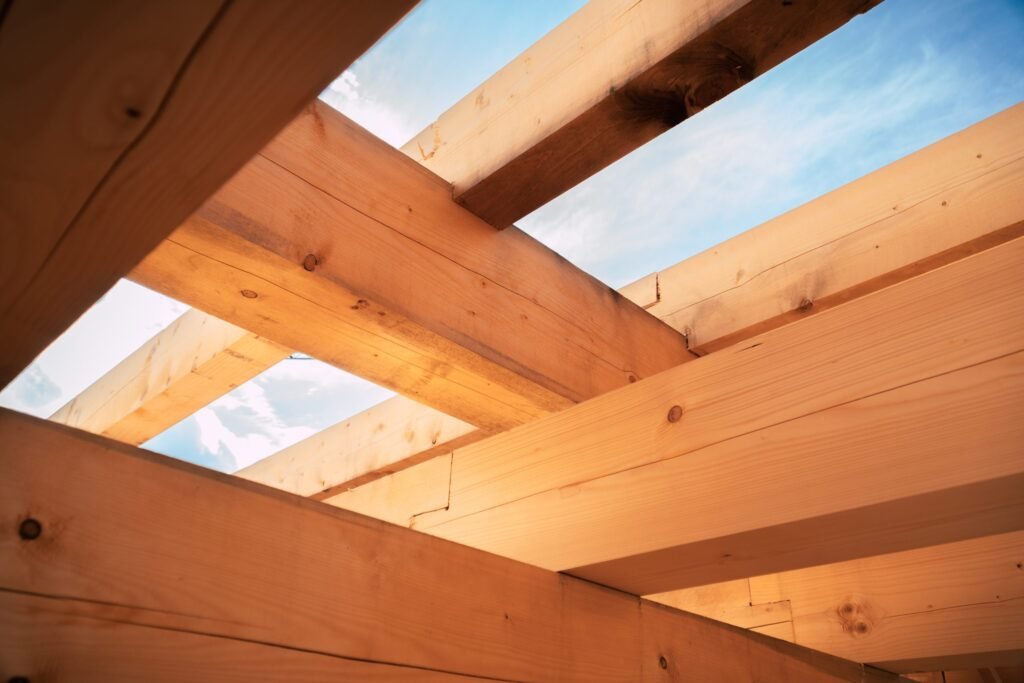
A Jersey couple is warning that hundreds of homeowners could be unaware of a hidden obstacle in the housing market after discovering their timber-framed property was effectively unmortgageable.
Nigel Stevens and his wife Chrissie were due to complete the sale of their house in mid-May ahead of a move to the UK to be closer to their two children.
While measuring up their soon-to-be new property in south Wales, however, the couple were shocked to discover that the long-awaited deal had suddenly collapsed.
Their Jersey property – a timber-frame house built in 1961 by renowned island architect Warwick Whitaker – had been deemed not eligible for lending against by major banks.
Their buyers were unable to secure a mortgage and purchase the property, the Stevens’ say they were abruptly, and without forewarning, left high-and-dry.
Unnecessary catch-all?
According to Lorraine Wright at The Mortgage Shop, it has “always been policy” for banks to refuse mortgages on timber-framed properties in the island between 1920 and 1965.

But talking to Express, Nigel argued that this “catch-all” fails to take into account work completed properties to update timber-framed houses to modern requirements.
“It’s sort of drifted over from the UK and is purely based on lenders not being willing to lend, often despite the fact that the property is sound, and it’s compliant with building regulations, planning regulations, whatever regulations you want,” he said.
“We replaced all the cladding, the windows – did huge amount of work, we put a conservatory in, all the internal stuff, the dry-lines of the lounge.
“When the cladding was redone, all the wood was sound, and it’s got all this foil insulation stuff underneath, so the house is dry, it’s insulated.
“We’ve withstood a couple of 100-mile-per-hour storms – so it’s a weird one.”
Blissfully unaware?
The couple purchased their house in 1997, and Nigel says he is worried that banks are now appearing to adopt a “blanket” policy on not facilitating mortgages for similar properties.
“There are clearly hundreds of homeowners in Jersey who are blissfully unaware of this problem after buying their homes in good faith,” he said.
“We had an extra mortgage on this house about ten years ago, so it’s within the last ten years that something has changed, because the banks were happy to lend on it – and other houses of the same structure – within the last ten years.
“Our architect friends hadn’t heard of this problem before. We’ve had two builders who said the house doesn’t need anything doing, or if you did anything to it would be detrimental to it.
“I’m hoping if the housing market picks up – because obviously the house prices have been falling – that the banks will become less risk averse again, but this is all just guesswork.”
A problem with no solution?
According to Nigel, the couple would be prepared to make adjustments to appease cautious lenders, but simply do not know what adjustments to make.
“[A surveyor] said there was an issue with the thickness of the walls, although they’re compliant with building regulations, planning regulations, and any regulations,” he said.
“He said that some lenders may be reluctant to lend, but it’s become clearer that nobody’s willing to lend.
“It’s compliant with everything except what lenders are willing to lend on.
“We’d fix it if we could, but we don’t know what to fix.”
What’s next?
Nigel said the couple sought a second opinion from an independent surveyor to better understand the issue.
While the surveyor could not identify any clear changes that would make the property more acceptable to lenders, he advised them to challenge the decision through a detailed appeal addressing each concern individually.
“But if a bank says no, it’s no – if we get another survey, they’re not going to say ‘well actually all right then’, because they’ve already made their minds up,” added Nigel.
“We’d be spending £1,500 on a proper survey to prove the house is okay, but that doesn’t mean the bank will lend anyway.
“We were going to get a third survey around from a different company, and they said it’s really not worth doing.”
Trapped in Jersey
Nigel concluded: “If somebody can tell us what we need to do to the house so we can get a loan on it, we would happily do it.
“At the moment, it’s just really sad and downright depressing. It looks like we are trapped in Jersey.”