
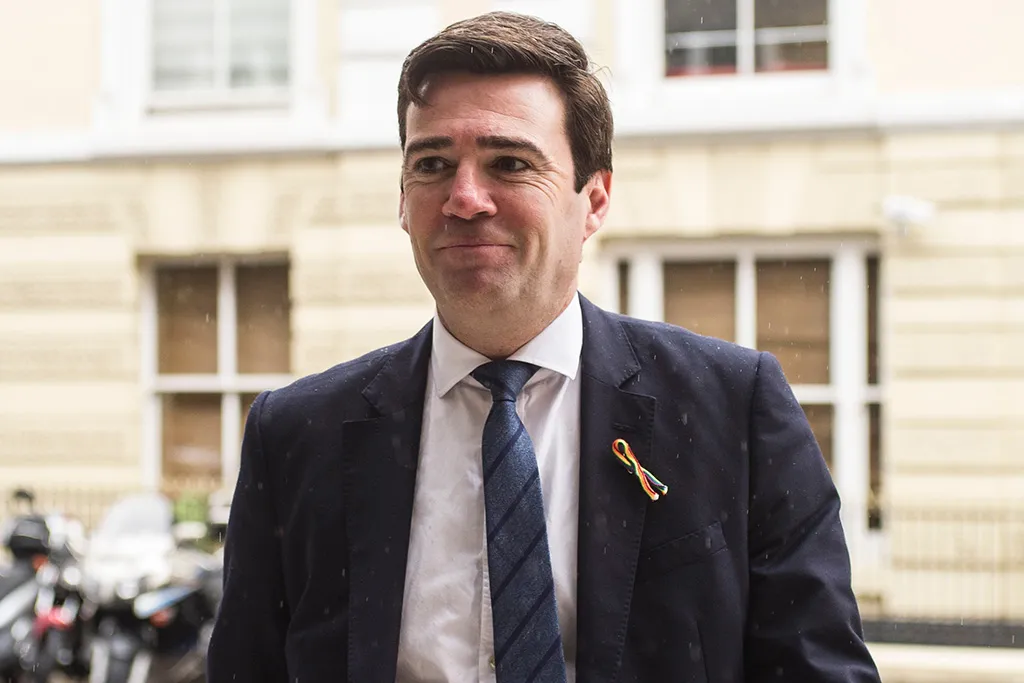
Prime minister-hopeful Andy Burnham has promised “decent infrastructure” across the UK, a massive council-house building programme and a keen focus on regeneration as he set out his vision for the next decade.
The former mayor of Greater Manchester also pledged to boost council resources, overhaul public procurement, boost devolution and launch a ‘N0 10 North’ if appointed premier.
Keir Starmer last week announced he would stand down as prime minister once a successor was in place, leaving industry leaders bemoaning a reign characterised by pledges and speeches but a lack of clear evidence that conditions were improving.
Burnham, who recently won the Makerfield byelection and is widely anticipated to become premier in July, launched his leadership campaign in earnest at the People’s History Museum in Manchester on Monday (29 June).
“We will bring about the biggest rebalancing of power our country has seen,” he declared. “It is time for Whitehall to accept that growth can’t be ordered from the top down, it can only be nurtured from the bottom up.”
Listing a number of ingredients for creating a positive economy, he added: “It comes from committing to decent infrastructure in all parts of the UK, and getting national investors to back the aspirations set by regions.
“It comes from not leaving everything to the market but [using] public intervention where necessary to set higher ambitions for towns and kickstart the process for change.”
Burnham declared: “This is Manchesterism.”
Number 10 North would become “the nerve centre of a rewired Britain”, he added.
Based in Manchester, the satellite prime minister’s office will be “the conduit through which we redistribute power and resources across the UK”, Burnham promised.
“It will make placed-based collaboration the new operating principle for UK plc, requiring all government departments and agencies to support strategic and local authorities with staffing and resources.”
The new hub will also be tasked with delivering a huge social housing construction drive.
“Britain has lost almost 1.5 million council homes since the 1980s and the same number of people are now on housing waiting lists,” said Burnham.
“Number 10 North will oversee the biggest council-house building programme since the post-war era. We will use vacant public land to reduce cost. We will bring higher density residential development to our towns.”
Burnham set out a raft of ways devolution would be encouraged when he leads the country.
He said this meant “more powers for London over education and housing, so [it] can do more for itself and remain the world’s greatest capital city”.
“The days of Whitehall fighting the devolution of power into regions and nations are over for good,” he added. “The whole of Whitehall will now be required to get behind our places.
“We will create a more streamlined state with a clearer purpose to power up all parts of the country and put a laser-like focus on growth and regeneration.”
Describing a decade-long mission to “raise living standards across the land”, Burnham said Number 10 North would support the regions in three major areas: reform of essential utilities, reindustrialisation and regeneration.
“On utilities, we will ensure all parts of the UK are able to take greater public control of essential services like water, housing, energy and transport,” he said. “We will set out 10-year plans to bring down the costs of these essentials to individuals, families and businesses.”
He added: “We will support every region to set clear and credible industrial ambitions and provide the support to achieve them. We will consolidate private and public investment at a place-based level and help all areas establish good growth funds.”
Burnham promised a renewed focus on social value to ensure British companies were better placed to win many public contracts.
“We need to safeguard sovereign manufacturing and production capabiity in critical sectors like steel, defence, energy, food and farming,”” he added.
Dr David Crosthwaite, chief economist at the Building Cost Information Service, said many questions remained for the prime minister-hopeful to answer.
“Andy Burnham’s commitment to a major council house building programme was perhaps the clearest proposal for the construction industry,” he said.
“However, the government is already working towards an ambitious target of delivering 1.5m new homes during this Parliament, and recent figures show England remains well behind the pace required to achieve that ambition.
“In his speech, Burnham set out what he wants to build, but not who will build it, how it will be funded or what would enable a significantly faster rate of delivery than the industry is currently achieving.
“More broadly, his speech was stronger on changing how decisions are made than on creating the conditions that encourage construction investment. Greater devolution may help local authorities bring forward projects that better reflect regional priorities, but additional powers alone do not drive construction activity.
“Projects only move forward when developers, investors and public sector clients have the confidence and resources to commit to them, which depends not only on governance structures, but also on funding, viability and the cost environment facing the sector.
“Notably absent was any acknowledgement of the near-term cost pressures facing businesses. Labour costs remain the primary driver of construction project costs, and the employer National Insurance increases introduced by the current government have added to the burden on supply chains.
“The construction industry will be watching to see whether Burnham’s leadership pitch produces bold new thinking or simply repackages existing commitments.”
Rico Wojtulewicz, director of policy at the National Federation of Builders, said: “We support Andy Burnham’s commitment to social housing and, like the post war period when millions of council homes were built, SME housebuilders and regional contractors will be ready to deliver.
“Should the council housing ambition become reality, we will finally see politicians understand how broken the planning process is and I would expect planning reform to be supercharged and wholesale.”