
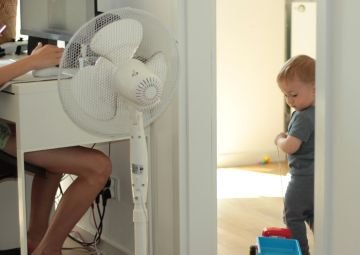
Over the past three years, I’ve been researching what it is like to live in an overheating home. I’ve listened to residents describe the daily realities of excessive indoor heat, the strain it places on health and wellbeing, and the ingenious ways people try to adapt. But as summers get hotter due to climate change, many residents are being pushed beyond the limit of what they can do on their own.
My work forms part of the Melting Metropolis project at the University of Liverpool that has been funded by the Wellcome Trust. Our team of historians, geographers, artists and community specialists has spent the last four years examining everyday experiences of heat and health in London, New York and Paris, from 1945 to the present. We want to move beyond statistics and models to better understand how heat is experienced by individuals and communities.
In London, we have spoken to tenants and leaseholders who live in different housing types and neighbourhoods. These first-hand accounts reveal the impacts of overheating in much greater detail than temperature measurements or modelling can capture. As one resident put it, “when you’re at home, there is no respite for a second once it gets hot.”
Extreme heat is a housing issue
People living in cities have always been affected by the urban heat island, but climate change is making very high temperatures more frequent, more intense and more lethal. Public attention has largely focused on streets, green space and transport – but our research shows that housing conditions play a crucial role in determining who can cope with heat and who cannot.
Overheating is not a future risk. It is already affecting residents’ day-to-day lives, physical health and mental wellbeing. Many people describe homes that warm up quickly during the day and fail to cool down overnight. One resident said of their home during hot weather, “it was about as comfortable as being in an abattoir”. Another explained that during summer, “sitting down is too hot, standing up is much too hot – but what are you going to do? Every day in the summer is over 27 degrees.”
Unequal experiences, limited options
Extreme heat affects everyone. But the impacts are felt unequally and housing is often key in shaping our experiences of heat. Residents with limited mobility, disabilities, long-term health conditions or low incomes often have the fewest options. Running fans or air conditioning increases energy bills, leaving windows open can feel unsafe and distant cooling centres seem inaccessible. Tenants and leaseholders alike can rarely adapt the outside of their home and some residents report that complaints about overheating are not taken seriously.
One tenant described how overheating has cut them off socially: “I’ve banned my family and friends from coming to my house in the summer. I can’t host people.”
Even within the same building, experiences can differ dramatically. Within the same blocks of flats, a lower-floor, north-facing flat remained relatively cool during high temperatures, while a top-floor, south-facing flat left its occupant exhausted and unwell for weeks afterwards.
More than a behaviour problem
While advice about closing blinds or changing daily routines has value, it won’t be enough in all instances. Many homes have been designed or adapted to retain heat – and climate change is pushing these buildings beyond what residents can reasonably manage on their own.
Our research suggests that overheating needs to be treated in the same way as cold, damp or mould: as a housing quality and safety issue. Mapping, modelling and standards matter, but they are not enough on their own. Listening carefully to residents’ experiences is essential to identifying which homes consistently overheat and where action is most urgently needed.
Responding to a growing risk
Recognising heat as a real and present risk is a vital first step. As extreme temperatures become more common, adapting homes so that they remain safe and liveable in hot weather will be central to delivering good-quality, healthy housing.
For many residents, overheating is already shaping everyday life at home. The challenge now is how quickly – and how fairly – we can respond.