
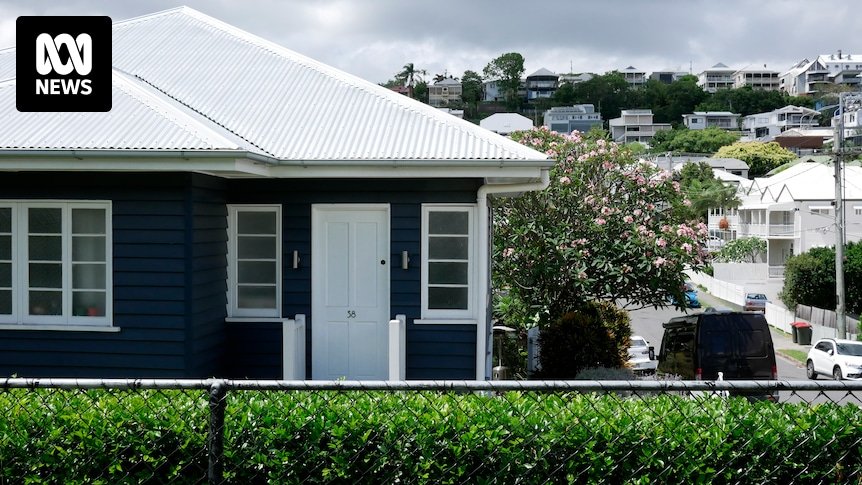
Australia’s housing market has continued to lose momentum, with national home values flatlining in May as higher interest rates, weak confidence and proposed property tax changes weigh on demand.
According to new Cotality data, Sydney and Melbourne led the weakness, with dwelling values falling 0.9 per cent and 0.8 per cent respectively in May. Values also slipped in Canberra, down 0.2 per cent.
Cotality research director Tim Lawless said the broad trend was one of the housing market losing steam, driven by several headwinds hitting at once.
“Generally, there’s a single catalyst that typically drives housing price inflections, whereas at the moment we’ve really got four headwinds that are quite clear.
“You’ve got affordability challenges, which have been existing for some time, but then on top of that, you’ve got 75 basis points of interest rate hikes, a global oil crisis that’s seen confidence fall off a cliff, and now you’ve got disincentives for investment as the budget’s handed down.”
Tim Lawless says the housing market is losing steam after being hit by a mix of pressures at once. (ABC News: Jessica Ross)
The slowdown is also showing up in sales activity. Nationally, the estimated number of home sales over the past three months was tracking 2.2 per cent lower than a year ago and 4.1 per cent below the five-year average.
“I think that’s a real reflection of the fact that fewer people are participating in the market, partly because of the high cost of debt, but also because confidence is so low,” Mr Lawless said.
“As the market moves into a weaker cycle, there will be more people who simply don’t want to buy during a downturn for fear of catching a falling knife.”
A patchy housing market
Beneath the flat headline result, conditions across the country were mixed.
Perth and Darwin recorded the strongest monthly gains, both up 1.5 per cent, lifting median values to just over $1.05 million and $634,368 respectively.
Brisbane, Adelaide and Hobart also rose, but at a slower pace, each up less than 1 per cent.
Nationally, the median dwelling value is $941,864.
| Index results as at May 31, 2026: Cotality | Change in dwelling values | ||||
|---|---|---|---|---|---|
| Area | Month | Quarter | Annual | Total return | Median value |
| Sydney | -0.9% | -2.1% | 2.3% | 5.4% | $1,282,020 |
| Melbourne | -0.8% | -2.3% | 0.5% | 3.9% | $812,621 |
| Brisbane | 0.9% | 3.4% | 19.1% | 23.1% | $1,126,149 |
| Adelaide | 0.5% | 2.8% | 12.3% | 16.1% | $950,703 |
| Perth | 1.5% | 4.8% | 25.8% | 30.8% | $1,050,354 |
| Hobart | 0.9% | 2.4% | 9.3% | 14.0% | $752,398 |
| Darwin | 1.5% | 5.2% | 20.3% | 27.9% | $634,368 |
| Canberra | -0.2% | -0.5% | 4.3% | 8.6% | $890,555 |
| Combined capitals | -0.1% | 0.0% | 7.8% | 11.3% | $1,030,973 |
| Combined regional | 0.6% | 2.4% | 11.8% | 16.7% | $771,365 |
| National | 0.0% | 0.6% | 8.8% | 12.5% | $941,864 |
Mr Lawless said mid-sized capitals were still growing, but their pace of growth had roughly halved from the end of last year, with the market gradually easing from a very strong position.
Regional markets have remained more resilient, with values across the combined regions rising 0.6 per cent in May, although that was the smallest monthly increase in a year.
Lower-priced homes also continued to hold up better than higher-priced properties, supported by credit availability and first home buyer opportunities.
However, Mr Lawless said even some affordable segments were now starting to fall, including in parts of Sydney, Melbourne and Canberra.
Regional markets and cheaper homes are still holding up better, but Cotality says even those parts of the market are starting to lose momentum. (ABC News: John Gunn)
AMP chief economist Shane Oliver said the national picture was likely to remain uneven.
“I suspect Perth will hold up reasonably well,” Dr Oliver said.
“It’s still playing catch-up in a way after years of weakness following the last mining boom over a decade ago.
“Outside of that, Adelaide and Brisbane are both slowing down.”
Dr Oliver said Sydney was particularly vulnerable because of poor affordability, while Melbourne had weak momentum and low confidence.
Shane Oliver says the risk of a deeper property downturn has increased. (ABC News: John Gunn)
Momentum loss, not a housing crash
Since the start of the year, the Reserve Bank has lifted interest rates three times, taking the cash rate to 4.35 per cent.
While annual headline inflation eased to 4.2 per cent in April, a closely watched measure of underlying inflation, trimmed mean inflation, edged higher to 3.4 per cent, keeping pressure on household budgets and leaving the risk of another interest rate rise this year alive.
Loading…
Policy settings are also shifting the outlook. Treasury estimates the proposed overhaul of negative gearing and capital gains tax would slow house price growth by 2 per cent over two years, compared with no change.
That is broadly in line with the Grattan Institute and a range of other economists, who expect prices to be 1 to 4 per cent lower than otherwise.
However, some forecasts are more pessimistic. Investment bank Morgan Stanley warns national prices could drop by 5 to 10 per cent due to an expected sharp decline in investor demand as lower expected returns and reduced borrowing capacity make property investment less attractive.
Westpac has said the tax changes are expected to “significantly affect” the housing market, predicting new investor demand is expected to fall by 34 per cent and the number of homes changing hands is expected to drop by 20 per cent. It expects home price growth to stall across the major capital cities this year.
Loading…
Prior Cotality research shows past housing downturns have generally been gradual, with combined capital city values falling by no more than 8.2 per cent over the past 40 years, although individual capitals have recorded larger falls.
Mr Lawless said Australian home values were likely to weaken further, but he was not expecting a crash.
“We’re certainly not expecting the market to drop, say, 20, 30 per cent or anything like that.
“But to see a downturn upwards of say 8 to 10 per cent doesn’t seem all that extraordinary to me, given how strong the upswing has been, and this array of headwinds in the market.“
Dr Oliver said the risk of a deeper downturn had increased, as higher interest rates, weak confidence, poor affordability and proposed tax changes weighed on the market.
“We expect property prices to fall over the next year,” Dr Oliver said.
“They could fall by around 5 per cent or so.”
However, Dr Oliver said a housing crash remained unlikely unless unemployment rose sharply, which he did not expect.
Those who have purchased homes recently could become victims of negative equity, Cotality warns. (ABC News: Ian Cutmore)
On the ground, some agents in Australia’s biggest city are already seeing the shift.
William Chan, director of Sydney-based agency Chan Yahl, said buyers had become more cautious, with fewer people attending inspections and more waiting to see whether prices fall further.
He said his agency, which services Sydney’s upper north shore, was now seeing about three groups per inspection, compared with about 11 groups this time last year.
“We’ve already seen an adjustment in the market in March of about 10 per cent in our particular market,” Mr Chan said.
“However, if the conditions start to fall away and deteriorate, we could probably see another 5 or 10 per cent more later this year.”
Investor pullback expected
Proposed changes to housing investment tax settings are expected to weigh on investor demand, which has been running near record highs, according to Cotality.
Many analysts say proposed changes to housing investment tax settings are expected to weigh on investor demand. (ABC News: John Gunn)
Treasurer Jim Chalmers last week introduced the first tranche of legislation to the lower house, outlining plans to replace the capital gains tax discount with an inflation-based system and limit negative gearing for property investors.
Cotality’s Tim Lawless said the impact of the budget was likely to become clearer over the coming months.
“We are expecting there’s probably going to be a fairly sharp pullback in investment activity.”
Mr Lawless said most property investors had traditionally bought established homes, meaning some demand could shift towards new builds under the proposed negative gearing changes.
“Given the fact that rental yields for Australian housing are so low, and opportunities for a positive cash flow are quite scarce, unless the investor had a large deposit, you’ll probably find investors become a much smaller portion of aggregate demand,”
he said.
Dr Oliver said some investors might switch towards newly built homes, but warned new builds came with their own challenges.
“You’re limited in terms of where you can buy. There’s always quality issues once those new builds come onto the market. New housing construction these days is very, very expensive compared to existing property.”