
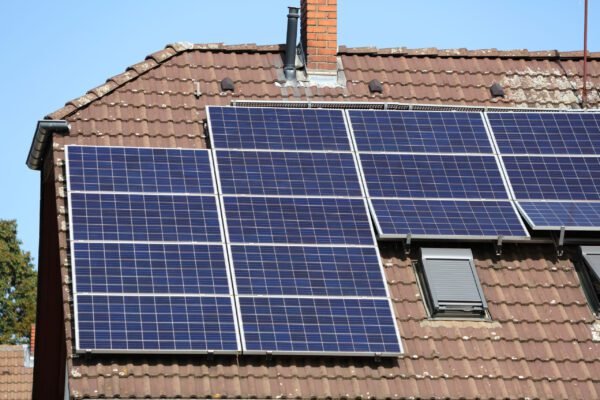
Private rooftop solar adoption grew around 43% faster than council deployment over the past year, according to data obtained by British solar company Gryd – deepening concerns that social housing tenants are being left behind as energy bills rise again.
The research comes as households brace for a 13% rise to the energy price cap from July, highlighting a widening divide between homeowners able to shield themselves from energy price volatility and social housing tenants who remain exposed to rising costs.
169,717 new solar installations were added to privately-owned homes over the past 12 months. In total, 1.67 million residential properties in the UK (5.5% of all housing) now benefit from rooftop solar, representing 6.6 GW of installed clean energy capacity.
By comparison, councils reported to have added around 12,000 new solar systems over the same period – equivalent to just 0.7% of all council homes – despite local authorities outperforming private homeowners on solar deployment rates just a year earlier.
The share of council homes with solar rose only marginally over the past 12 months, from 5.7% (93,944 homes) to 6.1% (106,191 homes).
Mohamed Gaafar, CEO and co-founder of Gryd, said: “The UK is entering another period of energy price volatility at the same time as housing efficiency requirements are tightening. Those pressures are converging most sharply in social housing, where tenants are often among the most vulnerable to fuel poverty and first exposed when energy prices spike.
“Private homeowners can respond quickly to price shocks by investing in technologies like solar that reduce their exposure. Social housing tenants rely on councils to make those upgrades on their behalf – but councils are operating within highly constrained funding environments. The barrier is rarely ambition alone – it is upfront capital, and how to best allocate what you have available.”
Gryd’s research found that the highest shares of solar-powered council homes are concentrated in northern parts of Britain, despite lower levels of sunshine than much of the south. North West Wales leads by a wide margin, with one in three council homes (34.2%) now equipped with solar panels, followed by North East Wales (21.7%) and Scotland’s Aberdeen and North East (13%).
Councils in Southern Wales reported the sharpest rise in progress, increasing from just 0.3% of council homes with solar last year – the lowest rate in the UK – to 8.1% today, bringing the region to around the national median. Scotland’s Highlands and Islands also made considerable gains, with rooftop solar now on 9% of council homes compared with 4.7% last year.
Progress among councils in England and Northern Ireland has remained comparatively static. Today, 5.4% of council homes in England and 3.9% in Northern Ireland benefit from solar, up only modestly from 5.2% and 3.8% respectively last year.
East Midlands is a surprising outlier in England, accounting for more than one-third of all new council solar installations nationally over the past year. The region’s solar-powered council homes increased by 88% in twelve months, from 4,542 to 8,556 homes.
Conversely, just 1.7% of council homes in London have rooftop solar installed, the lowest percentage in the UK. Low proportions of solar-powered council homes are also reported in Edinburgh and Lothians (2.7%), South East Wales (2.8%), South West Wales (2.9%), and Yorkshire and the Humber (3.2%).
The slowdown comes as pressure on councils to improve ageing housing stock is intensifying. The Warm Homes Plan requires all privately rented homes in England and Wales to reach EPC C by 2030, and the Home Energy Model is set to raise the bar for energy assessments from late 2029. While no equivalent statutory deadline has been announced for social housing, the sector expects comparable requirements to be a question of when, not if.
While social housing generally outperforms the private sector on EPC ratings, nearly one in three UK council homes (28.9%) still fall into lower EPC bands. The cost implications are significant: running a D-rated home in the UK can cost on average £1,500 to £1,800 more in energy bills per year than an A-rated home.
72% of Northern Ireland council homes are EPC-rated D or lower, the largest proportion in the UK. High rates of low-performing EPC council housing are also reported in Scotland’s Highland and Islands (55.1%), West Midlands (34.9%) and East Midlands (34.4%).
In Glasgow and Strathclyde, just 9.6% of council homes are EPC-rated D or lower, the lowest rates in the UK. Closely following are Southern Wales (13.6%), England’s North West (14.6%), and Scotland’s Aberdeen and North East (15.7%).
Gaafar said: “Private homeowners pulling ahead of councils is not a milestone to celebrate – it’s a warning sign that public housing risks falling behind.
“Emerging policy mechanisms such as the Warm Homes Plan signal a growing recognition from the government that public funding alone will not deliver the pace of progress required, and that private capital has a role to play in accelerating improvements across social housing.
“By this time next year, the question should be less about whether funding exists, and more about which financing models best help social landlords deliver the outcomes they need. As the private market gathers momentum, we need to make sure council housing keeps pace too, so the benefits of the clean energy transition are shared fairly.”