
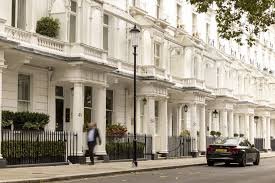
Some of Nigeria’s top bankers and business elites are increasingly buying London property as a hedge against economic uncertainty and currency volatility, despite rising taxes in the United Kingdom’s luxury housing market.
What was once viewed largely as a status symbol is increasingly becoming a broader strategy for wealth preservation, international diversification and long-term asset security.
In the past 10 months alone, a wave of high-profile acquisitions has renewed attention on Nigerian ownership of UK real estate. These include the late Herbert Wigwe, former CEO of Access Bank who was reportedly linked to more than 100 London properties through offshore entities, CEO of Access Bank Roosevelt Ogbonna’s reported £15 million acquisition in Hampstead’s Billionaires’ Row, and chairman of First HoldCo Femi Otedola’s £53 million mansion purchase in St John’s Wood.
Read also: Legal recognition of casual work and casualisation: The thin line
The acquisitions are drawing attention because they come at a time when parts of Britain’s wealthy class are reconsidering their exposure to the country amid rising taxes, tighter regulations and increasing living costs.
London property as a “safe haven” asset
Property experts say the trend is not entirely new, but that recent acquisitions by high-profile Nigerian elites have brought greater public attention to it.
“What is happening is that more high-profile names are now attracting public attention,” said Temidayo Oluyede, CEO of Edala Developments. “You would actually be surprised at how many Nigerians own properties in the UK, the United States and Canada, even though many of those investments are not publicised.”

According to Oluyede, the UK remains attractive partly because of its large Nigerian diaspora population and established migration routes.
“The UK has one of the largest Nigerian diaspora populations, and naturally, where people live, work and build communities, they also tend to buy homes and invest in property,” he said.
Another property expert, who asked to be identified only as Joseph, told BusinessDay that Nigerian banks and businesses are increasingly expanding internationally, making property ownership in markets such as London both strategic and practical.
“A number of Nigerian banks already have offices in London and other international markets,” he said. “As businesses expand into those regions, it becomes natural for top executives and investors to acquire properties there.”
Last week, BusinessDay reported that Access Holdings’ UK subsidiary overtook its Nigerian operations as the group’s largest earnings contributor for the first time.
Profit after tax at Access Bank UK rose by 73.5 percent to N83.8 billion in the first quarter of 2026 from N48.3 billion a year earlier, while profit from the Nigerian business declined to N52 billion from N79.9 billion over the same period.
The development reinforces how Nigerian banking groups are becoming increasingly international, with executive wealth and investment strategies also expanding beyond domestic markets.
The London effect
For many wealthy Nigerians, London property offers more than prestige. It is increasingly viewed as a stable hard-currency asset capable of generating rental income while preserving value in a volatile macroeconomic environment.
“In the UK, especially London, the market is heavily apartment-driven, which makes it easier to acquire multiple units compared with markets like the US where properties are generally larger and more expensive,” Oluyede said. “The demand for housing in the UK also continues to exceed supply, which makes the market attractive from an investment-yield perspective.”
According to Enness Global, more than 202,000 homes across the UK are registered to overseas owners, with London accounting for nearly 34 percent of internationally owned properties.
“International buyers continue to play an important role in the housing market, particularly across London and the wider South East,” Islay Robinson, the firm CEO said.

“What’s particularly notable is how stable the overall level of international ownership has remained despite economic and political uncertainty.”
Property firms targeting African investors say the weakening naira has accelerated interest in UK assets.
Data from Mercy Homes shows that the naira weakened from around N480/£1 in 2020 to about N1,895/£1 in 2025, pushing more Nigerians toward foreign currency-denominated assets.
“The naira has significantly reduced purchasing power,” the firm said in a recent report. “As a result, more Nigerians are looking for stable, high-yield investment opportunities, and UK real estate is emerging as a top choice.”
Although the currency has stabilised this year, trading within a relatively predictable range of N1,350 to N1,430 against the US dollar, it remains considerably weaker than its pre-devaluation levels in 2022.
Stable market, flexible financing
Real estate firms continue to market the UK as one of the world’s most stable property destinations for African investors.
In a BusinessDay interview done last year, Kayode Adeagbo, CEO of TMS UK Properties said the UK’s strong legal and regulatory framework remains one of its biggest attractions.
“In the entire European region, the UK real estate market is one of the most stable,” Adeagbo said.
According to him, UK property investments currently generate annual returns of between eight and 10 percent, while persistent housing shortages continue to support long-term demand.
“A practical reason many Nigerians invest in the UK is because they see it as an opportunity to generate residual income that can help cover expenses abroad,” he said.
However, he noted that Nigerian investors still face challenges including unfamiliarity with UK property laws, financing difficulties, currency fluctuations and property management concerns.
Offshore structures and elite wealth
Renewed scrutiny intensified in March after UK media platform The Londoner reported that Wigwe was linked to 106 London properties through offshore structures.
The investigation traced foreign-owned assets across London held through companies registered in jurisdictions such as Jersey, Guernsey and the British Virgin Islands. The report stressed that it documented ownership structures and did not allege wrongdoing.
Many of the assets reportedly span commercial and residential districts ranging from Oxford Street and Camden Market to luxury residential towers and high-end neighbourhoods.
Hampstead’s Billionaires’ Row and St John’s Wood remain among London’s most prestigious residential districts, home to billionaires, celebrities and global elites.
Analysts say the appeal of London property among Nigerian elites is also partly driven by status and social positioning.
“Many billionaires and ultra-high-net-worth individuals prefer to live in exclusive neighbourhoods surrounded by people within similar wealth circles,” said Tony Brown, a UK based financial and investment analyst. “A significant number of wealthy global investors already own properties in the UK, particularly in prime London locations.”
Brown noted that the latest acquisitions are notable because they are happening at a time when some wealthy residents are considering leaving Britain because of tax pressures.
“That is why it is interesting to now see more Nigerian buyers acquiring high-end properties in some of London’s most expensive neighbourhoods,” he said.
“For some buyers, owning property in prime London locations is also about prestige and global status. There is symbolic value attached to seeing Black investors and African business elites owning assets in some of the world’s most exclusive streets.”
Rising taxes fail to deter investors
The growing Nigerian interest comes despite rising property-related taxes and a broader luxury housing slowdown in the UK.
Data from His Majesty’s Revenue and Customs show that UK homebuyers paid £15.4 billion in stamp duties in 2025, an 18 percent increase from the previous year following changes to tax thresholds.
Britain is also set to introduce a new “mansion tax” on homes valued above £2 million from 2028, alongside higher property income taxes for landlords from 2027. At the same time, a recent Henley & Partners report estimated that the UK lost 16,500 millionaires last year as wealthy residents relocated to more tax-friendly jurisdictions.

“Recent policy shifts have significantly diminished the UK’s appeal to wealthy foreign nationals,” said Trevor Williams, former chief economist at Lloyds Bank Commercial Banking. “The abolition of the non-domicile status is a prime example.”
Yet, despite those pressures, Nigerian investors continue to enter the market. Analysts say the trend mirrors broader capital-preservation strategies among emerging-market elites seeking exposure to hard-currency assets and more stable investment environments.
UK housing slowdown creates opportunities
Despite the market’s long-term appeal, Britain’s housing market is under pressure from rising living costs and weaker domestic demand.
“The cost of living in the UK is very high, which has slowed home purchases among residents and affected mortgage lending activity for banks,” said Jennifer Oyelade, a UK-based global talent acquisition and employability leader. “However, the UK property market still offers relatively flexible financing structures. In some cases, buyers only need to pay a five to 10 percent deposit and can spread repayments over 20 to 25 years.”
According to Oyelade, rising costs have weakened local demand, prompting developers to offer lower deposit requirements and more flexible repayment structures.
“Housing developers are now offering lower deposit requirements because, although more houses are being built, demand from local buyers has weakened,” she said. “This is one reason many Nigerians are taking advantage of the opportunity.”
She added that many Nigerians are increasingly buying UK properties primarily for investment purposes rather than residential use.
“Some buyers purchase properties mainly to rent them out,” Oyelade said. “For example, if a landlord’s mortgage repayment is £500 a month, they may rent out the property for £750, allowing them to cover costs and still make a profit.”
“The bigger the property, the more rental income it can generate. Many Nigerians are therefore looking at UK real estate as a way to diversify their investment portfolios and build long-term wealth.”
A broader shift in African wealth
The trend ultimately reflects a broader transformation in how African wealth is being managed.
For many Nigerian banking executives and entrepreneurs, London property is no longer simply about luxury living. It is increasingly viewed as part of a global asset allocation strategy spanning real estate, business expansion, family migration and wealth preservation.
“There is a growing flight to safety among wealthy Nigerians and businesses,” Oluyede of Edala Developments said. “People do not want all their assets concentrated in one market.” For many investors, London property is viewed as a relatively stable long-term asset.”
For Nigeria’s banking elite, London property is increasingly serving not just as a symbol of status, but as a hard-currency refuge in a period of global volatility and domestic economic pressure.

