
Key takeaways
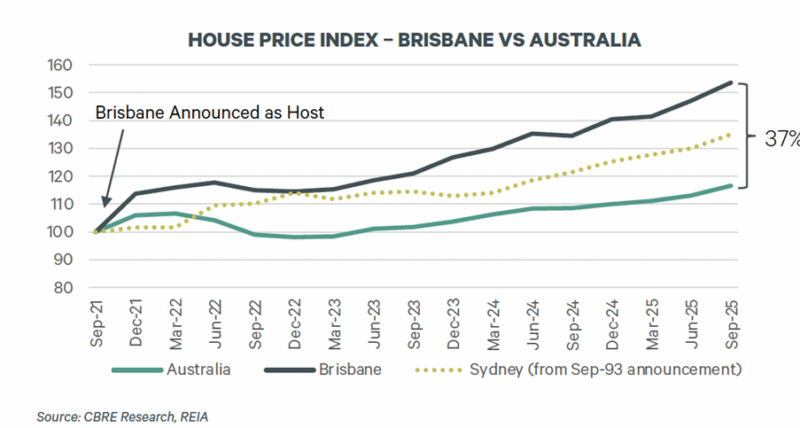
Brisbane’s house price index has already outperformed the national average by 37% since the 2021 Olympic announcement, exceeding Sydney’s 29% spread before the 2000 Games.
Across every Olympic host city since 1996, residential prices grew faster in the four years after the Games (42.5% average) than in the four years before (23.3%).
Queensland construction costs have risen 44% in five years, and the Olympics build will intensify pressure on supply right through to 2031.
Brisbane’s rental vacancy sits at approximately 1.0% and is forecast to remain there until at least 2031, with only around 3,100 new inner-city dwellings added per year.
Commercial real estate investment into Queensland increased from 19.2% to 21.1% of national volumes following the Olympic announcement, reflecting rising institutional confidence.
The post-Olympics bust fear is not supported by residential price data from comparable host cities – though individual market conditions and asset selection still matter enormously.
Every few decades, a city gets a moment that changes its trajectory.
Brisbane is in the middle of one right now, and most investors haven’t fully grasped what that means for property values over the next ten years.
Of course, the 2032 Olympic and Paralympic Games are much more than just a sporting event.
They’re a $7.1 billion infrastructure program, a global rebranding exercise, and a demand catalyst that’s been building since Brisbane was awarded hosting rights back in July 2021.
And the data from CBRE’s latest research report makes it very clear – the property story here is far more compelling than most media headlines suggest.
Let me walk you through what I think really matters for investors.
The Historical Pattern Is Hard to Ignore
Before we talk about Brisbane specifically, let’s look at what actually happened in Sydney – because I think it’s the most relevant comparison for Australian investors.
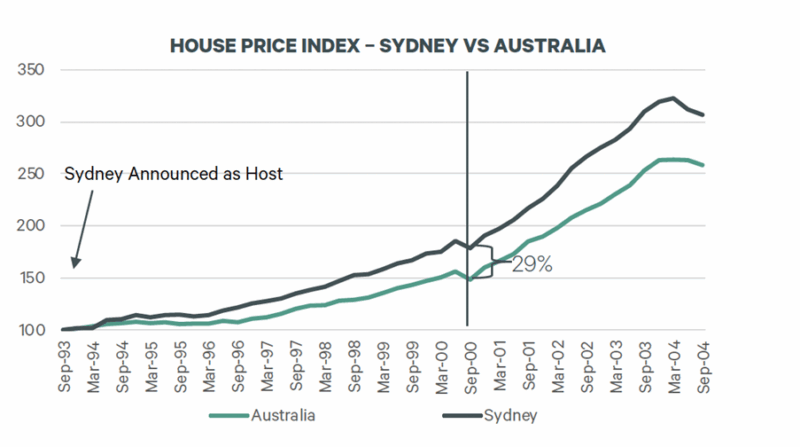
When Sydney was announced as the host of the 2000 Games, its house price index immediately began outperforming the national average.
By the time the Games arrived, Sydney’s prices had moved 29% ahead of the rest of the country, and that outperformance continued all the way until 2004.
Source: CBRE Research
Since the announcement of the hosting in 2021, Brisbane’s house price index has already risen 37% above the national average.
That’s a bigger spread than Sydney managed in the same timeframe, and the infrastructure build hasn’t even properly started yet.
The CBRE data also looked at what happened to residential prices in the four years after the Games across every host city since 1996.
The average price growth in the four years post-Olympics was 42.5%, compared to 23.3% in the four years leading up to the event.

Note: Olympic host cities, on average, grew faster after the Games than before them.
Now that’s a finding worth sitting with for a moment because I haven’t heard much talk about this before.
What’s Actually Being Built
A lot of investors get caught up in the headline number – $7.1 billion for venues – without understanding what that money is actually doing to the city’s fabric.
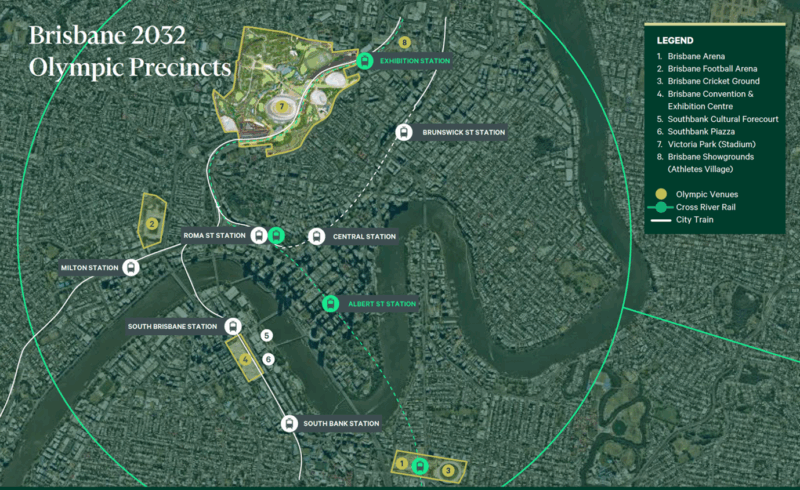
The original plan to redevelop The Gabba was scrapped, and in its place, a brand new 63,000-seat stadium is going up at Victoria Park at a cost of $3.8 billion.
Earthworks start mid-2026 with construction following in early 2027.
The old Gabba site gets demolished post-Games and redeveloped into an entertainment and residential precinct – which is itself a long-term investment story.
The Athletes Village is moving to the RNA Showgrounds at Bowen Hills, about 1.5 kilometres from the CBD. Around 2,000 units across six towers of roughly 25-30 levels will house over 10,000 athletes during the Games, then transition to residential use – most likely build-to-rent – afterwards.
There’s also a new National Aquatics Centre planned for Spring Hill, a 17,000-seat Brisbane Arena in the Gabba precinct, upgrades to the Chandler Sports Precinct worth $257 million, and the Cross River Rail project threading everything together.
The venues program spreads across the Gold Coast and Sunshine Coast too, with Athletes Villages in both locations converting to community housing post-Games.
The key thing to understand is that this infrastructure isn’t just for three weeks of sport.
Note: Most of it has been deliberately designed with legacy use in mind, which means Brisbane gets permanent infrastructure uplift, not just a temporary burst of activity.
The Supply Squeeze That Investors Need to Understand
Here’s something the CBRE report highlights that I think is genuinely underappreciated right now.
Queensland is already in a construction boom driven by government spending on hospitals, public transport, and energy.
Construction costs in Queensland have risen 44% over the past five years, and finding builders for commercial projects has become genuinely difficult.
As the Olympics infrastructure build ramps up from late 2026 through to mid-2031, that pressure on the construction sector will only intensify.
CBRE estimates around $11 billion in Olympics-related construction during that period, and if current trends hold, total Queensland construction activity could reach $25 billion per quarter by 2030 – a level comparable to the LNG and mining boom of 2010-2015.
So, what does that mean for property investors?
Quite simply, new residential and commercial supply is going to be constrained, and the cost of delivering new dwellings will increase significantly.
Builders and tradespeople will be absorbed into the Olympics pipeline.
Feasibility of new developments – already marginal due to high construction costs – will remain under pressure.
Meanwhile, demand keeps building.
Brisbane’s rental vacancy rate sits at around 1.0% right now, and CBRE forecasts it will stay at or below that level until at least 2031.
Inner city dwelling completions are projected to average just 3,100 per year from 2026 to 2031.
Tight supply, ongoing demand, constrained construction capacity, and rising rents. That combination will support increasing property values over time.
Will There Be a Post-Olympics Bust?
This is the question I’m often asked about Brisbane, and it’s worth addressing directly because I know some investors use this as a reason to sit on their hands.
The fear goes something like this: construction activity drops off after the Games, there’s an oversupply of apartments from the Athletes Village, and Brisbane faces a period of stagnation like some international host cities have experienced.
However, the data doesn’t support that fear, at least not for residential property.
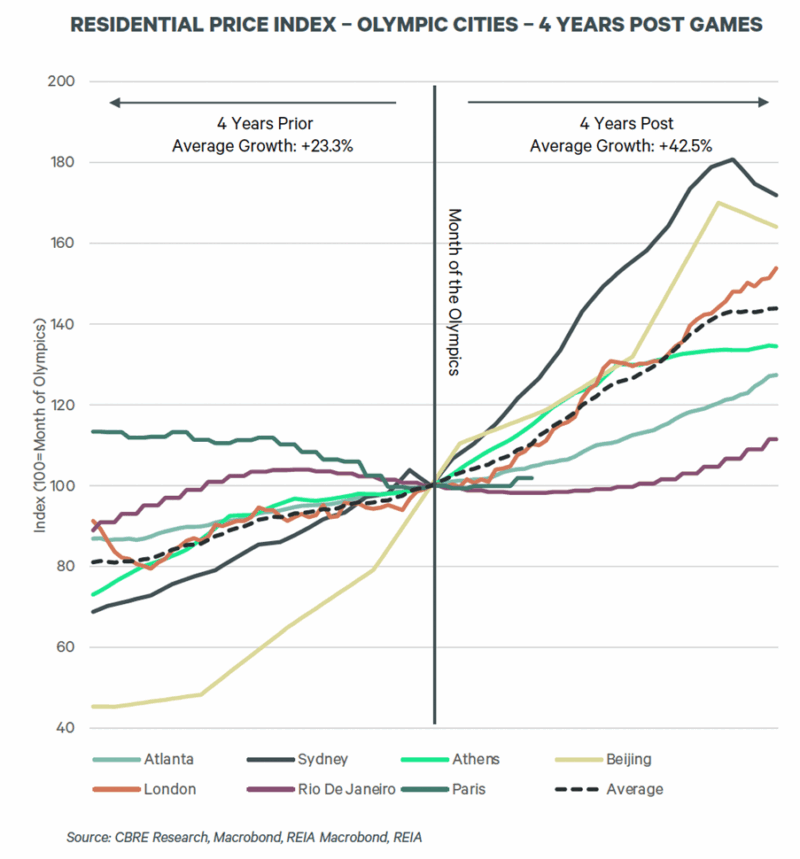
As shown in the chart above, across every host city since 1996, price growth actually accelerated after the Games rather than slowing.
The key outperformers post-Olympics were Sydney, Beijing, and London – three cities with genuinely strong underlying fundamentals before the Games, which is exactly what Brisbane has today.
On the Athletes Village specifically, the Gold Coast experience from the 2018 Commonwealth Games is instructive.
When the Smith Collective (the former Games Village) converted to build-to-rent with 1,252 units, Gold Coast vacancy briefly rose from 1.1% to 3.0% in late 2019, then quickly recovered.
Brisbane’s market is tighter today than the Gold Coast was then, and CBRE’s forecasts suggest there’s enough underlying demand to absorb the approximately 2,000 new units without a sustained market disruption.
The post-bust argument is also based on a misunderstanding of what drives Brisbane.
Population growth, interstate migration, relative affordability compared to Sydney, a chronic housing undersupply, and now a wave of global investment attention – these are structural forces that don’t switch off when the Olympic torch goes out.
The Investment Implications
So, as a property investor, I think there are several things worth considering here.
The first is timing. Brisbane has already been running strongly since the 2021 announcement, and the market is not cheap compared to where it was five years ago.
But the infrastructure build is still in early stages, and the evidence from Sydney suggests that outperformance tends to continue right through the Games period and beyond.
Investors who kept waiting for a pullback in Sydney in the late 1990s largely missed the run.
The second is location within the market.
The areas closest to Olympic precincts – Bowen Hills, South Brisbane, Spring Hill, Fortitude Valley – are undergoing genuine urban transformation, not just a short-term sentiment boost.
New rail infrastructure through Cross River Rail is also reshaping connectivity across the inner suburbs in ways that tend to permanently lift land values near stations.
The third point relates to the broader South East Queensland story.
The CBRE report notes that commercial real estate investment into Queensland as a proportion of national volumes rose from 19.2% before the Olympic announcement to 21.1% after it and international investors are paying attention.
The Gold Coast and Sunshine Coast are benefiting directly from the accommodation constraints in Brisbane, meaning the investment case extends well beyond the CBD.
And the fourth, perhaps most important point, is this: the Olympics is a catalyst, but the underlying story in Brisbane was already there before the Games were awarded.
Strong population growth, a more affordable entry point than Sydney or Melbourne, economic diversification, and a lifestyle appeal that’s been drawing interstate migrants consistently since the pandemic – these are the real reasons Brisbane’s property market has substance behind the headlines.
The Games are accelerating what was already happening.
They bring forward infrastructure investment, lift global visibility, and create a psychological confidence in the market that sustains buyer demand.
A Few Words of Caution
While I’m optimistic about Brisbane’s property outlook, I want to be honest about the risks too.
Construction costs remain stubbornly high, and that affects development feasibility across the board.
Hotel supply is running well behind what the Games will require – CBRE estimates around 81,000 rooms are needed across South East Queensland, against the current inventory of 67,200, with the pipeline suggesting only an 11% uplift.
That’s a genuine constraint and potentially a short-term disruption risk.
There’s also the question of what happens if the global economic environment deteriorates meaningfully in the next few years.
Brisbane won’t be immune to higher interest rates or a slowdown in immigration if those conditions change.
And for investors buying into capture the “Olympic premium,” I’d caution against paying over the odds for properties that don’t have strong fundamental investment merits independently of the Games.

Tip: The Olympics provides a tailwind; it shouldn’t be your primary investment proposition.
Good property investment is still about buying the right asset – well-located, owner-occupier appeal, scarce land, quality construction – and holding through cycles.
The Olympic story makes Brisbane a compelling market to focus that approach on right now. But the discipline of selection still matters enormously.
The Bottom Line
Brisbane’s property market has demonstrated a pattern consistent with that of every major Olympic host city since Sydney in 2000.
Prices outperform from the announcement, continue through the build-up, and historically accelerate again in the years after the Games.
The structural foundations underneath that performance are real – population growth, housing undersupply, infrastructure investment, and rising global recognition.
The $7.1 billion venues program is reshaping the city’s physical fabric in ways that will matter for decades, not just for a few weeks in 2032.
For serious long-term investors who take a decade-plus view and select well-located properties in the right parts of the market, I think Brisbane currently offers one of the more compelling investment cases in Australia.
If you’d like to talk through how this might fit into your broader wealth strategy, please reach out to the team at Metropole to chat with one of our Wealth Strategists. Just click here and lock in a time.
We work with investors across the country to build long-term portfolios grounded in evidence, not hype – and Brisbane is very much on our radar right now.
We’re much more than just another buyer’s agent. We help you safely grow, protect, and pass on your wealth through strategic property and wealth advice.
Property is the vehicle. Strategy is the driver.
Click here now and have a chat with one of our Wealth Strategists.