
For the last decade, successive governments have been trying to develop the Future Homes Standard – an update to the way that new homes have to be designed in England.
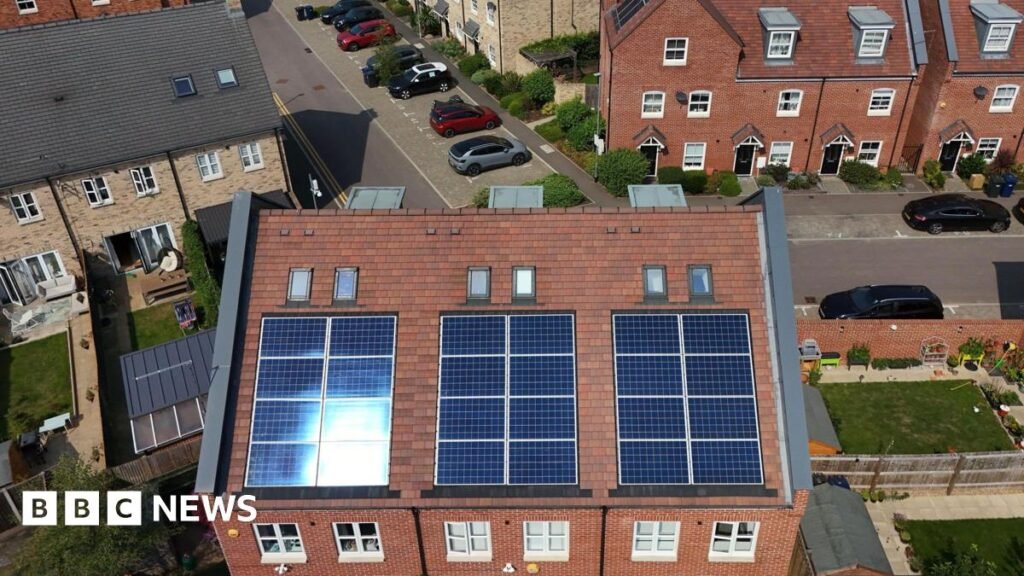
The guidance published on Tuesday means that from 2028, no new homes will be on the gas network – and will instead be on a heat network or get a heat pump – and they must have solar panels on their roofs covering an area equivalent to 40% of the ground floor space.
“The Iran war has once again shown our drive for clean power is essential for our energy security so we can escape the grip of fossil fuel markets we don’t control,” said Energy Secretary Ed Miliband.
The announced changes have been welcomed by the energy industry and those working in green technology for providing certainty that heat pumps and solar panels are worth investing in.
“It’s going to give clarity to the UK market, installers, builders, manufacturers, that there’s a significant market that’s there,” said Garry Felgate, CEO of MCS Foundation, which certifies installers of low carbon heating systems.
The changes in building requirements are estimated to add an additional £10,000 onto the cost of the home for developers, but over the long term will likely bring down the cost of energy bills for customers.
The savings could be significantly increased where homes have batteries, but the government opted not to include those as a requirement.
Hannah McCarthy, head of partnerships for new homes at Octopus Energy, told the BBC: “Decarbonising the new housing stock is a fantastic step – batteries would take that a step further.”
Although the Home Builders Federation (HBF) said the additional cost that developers now face from the changes was “not welcome at any time”, it said the industry had been given a lot of forewarning.
But Neil Jefferson, CEO of HBF, said the size of the solar panels mandated for each home was unexpected.
“The government has really pushed the number of solar panels that are required on rooftops right to the limit, we think 60% of homes can’t actually reach that standard,” he said.
There are exemptions to the requirement, such as when the design does not give enough space for the solar panels.
But Jefferson said: “Each home will have to be looked at individually.
“There are some challenges within the process [and] we don’t want bottlenecks.”
The government has a target to build 1.5m homes by 2029 – but in December the housing secretary, Steve Reed, told the BBC there would need to be a surge in building after rates of construction appeared to drop.
Dr Ellie Chowns, from the Green Party, said there were some “genuine positives” in the new standard, but added that it was “utterly ridiculous” to wait until 2028 before implementing them.