
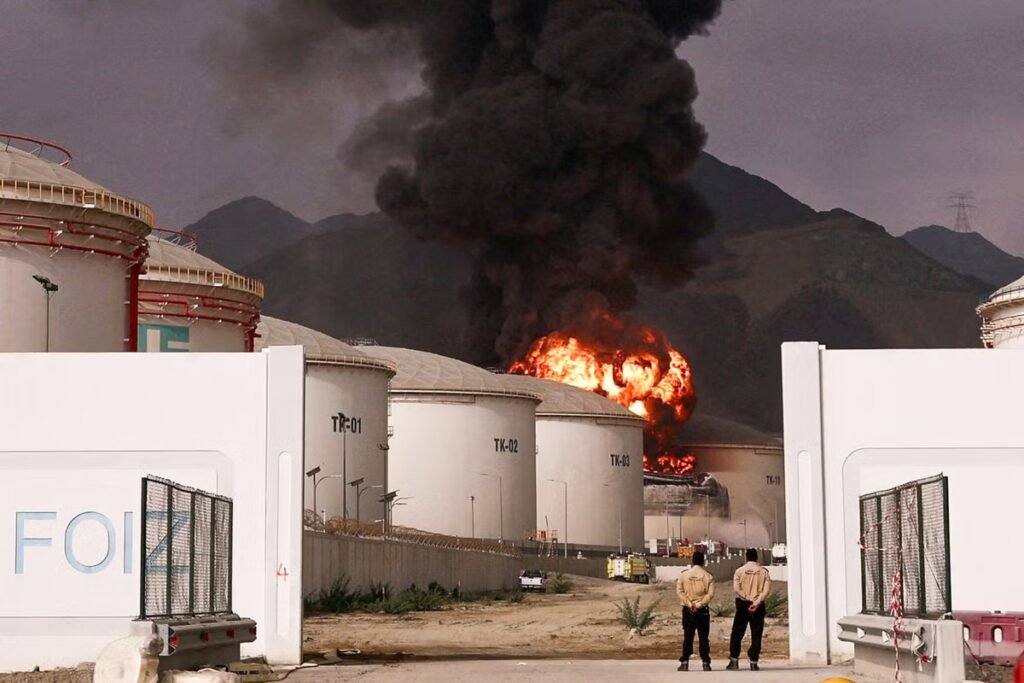
What happens on commodities markets, and in the conference rooms of the world’s central banks, may prove as crucial to the outcome of the Iran war as anything that happens on the battlefield or in the skies above the Middle East. If the conflict spreads and intensifies still further, the economic consequences for Western nations may prove severe.
Energy prices are the main way in which prosperity will be damaged. If, as is certainly possible, the effects of the conflict start seriously to impact the cost of living and jobs, then voters across the advanced economies, already lukewarm about the US-Israeli attacks on Iran, may turn militantly hostile to it. It is certainly not good news…
What’s happening to energy prices?
Spot prices are up sharply. The price of a barrel of West Texas Intermediate (WTI) oil, a commonly used international benchmark, has gone from about $55 (£41) at the turn of the year to some $85 (£64) now. To put that in perspective, it spiked at over $120 (£90) after the full-scale invasion of Ukraine four years ago. It still has some way to run before it repeats, say, the quadrupling of prices virtually overnight during the Yom Kippur war in 1973.
Natural gas tells a similar story. The spot price of a therm of gas in the UK is also well up – about 40 per cent since January, to 137 pence. But it, too, briefly spiked at more than 600p when the Ukraine war started, eventually settling down to around current levels in early 2023.
Because of the Ofgen price cap, the effects on consumers won’t be felt until the second half of the year, though some advantageous fixed-price energy deals are being pulled, while fuel oil seems to be climbing already. Of course, businesses aren’t covered by the price cap.
How bad will it get?
No one can say, because no one, not even President Trump (or especially President Trump, if you like) can say for how long the fighting will continue, or how it will end. If it is another “12-day war” like Midnight Hammer last summer, the effects will be small and transient. If it leads to, say, a permanent and radical reduction in the supply from Iran and the Gulf states, it could conceivably tip the world into a depression.
The analysts at Wood Mackenzie, a leading consultancy, warn that oil could hit $100 a barrel if the crisis isn’t resolved soon.
Why are prices soaring?
It’s the sudden loss of supply. Some 300 oil tankers are stranded in the Gulf because Iran has closed the Strait of Hormuz, the main channel for exports to Asia. Still worse, the oil and gas fields, especially in Saudi Arabia and Qatar, are being shut down – they are vulnerable to drone attack by Iran and its terrorist allies. The land pipelines cannot fully compensate for the loss of maritime capacity; not that it matters anyway if production is halted and stocks are exhausted. Oil and other tankers in the region are uninsurable.
Can it be helped?
Trump has assembled a package of measures designed to alleviate the problem, including US naval escorts and “reasonably priced” maritime insurance, as well as lifting sanctions on Russian oil production and sales, especially to India.
The US, the new government in Venezuela, and the braver Gulf states could try to ramp up production of hydrocarbons, but probably not enough to compensate for the loss of supply. Oil refineries also need a “blend” of different types of crude oil to produce fuel, plastics and chemicals, so an abundance of, say, North Sea or Texas oil is no good without some Arabian product in the mix.
Why does it matter?
Thanks to successive oil-price shocks, global industries and consumers are less exposed to the impact of oil prices than they were before 1973. In addition, the growth in renewables and nuclear power also helps dampen the shock, and of course, we’re moving into summer in the northern hemisphere.
Locally produced coal power can also be substituted in places like China. But in the UK, gas has long been the dominant source of domestic heating, and is still important in energy generation, while petrol is still the prevalent fuel. Virtually everything produced in a factory, or an office, or in the leisure sector, or anything that’s transported, is affected by the cost of energy.
So will inflation go up?
Yes. The question is by how much. Perhaps it won’t reach the post-Ukraine high of 11 per cent, but certainly another 1 or 2 per cent on the CPI as things stand.
Will interest rates still come down?
That does depend on whether the Bank of England decides that this is a sudden “one-off” that will eventually wash out of the numbers, or if it threatens to ignite another bout of domestically driven inflation, mainly via higher wage demands. There’ll probably be more strikes.
Will the energy price cap save us?
Yes and no. Yes, because it’s now an accepted and expected policy response. No, because it doesn’t cover businesses, and it’s incredibly expensive for the Treasury to subsidise energy bills. Thus, the original energy price guarantee of £2,500 for an average home, launched by the then prime minister Liz Truss in 2022, was estimated to cost £150bn – approaching as much as the NHS. As energy prices subsided, it wasn’t as bad as that, but still amounted to about £44bn – roughly the same as the defence budget.
In a worst-case scenario, it would be unaffordable because debt and the cost of servicing it is so high already, so the “cap” would be very high. At best, trying to control energy bills would wreck Rachel Reeves’s chances of adhering to her fiscal rules.
Anything else?
Just potentially catastrophic effects on investor confidence and the stock markets, destroying people’s savings and pension funds. Two significant danger spots here are cryptocurrencies and AI data centres – both highly energy-intensive and vulnerable to spiralling world prices.
Would the world be better off if the Iran war ended now?
Yes.