
An email I’d been dreading finally arrived last month. It was from my bank, reminding me that my fixed-rate mortgage — set, seemingly in another world, at 1.59 per cent — is ending in May and that it was time to decide what to do next.
It’s a question that about 1.8mn people will face in 2026, as the UK enters the last year of its long, tearful goodbye to sub-2 per cent mortgage rates.
The fifth anniversary of Liz Truss’s rate-exploding mini-Budget won’t be until next September. But mortgage rates were already rising in the months leading up to it, meaning that by about this time next year we’ll have seen the sun finally set on the last rates that start with a 1.
But it was not sadness at leaving what is, in all likelihood, the lowest rate at which I’ll ever borrow, that made me dread the email — rather, it was the remarkable amount of uncertainty about what to do next. Should we take a tracker or fix? And if we do fix, how long for?
If your fixed-term deal is coming to an end and you feel anxious, you may have good reason: the mortgage market has not been this jittery in decades. And that’s before the conflict in the Middle East exploded interest rate expectations for this year — hardly the most important aspect of the crisis, but crucial to our subject matter nonetheless.
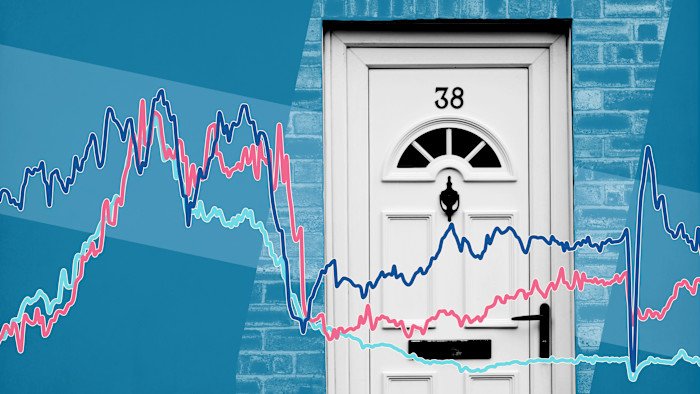
Even if we ignore the immediate fallout of the mini-Budget, the monthly percentage point change in quoted fixed mortgage rates shows that volatility since the start of 2023 is three times higher than in the decade to 2022. In recent months, that volatility had appeared to be decreasing — until Saturday morning.

Currently, the mortgage rate you are offered, be it for buying or remortgaging, can vary significantly depending on what month or even week you’re looking to secure a deal. Data from Moneyfacts shows that while the number of available mortgage products has increased in the past couple of years, the average shelf life that they’re available has shrunk to less than three weeks.
So how did the mortgage market become so unstable?
The flippant — and incorrect — answer is to lay the blame at the door of the former MP for South West Norfolk. In reality, it’s down to a mix of sticky inflation, geopolitical uncertainty and the fundamental restructuring of the mortgage market over the past 20 years, which has left it especially vulnerable to the first two factors.
When we bought in early 2013, volatility was low. The general direction of mortgage rates was downwards, but monthly changes were usually small. We’ve always gone for five-year fixes, but this is actually the first time we’ve reached the end of a fixed-rate period — on previous occasions, a quick bit of spreadsheet work always showed that it was more attractive to pay the early repayment charge about a year early and lock in a lower rate for another five years.
The last time we fixed, our preference for longer-term certainty worked out well, since — by nothing other than sheer fluke of timing — we avoided the worst of the mortgage rate shocks of recent years, when borrowers saw rates peak above 6 per cent for some fixed-rate products and about 8 per cent for revert-to or standard variable rates.
Now we’re in a period of mortgage market volatility similar to that in the run-up to the 2008 global financial crisis. But the structure of the market is very different today from what it was then.
Historically, variable-rate mortgages were the most popular product type. At the beginning of 2004, they accounted for three-quarters of outstanding mortgage balances and 83 per cent of new advances, but since then there’s been a massive shift to fixed-rate mortgages. By the third quarter of 2022, just 15 per cent of outstanding mortgages were on variable rates.

The big implication of the shift is that it’s the market’s perception of long-term interest rates rather than the Bank of England’s base rate, that has a more direct impact on the mortgage rates you’re offered. And markets can spook easily.
That didn’t matter during the low inflation period leading up to the pandemic and Russia’s full-scale invasion of Ukraine, but in this more uncertain, high inflation world, it has led to more volatility in the rates available. Unfortunately, this has come at a time when the structure of the remortgage market has changed too.
Before the GFC, the remortgage market was booming because it was easy and popular to extract equity from your house while prices were rising rapidly. People leveraged up to invest in a buy-to-let, bought a new car or even splurged on a luxury holiday. Some stories I’ve heard from mortgage brokers are wild — but expense accounts, sales incentives and lax (or non-existent) regulation created a boom that quickly turned to a bust as the credit crunch hit.
Since then, the mortgage market has been in the doldrums — and has had to adapt to a new reality with much lower activity levels. Even by 2019, the number of mortgage approvals for house purchases was still 45 per cent below what it was in 2006; the number of remortgages was 51 per cent lower. Worst hit was “other” approvals, covering further advances, down 81 per cent.

In the wake of the mortgage rate spikes of 2022 and 2023, the number of remortgages fell even further. Fewer people are choosing to move to a new lender when their fixed rate ends, but there’s not been an increase in borrowers stuck on standard variable rates. So what have they done?
The answer is the big innovation in the remortgage market over the past decade: the product transfer, which has come into its own since the pandemic. In 2006, when there was a far smaller proportion of fixed-term deals, there were 1.14mn remortgages. Last year, there were 320,000 remortgages — and over 1.54mn product transfers.
Rather than borrowers being left to drop on to typically much higher revert-to rates or arranging a remortgage, they are now incentivised to transfer to a new fixed rate with their existing lender. The main benefit is that you don’t need to pass any additional affordability tests — which can be tricky, given the higher interest rates, and the fact that high house prices and stricter lending criteria mean buyers’ finances are typically stretched to begin with.
Product transfers are popular but are you getting the best deal? In the broader mortgage market that covers both purchase and remortgage but not product transfers, 84 per cent of sales were via intermediaries such as mortgage brokers to help secure the best product. However, choosing a product transfer typically means taking the risk yourself — made all the trickier by more volatile mortgage rates.
Still, an imperfect check by comparing UK Finance data on the average product transfer mortgage rate to those for simple remortgages (where there’s been no equity withdrawal) shows that, in late 2022, there was a rate premium of about 60 basis points for choosing a product transfer. As of last December, that had fallen to just 7 basis points. The brokers won’t be happy but, as the scale of the market shows, it looks like a product transfer is a good option — especially if it avoids the hassle of all the affordability checks with a new lender.

It’s too early to tell what effect the Middle East conflict will have on UK inflation. When the email from my bank first arrived, my first thought was to opt for a variable rate product, since I expected interest rates to be on a downward path over the foreseeable future.
But even then, the numbers weren’t exactly compelling. Bank of England data shows that the average two-year variable rate was 4.03 per cent in January, compared with 3.91 per cent for a two-year fixed-rate product, but the actual premium for a variable rate from my lender was larger. A quick bit of spreadsheet work using interest rate expectations shows that a two-year fix will probably work out cheaper in terms of total interest over the term, and it provides a bit more certainty.

Those expectations have shifted. Last week, the market was pricing in two quarter-point cuts in 2026, with the chances that one of those cuts would come this month at 90 per cent on Friday night. Following the US-Israel strikes on Iran, that has dropped to below 20 per cent.
With swap rates rising, it seems the bigger risk is that mortgage rates will increase rather than decrease before May. So on Tuesday morning, I locked in a two-year fixed-rate product transfer — sub-4 per cent is the new sub-2 per cent — to move to when the current one ends in May with no early repayment charge.
I’ve still got the flexibility to change it if rates fall before then, but at least it provides some peace of mind — and I can get back to feeling anxious about the wider news agenda, rather than my mortgage rate.
Neal Hudson is a housing market analyst