
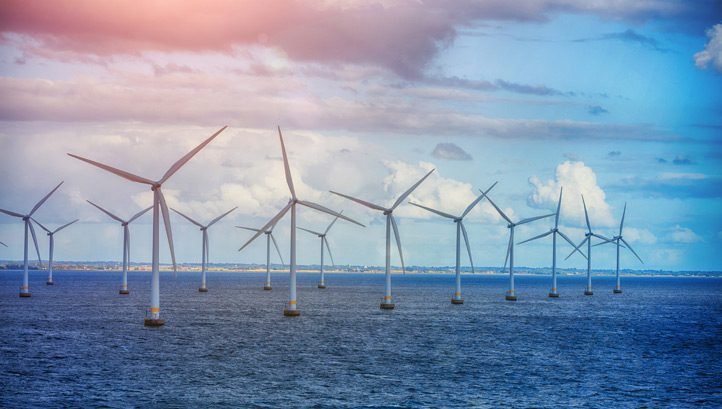

The UK and Germany are also expected to agree to deepen cooperation on offshore hybrid assets.
UK Energy Secretary Ed Miliband signed the agreement, known as the Hamburg Declaration, alongside leaders from countries including Belgium, Germany, Norway, France, Iceland, Ireland, Luxembourg, the Netherlands and Denmark on Monday (26 January). The signing took place at the Future of the North Seas Summit.
North Sea nations previously committed to building 300 GW of offshore wind by 2050.
Under the agreement, participating countries plan to deliver up to one-third of that capacity by 2050.
The new deal sets out a framework for the first large-scale joint delivery of offshore wind in the North Sea, rather than relying only on national projects.
These projects will include so-called offshore hybrid assets, wind farms that connect to more than one country through interconnectors, thereby allowing electricity to be transmitted across borders.
The agreement does not commit funding levels, but governments said further project announcements from industry are expected as planning work continues.
Miliband said: “We are standing up for our national interest by driving for clean energy, which can get the UK off the fossil fuel rollercoaster and give us energy sovereignty and abundance.
“After our record renewables auction, we today go further by signing a clean energy security pact with European allies to ensure we maximise the clean energy potential for the North Sea.”
The UK recently secured 8.4 GW of offshore wind capacity as part of its latest Contracts for Difference (CfD) auction round, the largest single procurement of offshore wind to date in Britain and Europe.
UK’s participation in the EU electricity market
In addition to the Pact, the UK is also expected to sign a statement of intent with Germany, Belgium, Denmark and the Netherlands as part of the meeting to coordinate planning for an interconnected offshore electricity grid.
This includes work on cost-sharing, regulation and market arrangements designed to speed up the construction of cross-border power links.
The UK and Germany are also expected to agree to deepen cooperation on offshore hybrid assets, which combine wind farm connections with interconnectors on the seabed. These systems are intended to reduce the need for separate cables and make it easier to move power between countries.
German Minister of Economics and Energy Katherina Reiche said: “The North Sea is a strategic key area for Europe’s energy and supply security. By planning expansion, grids and industry together and implementing them across borders, we are creating clean and affordable energy, strengthening our industrial base and increasing Europe’s strategic sovereignty.
“Today’s investment pact provides reliable perspectives for the offshore sector, secures creation of value in Europe and brings future-proof jobs.”
Leaders are also predicted to discuss cooperation with NATO on protecting energy infrastructure in the North Sea, including cyber security and physical risks to cables and platforms.
This comes as US President Donald Trump criticised wind power as economically damaging at Davos last week, while arguing that Western investment in renewables has weakened Europe while strengthening China.
Trump said he “hasn’t been able to find any wind farms in China”, arguing that the nation is a manufacturing and exporting hub only. But China hosts more than 560GW of operational wind farms, with its wind generation capacity exceeding the USA’s threefold.
Read more about how the sustainability conservation took shape at Davos 2026 here.