
The UK Government has been bankrolling polluting fossil fuel projects in Africa and Asia while publicly committing to net zero at home, The i Paper can reveal.
Hundreds of millions of pounds of Britain’s international aid budget is invested in oil and gas projects, with profits being funneled back to the UK taxpayer.
British International Investment (BII), which is owned by the Foreign Office, has funded power plants and pipelines as part of its remit to invest in “development” projects for a financial return.
This includes three gas power plants in Ghana, as well as the construction of a giant floating port, which will receive shipments of liquefied natural gas (LNG) from other countries.
The finding comes on the 10-year anniversary of the Paris Agreement, which saw almost 200 countries, including the UK, agree to limit climate change by reducing carbon emissions.
So far, BII has funded 18 fossil fuel projects in Asia and Africa since the Paris Agreement was signed in 2015, a Freedom of Information request by The i Paper has found.
Britain’s aid budget has supported £320m in active investments in gas power plants, pipelines and oil exploration across countries including Ghana, Nigeria and Bangladesh.
The investments call into question Britain’s role as a global leader on climate change, critics claim, with one expert accusing the UK of “carbon colonialism”.
One of the gas plants in Ghana is responsible for 900,000 tonnes of CO2 emissions every year – equivalent to roughly half a million flights between London and New York – according to estimates seen by The i Paper.


It also raises questions over how the UK’s international aid budget is used. BII argues it is providing access to energy as well as employment for Ghanaians.
However, some climate campaigners disagree. They claim that Ghana’s gas projects prioritise the profits of foreign interests, while locking the country into using polluting fossil fuels, and they believe provide few benefits for those living in the shadows of imposing plants.
The i Paper spoke to locals and environmental experts in Ghana to discover the impact of British-funded gas on the West African nation.

‘We are really suffering’
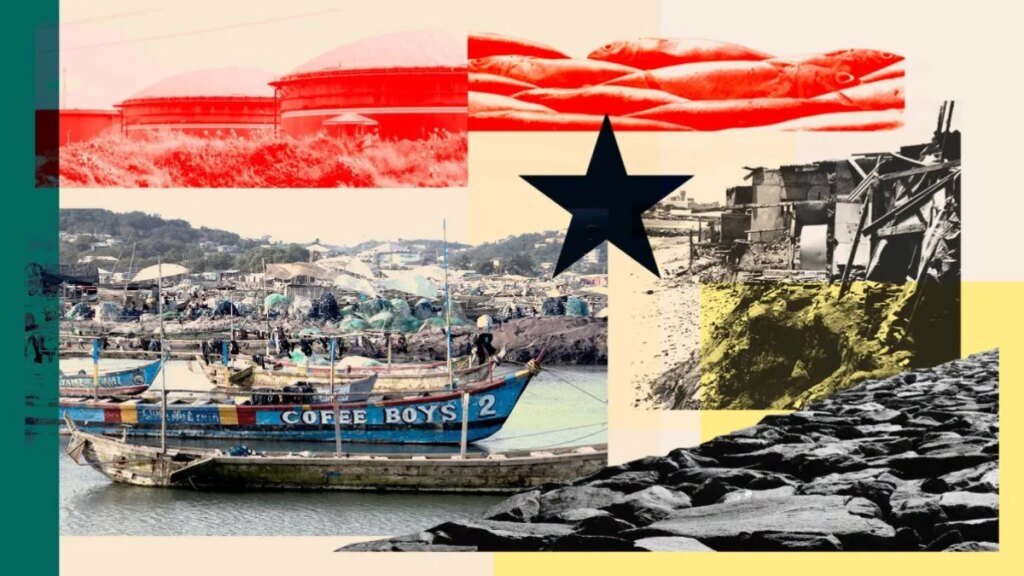
Before it became an industrial zone, Aboadze used to be a fishing hub. Wooden canoes line the seafront. The town is 124 miles west of the capital Accra.
For centuries fishing has been the lifeblood of the community here, but this has changed over the past 20 years. The town has transformed into an industrial zone funded by foreign investors, including the UK Government.
On a humid Tuesday afternoon, the town’s coastline is buzzing with activity.
Dozens of children chase a football along the beach while their mothers smoke fish on an open fire. A group of men lounge in the shade beneath some trees.
A complex of gas power plants looms over them, billowing smoke into the air.
It includes the Amandi Energy Plant, built between 2016 and 2021. BII played a leading role in financing the project. This included providing an $83m (£63m) loan in 2016, one year after the UK agreed to reduce its emissions under the Paris Agreement.


At the time the deal was the largest loan ever agreed by BII, formerly known as the Commonwealth Development Corporation (CDC), in Africa. The fund is an extension of Britain’s diplomatic “soft power” in the region. The climate impact of the project was considered secondary to the tens of thousands of jobs, and the promise of a stable electricity supply for the region.
The CDC’s managing director at the time, Holger Rothenbusch, said the plant had “the potential to create thousands of direct and indirect jobs in the region”, and boost existing businesses by providing “more consistent access to power”.
Almost a decade later, the promise of jobs and economic development is yet to materialise for many locals, despite BII reporting the plant employs more than 120 people and created more than 1,750 direct jobs during its construction.
The i Paper spoke to people living in the immediate vicinity of the plant. All of them said they had struggled to find work in industry.
Sitting among a group of young people gathered in the shade on Aboadze’s beach, hiding from the afternoon sun, Samuel Kwofie said: “The standard of living has become really expensive. Because we don’t have any work to do, we sit under these trees until evening.
“We continue to plead that there should be jobs for us. They haven’t helped us.”
“We are suffering, and our husbands are jobless,” added Ama Anatiwa. “We are not benefiting.”


Many of the workers at the gas plants have moved to Aboadze from other richer parts of the country, like Accra, according to the locals. Some of them live in a gated community on the outskirts of town and make use of a private hospital and school that locals say are too expensive for them.
Meanwhile, plenty of residents in the traditional fishing village live without basic infrastructure, such as toilets and a reliable water supply. They complain of pollution from the local plants.
‘Development aid doesn’t help Africa’
Roughly 155 miles east along the coast, the town of Kpone sits in the shadow of another foreign-backed industry.
The factories lining the main road into the town include CenPower, a fossil fuel plant that opened in 2019 with investment from the UK and other foreign governments.
BII invested in the project via the African Infrastructure Investment Fund, based in South Africa, that finances projects across the continent.


BII states its investment in the fund improves living standards “through the provision of more and better-quality infrastructure”.
But despite becoming an industrial hotspot, Kpone still lacks basic infrastructure. The main road connecting the town to the nearby city of Tema is almost impassable for the average car, with dozens of trucks using it each day.
Locals tell The i Paper they also suffer with shortages of water, which sometimes has to be brought in from other towns.
Pastor Emmanuel Appiah said it would be better if development aid was spent on projects such as building roads or water infrastructure, where the benefits are more tangible for local people.
“The only time you can say a community has benefited from a project is maybe if it goes to a water supply project. Now the community has water. If it’s a road, maybe now they have a good road,” he said.

“Over the years much pounds sterling and dollars has been pumped into our nations but we don’t really see the intended benefits.”
However, some in the town believe the promise of jobs from industrialisation has materialised.
“CenPower has been good for this town. Some of my friends work in that place,” said local business owner, Isaac Norty.
Fossil fuel debts
The UK Government has justified its gas investments in Ghana, arguing that the plants provide local people with reliable and affordable electricity.
While access to energy has certainly improved in the developing nation, the cost of electricity for the average Ghanaian increased by 150 per cent between 2014 and 2024, official figures show. Ghana’s energy prices are broadly average for Africa, but significantly higher than in neighbouring Nigeria.
High electricity prices are a legacy of “predatory investments”, according to research published earlier this year by ActionAid Ghana and Somo, the Centre for Research on Multinational Corporations.
The report, titled “Gaslighting Ghana”, revealed how foreign-owned gas projects, including those backed by the UK Government, have “devastated” Ghana’s economy by locking its government into “take-or-pay” contract, obliging it to spend hundreds of millions of dollars for electricity each year, regardless of demand.

The World Bank has described the fossil fuel sector as a “fiscal burden” in Ghana that costs the government 2 per cent of GDP annually.
It’s part of a wider debt crisis in the West African nation, which sees the government lose around a third of its annual revenue to debt payments.
“This is not just about emissions,” said Mohamed Adow, director at climate think-tank Power Shift Africa. “It’s about equity and who controls Africa’s energy future.”
He added that the finance behind fossil fuel projects often sees “profits flow out to the [global] north and pollution stays behind in Africa”.
Renewable investment
Alongside their economic legacy, there is also the climate impact of Ghana’s gas projects. Carbon emissions from the country’s energy sector increased by almost 150 per cent between 2010 and 2021.
Most climate activists agree it’s unfair to criticise countries like Ghana, which have historically contributed very little to climate change, for increasing carbon emissions as their economies develop.
However, some campaigners argue that countries like the UK, which have committed to a net-zero future, should be helping developing nations to build renewable energy infrastructure, instead of creating a reliance on fossil fuels.
“Locking in Global South countries to outdated carbon-intensive models of energy production is just completely wrong,” said Nick Dearden, director of Global Justice Now.

“The continued exposure of BII’s global portfolio to fossil fuels, alongside its inadequate net-zero target, remains deeply worrying,” said Beth John, climate adviser at Oxfam.
In 2020, BII introduced a new net-zero policy that prevents investment in the majority of fossil fuel projects, however it makes an exception for gas-fired power stations if the project is deemed compatible with a country becoming net zero by 2050.
BII makes its day-to-day investment decisions independent from the UK Government, but the Foreign Office sets the organisation’s investment policy. So, if a future government ditched the UK’s net-zero pledge, BII could reverse its net-zero policy that prevents investment in fossil fuel projects.
No new fossil fuel investments have been made in Ghana since 2020, although BII has helped to fund gas power plants in other African nations, including Côte d’Ivoire and Mozambique.
A spokesperson for BII said the organisation “seeks to manage and responsibly exit our legacy fossil fuel investments. As a result, since 2020 the value of those remaining assets in our portfolio has fallen by a third”.
The Ghanaian government has a target to reach net zero by 2060, but it’s currently unclear if this will be met. Less than 1 per cent of the country’s power comes from wind, solar or other renewables.
BII said it has significantly expanded its renewable energy portfolio across Africa in recent years. As of December 2024, it had $2.1bn (£1.6bn) invested in renewable projects globally.
Its climate finance portfolio is now four times the value of its fossil fuel assets, a spokesperson added.

This includes one direct investment in Ghana, a $5.1m (£3.9m) loan to Bboxx, a distributor of solar home systems in West Africa. It has also invested in Manocap Energy, which helps businesses in Ghana transition to renewable energy.
A BII spokesperson said the organisation “is a global leader in tackling the climate emergency in emerging economies”.
“We made 130 climate finance investments between 2022-24, totalling nearly £2bn , including in countries such as DRC, Sierra Leone, Zambia, Zimbabwe and Malawi,” they added.
However, Gloria Kuzo, from the Ghana Energy Transition Consortium campaign group, believes gas has no role to play in her country’s future.
Your next read

“Investments should focus on clean energy sources,” she said. “When it comes to gas, in a few years to come they will become stranded assets.”
Adow, the climate think-tank director, said: “Africa is rich in renewable resources – sun, geothermal. What we lack is the finance and clean technology to harness it. The UK should be building decentralised solar grids, wind farms… not oil pipelines and gas terminals.”
“You can’t be cleaning your act back home and financing fossil fuel infrastructure in the Global South and in Africa. Development finance should not be a backdoor for carbon colonialism,” he added.