
One of the biggest reasons Australians with enough savings for a deposit on a small investment property hesitate to buy is the fear that the purchase will turn into a monthly cash drain, even if it does build equity over time.
With interest rates at their current highs, finding a property where rental income comfortably covers outgoings – such as mortgage repayments, strata fees and council rates – can feel out of reach, even as rents continue to climb.
Achieving this balance, known as positive gearing, seems even harder if you’re borrowing heavily on a modest deposit. But according to leading property developer Eddie Dilleen, it is possible – provided you choose the right property in the right location and have the patience to wait a few years.
Dilleen, from Sydney, has been buying properties around the country – and turning them into reliable passive earners – since he was 18.
He has a portfolio of 180 properties and counting worth an estimated $130million, and attributes his success to going against the grain, doing what others aren’t, and buying properties that have recently decreased in value.
To ensure he can service the loans, most of the properties – but not all – are positively geared, meaning the rent covers the cost of the mortgage.
While it’s difficult to achieve positive gearing immediately after buying a property – and would be misleading to suggest otherwise – Dilleen said it can be done after three to four years due to the combination of rent increases and rate reductions.
Now, he’s revealed to Daily Mail a list of ten hotspot suburbs where buyers can still find houses for less than $600,000 and units for under $500,000 – and which he predicts could be conceivably positively geared within a few years.

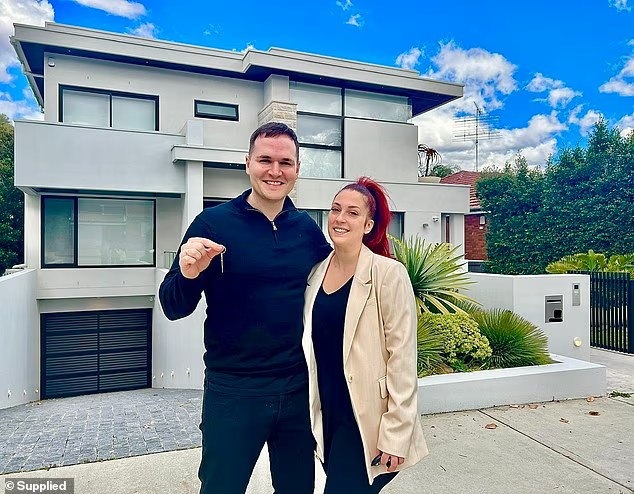
Eddie Dilleen (pictured with his wife) has been buying properties around the country – and turning them into reliable passive earners – since he was 18
‘These areas have the best capital growth, but many would not be positively geared immediately. Some lower-priced units would be possible, but definitely not houses,’ the 34-year-old investor explained.
‘A lot of people think the property market is cooked right now. Prices are high, interest rates are up, and most suburbs feel out of reach,’ he added.
‘But the truth is, there are still places in Australia where you can buy and set yourself up with a long-term property income through building your property portfolio.’
Dilleen and his team of experts and analysts have sifted through hundreds of properties across the country to determine which suburbs are outperforming others.
At present, his focus is on buying property in Melbourne, which is currently at the bottom of its growth cycle and therefore much cheaper compared to other markets.
For context, Dilleen was investing in Adelaide and Brisbane about five years ago when those cities were at the bottom of a growth cycle and since then, prices have soared.
You can read more about Dilleen’s strategy for buying in Melbourne – and why units near the city are a smart investment – here.
Here are 10 suburbs – five of which are explored in depth – where Dilleen is personally investing right now.

All of the suburbs are in Victoria, which is now at the bottom of its ‘growth cycle’ as the demand is currently lower compared to other markets
Brighton East
In the coastal residential suburb of Brighton East, located 13km south of Melbourne, the median house price sits at $2million, whereas the median unit price is around $1.1million.
However, Dilleen has secured units for himself and clients for as little as $325,000.
On one occasion, he was able to achieve this by purchasing a block of 10 units for $3.25million total with nine other investors. Each unit has one bedroom, one bathroom and one car space.
Individually, each unit’s value ranges between $400,000-$450,000 but Dilleen scored a 30 per cent discount by joining forces with other savvy buyers.
Currently online listings show units available for less than $550,000 in both Brighton East and neighbouring suburbs Brighton and McKinnon.

Craigieburn is Eddie’s number one recommendation, closely followed by St Kilda and Melton
Maribyrnong
In Maribyrnong, potential buyers can pick up a one- or two-bedroom unit for as little as $300,000, with the median price sitting at about $500,000.
‘It’s a very affordable entry level into a market where the median house price is $1.1million,’ Dilleen said.
‘If you buy a unit for $350,000 – you can’t even build the same type of property for $550,000.’
The area itself is 10km from the CBD and is close to transport, schools, shops and amenities, making it always in demand for renters.
Melton
While Melton is further out compared to Brighton East and Maribyrnong, located 37km west of Melbourne, it’s still a great option for investors looking for positively geared hotspots.
The median house price hovers around $600,000 whereas units are less at between $280,000 and $350,000.
‘It’s ridiculously affordable and, once again, below the replacement cost to build,’ Dilleen said.
‘To build the same property, you would have to first buy the land for $200,000-$300,000 for 600sqm then build the property for say $400,000-$450,000. It pushes up the price to $700,000.
‘This market will increase with demand, inflation and because it’s undervalued as a whole.’
St Kilda
The average house price in St Kilda is $1.5million while the average unit is a third of the price at $500,000.
However, Dilleen has picked up units, townhouses and villas in and around St Kilda for as little as $280,000 recently.
‘To me, when the median house price is $1.5million, there’s a price gap of $1.2million. You can get into a really expensive suburb without spending millions,’ he said.
Craigieburn
Craigieburn is the one suburb Dilleen predicts will skyrocket in the future. Property he’s purchased there in the last six to 12 months has already increased in value.
‘Many people might think I’m crazy for mentioning this suburb,’ Dilleen said.
Yet it’s conveniently located, has ample access to shops, amenities and transport, and isn’t as far from the city centre as suburbs like Melton.
Buyers can easily grab a three-bedroom house for $500,000 – a price Dilleen expects will soar to $800,000 in the near future.
Honourable mentions
In addition to the above suburbs, other Melbourne hotspots where Dilleen predicts properties can be positively geared within three to four years include Balaclava, Prahran, South Yarra, Dallas and Werribee.

Craigieburn is one suburb Dilleen predicts will skyrocket in the future, as property he’s purchased there in the last six to 12 months has already increased in value
Should buyers use superannuation or get a loan to fund a deposit?
So, should you borrow money from the bank or withdraw funds from your superannuation to pay a deposit on a new home?
‘In my opinion, you would be stupid not to use super to buy property,’ Dilleen said.
‘Nine years ago, I turned $60,000 of superannuation into over $2million by buying investment properties within my self-managed superfund.
‘You could only get a result like this by investing in property because you’re getting a compound growth effect.’
Property predictions for the next one, five and ten years
Over the next 12 months, Dilleen predicts all markets will see different growth rates.
‘In five years, we will have 40 per cent growth in Melbourne and Sydney, although this does depend on the different price brackets. Growth can vary in different brackets,’ he said.
‘As an example, properties under $1.5million can have a different growth rate compared to properties over $5million.
‘In ten years, particularly Melbourne and Sydney, the price growth will be 65 per cent higher than it is now.
‘I see the most growth being in Melbourne in the affordable price brackets from a percentage standpoint.’
Is chasing positive cash flow a smart long-term strategy – or is it only suitable for certain types of investors?
A lot of new investors think ‘positive gearing’ means guaranteed profit.
But unlike negative gearing, investors won’t have the tax advantages and won’t be able to claim costs, such as the interest, on tax at the end of the financial year.
‘Chasing positive cash flow is not necessarily the smartest long-term strategy,’ Dilleen warned.
‘A better strategy is to aim to buy properties that are undervalued where you can make immediate equity on the way in, then focus on the highest growth that you can achieve in the shortest possible time.
‘In my early days, I placed a lot of emphasis on always trying to make each property positively geared. That’s important, of course, but I know now that the most important thing is the equity that is made within the property.
‘That’s what creates the real wealth cash flow, and positive gearing is second to that.’
Would you ever buy a house and land package or off the plan?
Dilleen’s strategy involves buying existing homes rather than building from scratch to avoid building costs.
‘I would only ever buy a house and land package if I could tell that it was extremely underpriced, which 99 per cent of the time is extremely difficult,’ Dilleen said.
‘I recommend to only buy existing properties because they grow the most and are the safest type of investments.
‘With house and land packages, there’s more that can go wrong and scaling a portfolio is 100 times slower.’
To receive a free copy of Eddie’s book 30 Properties Before 30, click here.