
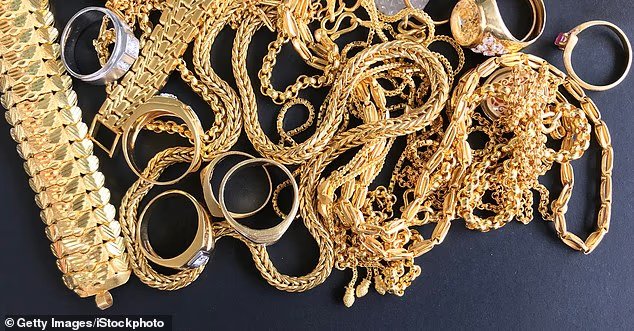
I’m in the smelting room at leading bullion house Hatton Garden Metals, as gold necklaces, chains and watch straps are melted down, ready to be turned into a gleaming melt bar.
With the price of gold soaring (an ounce of gold is about £3,100 – up by more than 40 per cent since January 2024), there has been a stampede of customers queuing to cash in their scrap. ‘People have brought in the weirdest things – a gold golf club, a gold belt, a gold handbag, even a gold face mask – and it has all been melted down,’ says Zoe Lyons, 36, managing director of Hatton Garden Metals.
I watch as the molten mixture is tipped into a mould. It’s just like baking, except the temperature is 1,100C – and once cooled, you have a 7kg gold bar worth £480,000*. ‘We use a bit of Fairy Liquid to clean it,’ says Zoe dreamily. A bar this expensive is eventually recycled into products such as gold coins and bars.
The family-owned bullion house is in Hatton Garden, London’s main jewellery, precious-metal and diamond district. With its network of narrow alleys, the area feels Dickensian. But blonde, glamorous and articulate Zoe and her sister Emma, 38 – aka the Bullion Sisters – are the modern faces of gold trading. They appear as experts on the BBC, ITV and Bloomberg, and are the third generation of a family steeped in jewellery and pawnbroking (their dad is director of the company; their mum, Kathy Lyons, stars in ITV’s Million Pound Pawn). ‘We live, sleep and breathe gold,’ Zoe says.
And if you’re strapped for cash in the Christmas run-up, they might just transform your fortunes.

Most of us think of gold dealers as shady figures with high-security vaults in Zurich. But the queue at the Hatton Garden Metals counter is full of young people clutching gold scrap wrapped in kitchen roll and middle-aged women with Zara bags full of bracelets, rings and orphaned earrings.
As the experts behind the counter assess these treasures using state-of-the art equipment, there’s an audible gasp. ‘They maybe didn’t realise their broken necklace is now worth so much, and they’ll start stripping off their rings,’ says Emma. She loves it when customers hit the jackpot. ‘The team like nothing more than saying, “Did you know that’s worth £10,000? You can clear your mortgage with that”.’
I curse the fact that I don’t have gold chains in the attic so I can be part of the new gold rush. Emma has never seen anything like it. ‘There’s an energy in the market. It’s like electricity. You think there can’t be more gold coming out of the woodwork. But every day you open, there’s more.’ She wears trainers so she can zip around the office faster, and they’ve hired extra security to manage the growing queues.
Most of what the team purchase is smelted down and sold back to the market at a price fixed twice-daily globally; in the UK, overseen by the London Bullion Market Association (LBMA).
There are two strands to Hatton Garden Metals. You can bring gold in to be melted down for cash, transferred into your account that day. Or they can help you purchase physical gold as an investment, whether you’re spending thousands in bullion or nabbing a gold sovereign for a few hundred.
While much gold trading seems off-putting for the average person, the great thing about visiting a bullion house is it feels possible. You can book a free consultation call with a precious-metal adviser, make the sale online, then collect your bullion (high-purity gold bars and coins) from the counter. Or have them delivered to your door, or stored.
They provide discreet packaging for customers to safely courier their gold home with them. ‘Though I’ve seen a man strip off his clothes to put his gold coins into a body harness worn around his chest!’ says Zoe. ‘The coins were lined up like bullets.’
Some customers buy a little every month for a pension or rainy day. And younger people who can’t get on the housing market are putting savings into gold. ‘Younger investors are super-knowledgeable; they’ve watched YouTube tutorials on how to buy gold,’ says Zoe.
It’s not just the wealthy who are turning to gold as a ‘safe-haven asset’ as the metal’s price continues to soar. One factor driving the gold market upward is FOMO (fear of missing out). Gold coins that cost £700 when Zoe started working at the business 15 years ago are now valued at £3,000 each. Even she wishes she’d bought more (she only has a few).
I talk to customer Diane, 68, who has a sports business in Cheshire, and invested £20,000 in British gold sovereigns a year ago. She sold them when the market peaked last month. ‘I still can’t believe I made £18,000 profit,’ she says. ‘When the girls told me my return, I nearly fainted into the soup I was making.’ Last year, the Royal Mint, which buys and sells gold bars and coins, had a record year for customer purchases. Revenues from its gold bullion sales were up 153 per cent year-on-year.
So what sparked this new gold rush? From global debt and climate crisis to Trump’s presidency, and increasing geopolitical instability, the world feels uncertain. And so, many turn to gold (one of the earliest forms of currency) in search of security.
‘When you stop trusting paper money, stop trusting banks, stop trusting governments to control the way they spend, gold is the anti-idiocy,’ says Merryn Somerset Webb, a senior Bloomberg columnist who writes about wealth, investing and personal finance.

Zoe Lyons in the foundry at Hatton Garden Metals
‘I don’t trust the banks and fiat currency is just worthless paper,’ says Mary, 82, retired and based in North Yorkshire, who has just invested £50,000 in British gold sovereigns. She lost nearly £2 million trading on the stock market during Covid (‘but I’m a warrior’), so gold seems a ‘sensible’ alternative. When the price hit an all-time high in mid October there was a shortage of coins to buy (even the Royal Mint had none), but with Zoe’s help, she tracked down ten coins.
Gold is a physical product that exists outside of the banking system so while currencies tend to lose value over time, gold does not. ‘Customers think, “This is my money. I want it to be tangible. I want to take it out of the bank and monetary system.” It feels old-school smart to invest in gold,’ says Emma.
The global supply of gold is limited. According to the World Gold Council, only around 216,265 tonnes have ever been mined (which would fit into 3.5 Olympic swimming pools). ‘Gold is finite, which fuels the excitement of the market,’ says Zoe.
The other great advantage is British gold coins are exempt from capital gains tax because they’re classed as UK legal tender. ‘The limit for ISAs is £20,000 per tax year, but with British gold coins, there’s no restriction,’ says Zoe.
Historically, gold has had a slightly wheeler-dealer feel. Investors tend to be men over 40. But the sisters want more women to get involved. Many of us buy and sell vintage bags and fashion items on Vestiaire, Vinted and Ebay, so why not invest in gold?
‘You don’t have to buy from us,’ stresses Zoe. ‘But do your research. Be aware of the market, how you can protect your money and how to invest and grow it. We’re two youngish females running one of the UK’s largest bullion houses. That makes our approach a bit different.’
In their boardroom the sisters show me a tray of bars and coins. There are biscuit-sized Britannias, each containing one ounce of 24-carat bullion, as well as smaller sovereigns. The largest gold bar is the size of a Nokia mobile phone. Gold is surprisingly dense: the 24-carat bar weighs 1kg and is worth about £90,000. ‘That’s the down payment for a pretty big house,’ Zoe says totting up the value of the tray. ‘Around £250,000.’
Christmas is the ‘silly season’ for gold buying even if it’s just a modest stocking filler. ‘£100 will get you a 1g gold bar,’ says Zoe.
But while gold has a reputation as a stable asset, major surges have been followed by significant falls. ‘While gold protects against inflation over the long term, it may not shield against short-term fluctuations,’ warns Somerset Webb. Though, she adds, sustained buying by the world’s central banks has been driving the price forward. ‘The big buyer in the run-up to this has not been the individual investor. It has been the central banks, particularly China, buying piles of gold for their reserves instead of buying dollars. So there is a huge state buyer out there backing the price.’
Will the bubble burst? ’We’re constantly asked what’s going to happen,’ says Emma. ‘We don’t have a crystal ball. But if it feels right for you to invest now in terms of your savings, make it on that decision.’ Customer Diane adds: ‘Even if you have bad times with gold, it will always go back up.’
Gold is a long-term investment, stresses Zoe. It’s best not to monitor the price too obsessively. ‘Buy it, put it away and forget about it. Then sell when it’s right for you.’
GOLD! Always believe in your sale price
Zoe Lyons crunches the numbers to compare 2020 gold prices to those in 2025*.
| Item | Weight | 2020 | 2025 |
|---|---|---|---|
| 9ct gold | per g | £16.62 | £37.16 |
| 18ct gold | per g | £33.25 | £74.33 |
| 24ct gold | per g | £44.33 | £99.12 |
| 18ct gold necklace | 3.5g | £33.25 | £74.33 |
| 18ct white and yellow gold bangle | 23.4g | £778 | £1,739 |
| 9ct St Christopher pendant | 1.4g | £23 | £52 |
| 9ct gold hoop earrings | 6g | £99 | £222 |
| Gem-set ring | 1.3g | £21 | £48.30 |
| Gold Sovereign coin | 7.98g | £324.53 | £725.54 |
*2020 average based on High and low on the AM fix: £1,379. 2025 gold live price at approx 2pm on 14 Nov: £3,082.97.